Jim Tomlinson has argued that deindustrialisation was the ‘meta-narrative’ of post-war British history. 1 In Wales, its historical economic reliance on extractive industries such as coal and slate saw their decline begin earlier in the twentieth century. Therefore, deindustrialisation has arguably been a ‘meta-narrative’ in Wales for decades longer. My dissertation looks at the history of worker and trade union responses to deindustrialisation in the south Wales coalfields and north Wales slate quarrying communities, addressing both the relative lack of literature on Welsh deindustrialisation (especially when compared to the historiography of Scottish deindustrialisation), and the regionalism of Welsh labour historiography.
The SSLH’s bursary funded my trip to the Richard Burton Archive at Swansea University and the South Wales Miners’ Library, which holds the South Wales Coalfield Collection. Hailing from northwest Wales and having already studied the slate industry’s decline for my undergraduate dissertation, accessing the archive of the NUM (South Wales Area) was a crucial resource for understanding the South Wales coal mining industry. The bursary also funded a year’s subscription with the British Newspaper Archive, allowing me access to sources to supplement my findings at Swansea. The example of Seven Sister’s Colliery shows the fruitfulness of these archives.
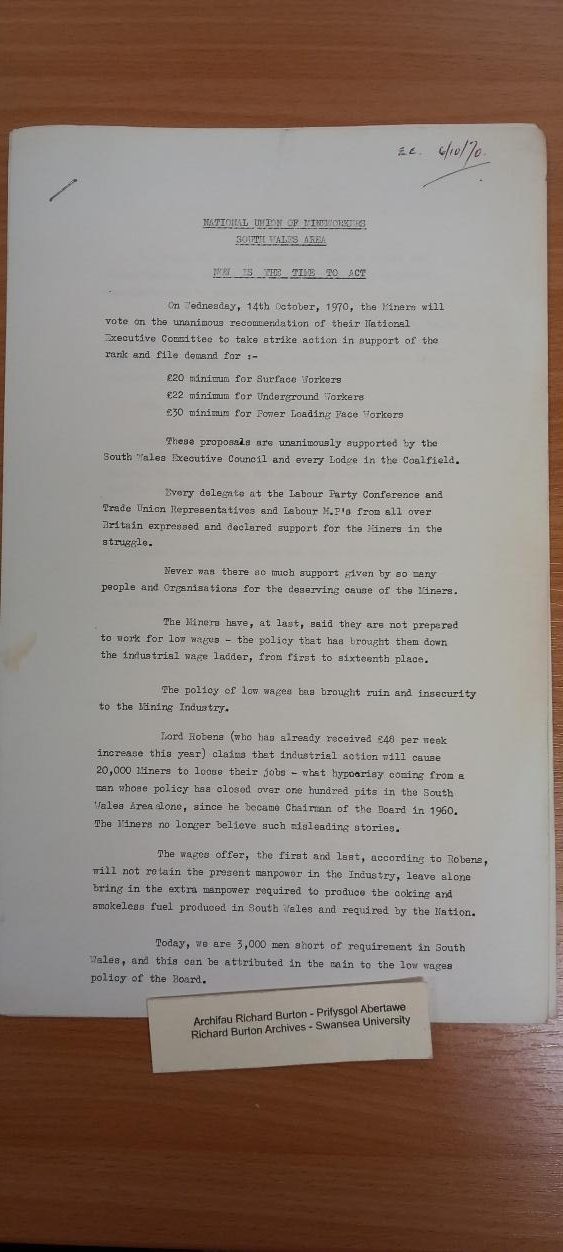
‘Now is the Time to Act’, October 14, 1970. SWCC/MNC/NUM/3/1 (NUM South Wales
Industrial Relations), Richard Burton
Archive, University of Swansea Library.
Reproduced with permission from Richard Burton Archives and NUM (South Wales
Area) [click to enlarge]
The closure of Seven Sister’s Colliery in 1964 provides an example of a ‘cooperative’ approach to closure which marked the NUM’s approach to coalfield deindustrialisation in the post-war period until the 1970s. The colliery’s closure also exemplifies the legacies these closures left which inspired the shift towards industrial action in the 1970s. A cooperative response to closure did not seem guaranteed. The local lodge’s militancy over local grievances in two strikes in the five years prior 2, alongside the initial response by local councillors (themselves miners) in the press vocally criticising the closure, suggest that whilst their response delayed the closure so that the NUMSWA (NUM South Wales Area) could meet the NCB, they later agreed to close the mine for geological reasons in exchange for guarantees of alternative employment. 3 A lodge official at the NUM District meeting on the 14 February 1963 described how they ‘had been compelled to reassess its prospects in light of the assurances and guarantees that had been given by the Board.’ 4 In exchange for alternative employment, the union was willing to cooperate with management in mine closures.
The NUM’s cooperative approach was increasingly tested as the Wilson government (1964-70) accelerated the colliery closure program. When, in 1968, Cefn Coed Colliery’s closure was announced, this legacy of closures prompted an unofficial stay-down strike. One striker stated that the miners in Dulais Valley were ‘very bitter’ following repeated moves between mines as they were closed, citing Seven Sisters as an example. 5 In 1968, it remained an isolated incident, but their action foreshadowed a shift towards industrial action. This shift towards industrial action is shown by the NUMSWA’s Executive Committee statement on 14 October 1970, (see accompanying image), which endorsed an unofficial strike over wages as official. The NUMSWA’s statement also tied low wages in the industry with a ‘manpower’ issue which was being used by the NCB as further justification for colliery mergers and closures.6
Following this research trip, I categorised the responses of the NUMSWA to deindustrialisation into three categories; cooperative, political, and industrial action. This provides a framework for comparison with responses to deindustrialisation in other industries. After discussions with my supervisor, this research trip has encouraged me to narrow the dissertation’s focus to trade union and worker responses to deindustrialisation due to the wealth of materials available, rather than assessing different agents. The bursary has significantly shaped my research and I am incredibly grateful for the Society’s support.
Cian Ireland is studying an MA in Modern History at the University of York.
Find out more about the bursaries on offer from the Society for the Study of Labour History.
References:
1. Tomlinson, Jim. ‘De-industrialization Not Decline: A New Meta-narrative for Post-war British History.’ Twentieth Century British History, 27, no. 1 (2015): 76-99.
2. Neath Guardian. ‘Miners on Strike.’ Editorial. 11 September, 1959, 1; Neath Guardian. ‘’Old Word Strike’ Ends at Seven Sisters Pit.’ Editorial. 15 December, 1961, 1; 24.
3. The Daily Mirror ‘Blackboard Plan to Save Pit.’ Editorial. 16 January, 1963, 1; Neath Guardian. ‘Pit-Closure: Lord Brecon’s Statement Recalled.’ Editorial. 18 January, 1963, 1.
4. Minutes of the NUM District Meeting at Labour Hall Swansea, 15 February 1963, South Wales Coalfields Collection, MNC/NUM/1/4, Richard Burton Archives, University of Swansea Library.
5. Laurie Robert. ‘Bitterness in Dulais Valley Highlighted by Strike.’ Neath Guardian. 13 June, 1968, 1.
6. NUMSWA Executive Committee, ‘Now is the Time to Act’, 14 October 1970, South Wales Coalfield Collection, Richard Burton Archives, University of Swansea Library.
Discover more from Society for the Study of Labour History
Subscribe to get the latest posts sent to your email.

