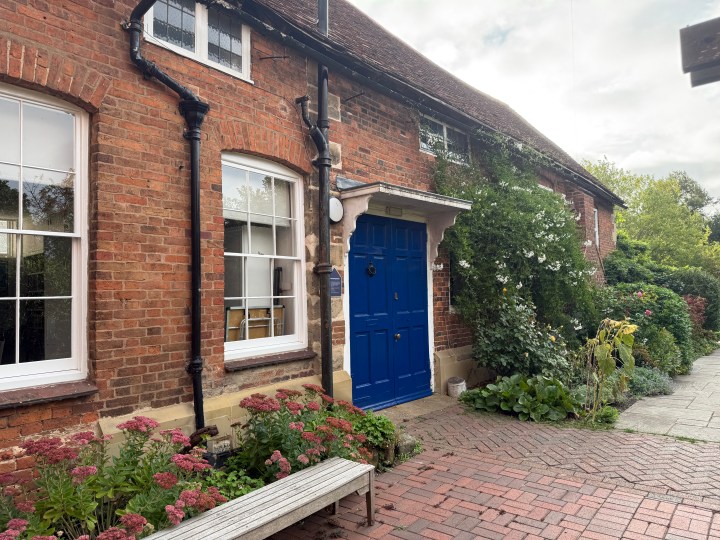
Some fifty delegates crowded into the seventeenth-century Friends Meeting House at Warwick on Saturday 19 September for Chartism Day 2026 to hear speakers range across the history and historiography of the Chartist movement. Mark Crail reports.
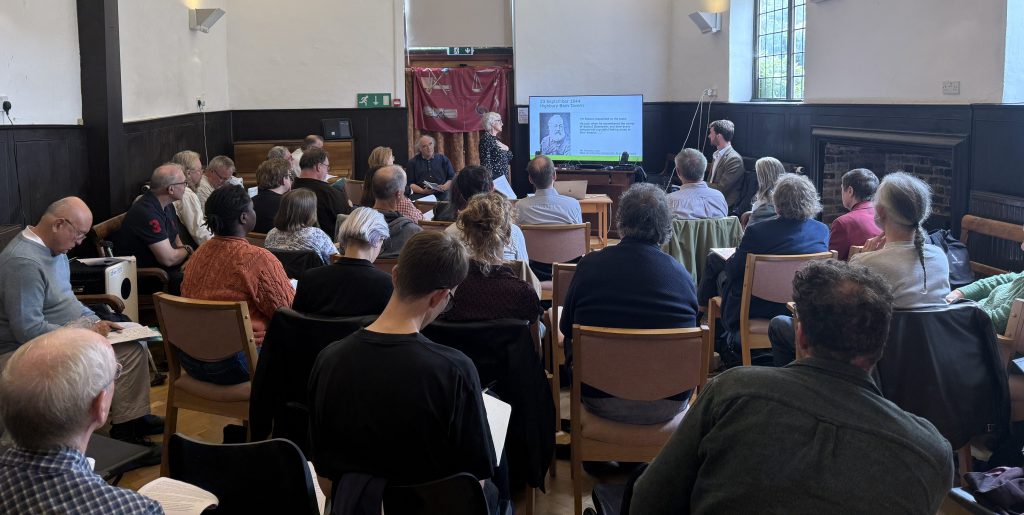
Apart from a two-year hiatus during covid, the event has been held annually since September 1995 when, under the guidance of the renowned Chartist historian Dorothy Thompson, the first conference took place at the University of Birmingham. Chartism Day is supported by the Society for the Study of Labour History and has taken place in a variety of locations in England, Wales, Ireland and France, bringing together senior academics, junior scholars and members of the wider public who share a common interest in the history of the Chartist movement.
Dr Joan Allen, co-convenor of the event along with Dr Richard Allen, welcomed delegates to Warwick, noting its association with Chartism, both as a place where many Chartists were incarcerated after the events of 1839, and as the town where the radical Rev Arthur Wade had his living as vicar of St Nicholas Church.
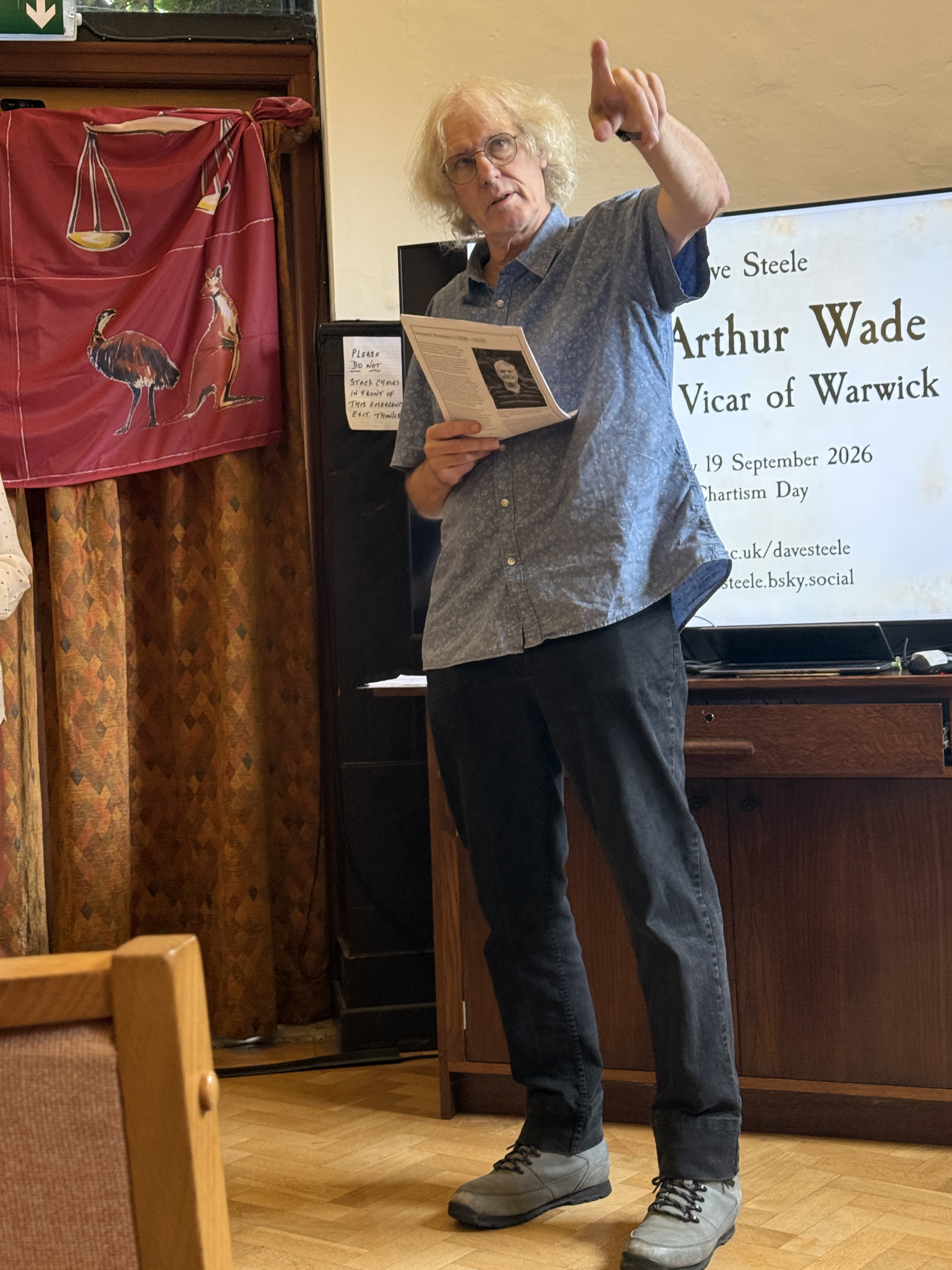
The first speaker, Dr David Steele, traced Wade’s life and political progress from being the son of a leading Tory attorney in the town through a short spell in the Navy to his adoption as vicar at St Nicholas of a latitudinarian theology and into radical politics. Wade became a member of the Birmingham Political Union and served on its council, but proved too radical for them, and eventually left his parish in the care of a curate and moved to London where he became active in the National Union of the Working Class and eventually the London Working Men’s Association. Wade was especially active in the campaigns on behalf of the Tolpuddle labourers and later the organisers of the Newport Rising. Although he later gravitated away from the mainstream of Chartism represented by Feargus O’Connor, he remained an active supporter of William Lovett and other Chartist organisations until his death in 1845.
Professor Peter Gray spoke on the relationship between the Irish radical land reformer William Sharman Crawford and the Chartist movement, especially in Rochdale. Crawford had become friendly with William Lovett and signed the People’s Charter in 1838 after falling out with Daniel O’Connell over his authoritarian leadership of the Irish repeal movement, and had attempted to form a radical Ulster Constitutional Association. After being approached by the Rochdale Chartists Thomas Livsey and James Taylor, Crawford succeeded in being elected as MP for Rochdale in 1841 in an uneasy alliance with middle-class radicals led by John Bright. Crawford was initially hailed as a Chartist by Feargus O’Connor, but the relationship soured after he retained his allegiance to the Anti-Corn Law League and worked with Joseph Sturge to set up the Complete Suffrage Union in 1842. Despite this, Livsey succeeded in keeping Rochdale’s Chartists behind Crawford’s popular radical programme until he reconciled with O’Connor in support of the Land Plan in 1846. Crawford remained MP for Rochdale until 1852, when he gave up the seat to contest County Down with the support of the Irish Tenant League.
From Shelley to Byron, and from Mazzini to Rossetti and William Morris, the ‘spectre’ of pre-modern Italy haunted radical and reformist discourse in the nineteenth century, Professor Stephen Milner told the conference. These social, economic and cultural influences, drawn from a range of late medieval and renaissance sources, were woven into Chartist thinking, leading to the coining of the word ‘proletariat’ and the adoption of Dante as a dissenting anti-Catholic by evangelical Chartists. There was, however, a significant gap in the Chartist reading of medieval Italy, with the Ciompi revolt of 1378 to 1382 largely missing from Chartist discourse. This rebellion consisted of artisans, labourers, and craftsmen who did not belong to any guilds and were therefore unable to participate in the Florentine government – elements which might have been expected to appeal to Chartists.
Frederick Hyde began with an episode from George MacDonald Fraser’s Flash for Freedom novel of 1971 in which Harry Flashman witnesses a fight between a French revolutionary agitator and a London butcher’s boy in Trafalgar Square during the Chartist demonstration of 10 April 1848. Intrigued, Hyde had discovered that the author had taken the story from a story that first appeared in The Globe of 12 April 1848. The key point of the story was that the French agitator had complained that English radicals had no fight in them but had then been soundly beaten by the butcher’s boy. The story had spread through the practice of ‘scissors and paste’ journalism, appearing over the following weeks in newspapers all over the country, sometimes with embellishments. In various forms, the story continued to be told, helping to shape attitudes towards the question of asylum for European refugees and early immigration controls. As Hyde pointed out, however, it is unlikely the incident ever happened, not least because there were no Chartist demonstrators in Trafalgar Square that day. It was, in effect, a pre-internet meme.
Alison Denham discussed the attendance of women at a number of Chartist dinners and banquets held for the ‘democrats of all nations’ in London between 1844 and 1847, noting that by being there they would have been exposed to the internationalist themes of the speeches. She focused in particular on two sets of events. In September 1844, two banquets were held to welcome the German socialist Wilhelm Weitling to London; and in August 1845, George Julian Harney chaired a democratic supper to commemorate the French revolution, followed in September by a dinner to inaugurate the Fraternal Democrats. There were then further dinners to celebrate the birthday of Henry Hunt and further annual dinners of the Fraternal Democrats in 1846 and 1847.
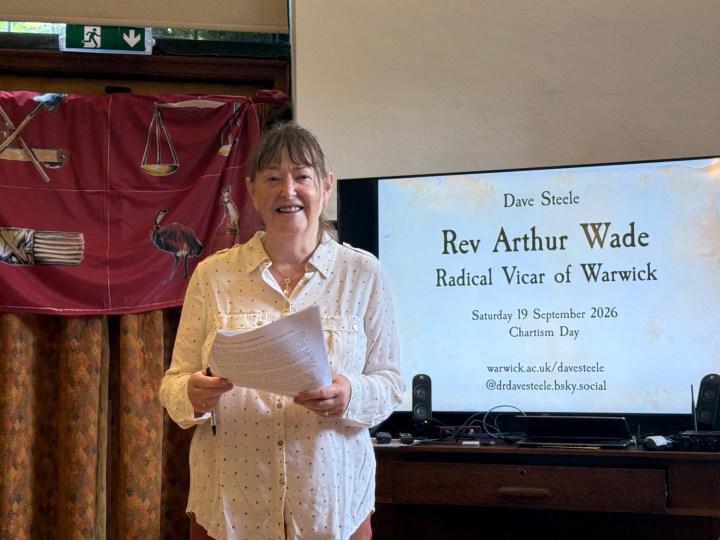
Co-convenor Dr Joan Allen opens the conference. 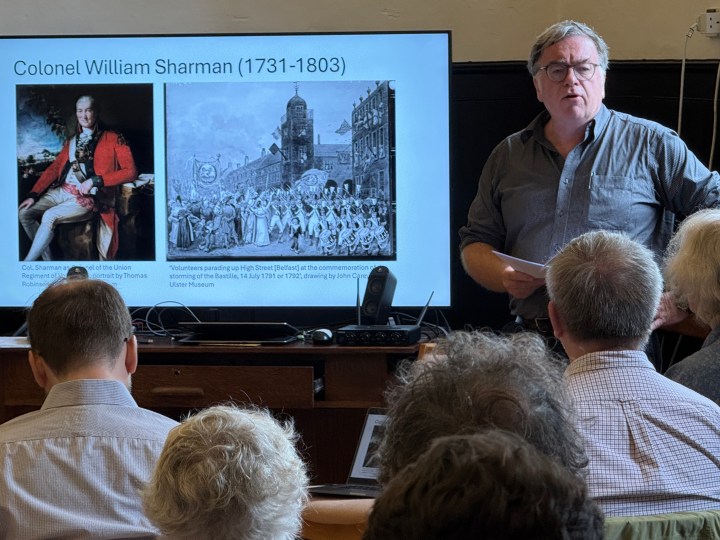
Professor Peter Gray on William Sharman Crawford and Rochdale Chartism 1841-52 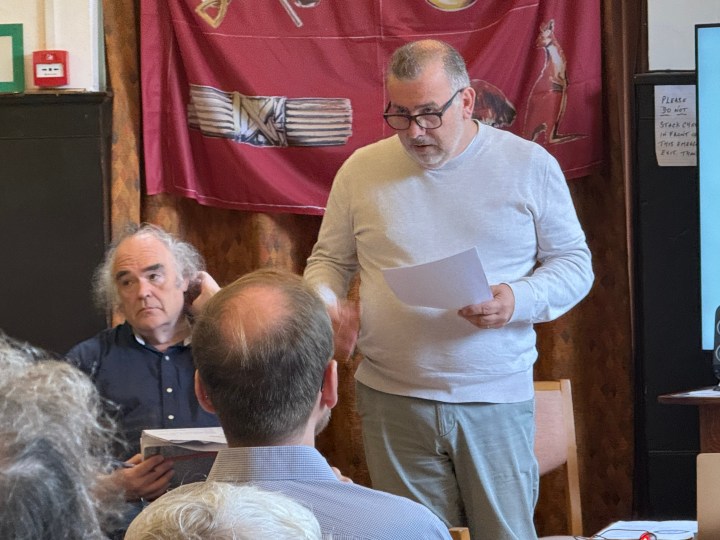
Professor Stephen Milner on Pre-Modern Italy and the working class: the renaissance of Chartism 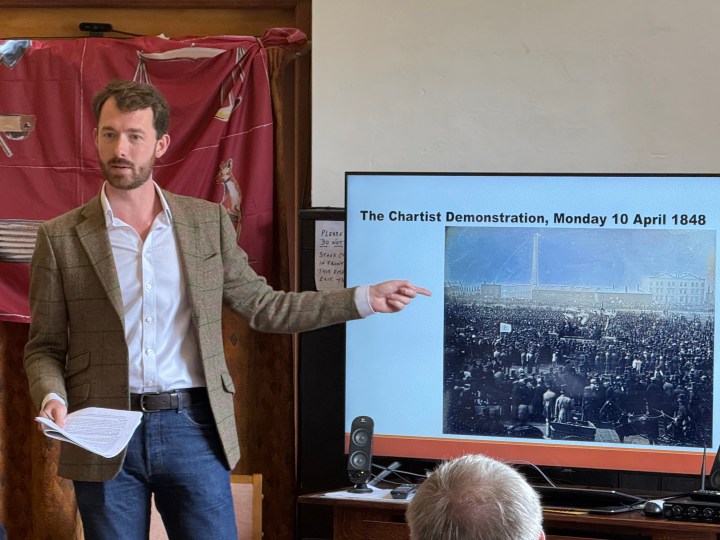
Frederick Hyde on Flashman and the butcher’s boy: the forgotten aftermath of the third Chartist demonstration. 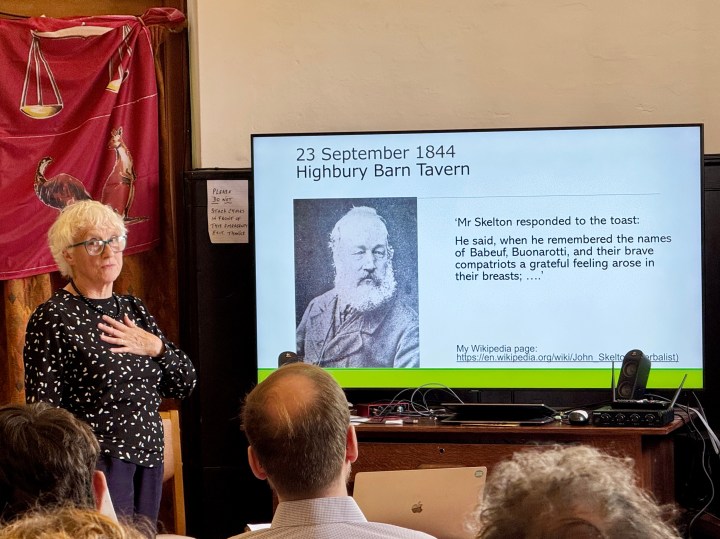
Alison Denham on fraternal dining: London, 1844-47 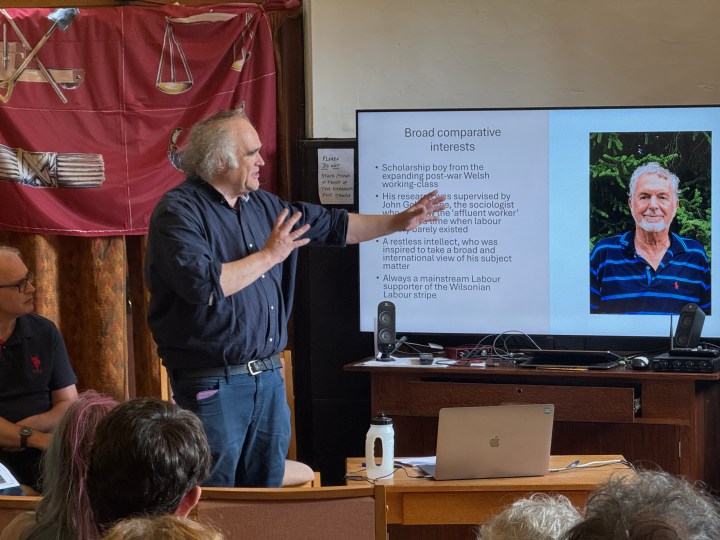
Professor Tony Taylor pays tribute to the late radical historian, Iori Prothero. 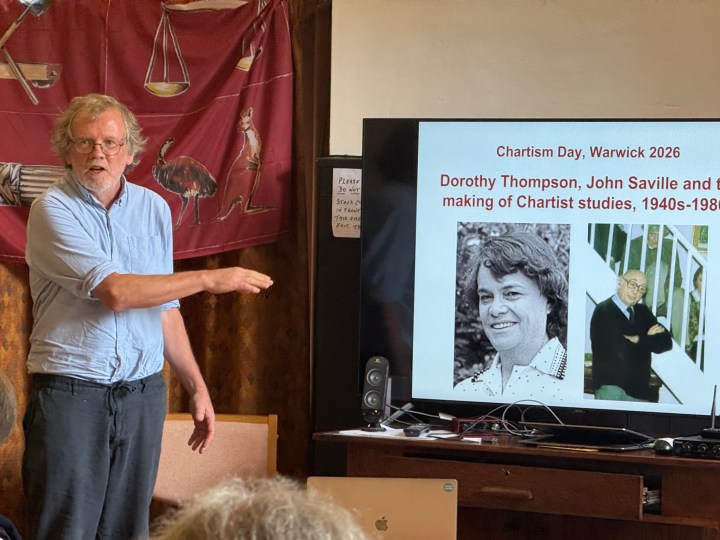
Professor Kevin Morgan on Dorothy Thompson, John Saville and the making of Chartist Studies, 1940s-80s. 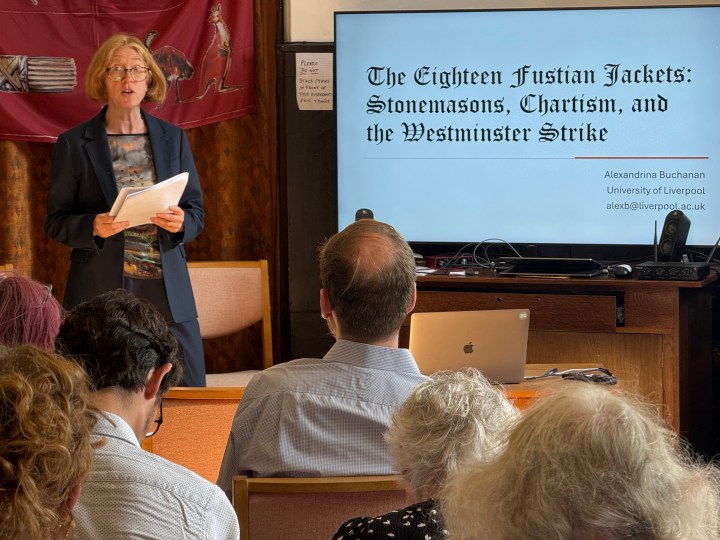
Dr Alexandrina Buchanan on ‘the 18 fustian jackets’: who carried the 1841 Chartist petition? 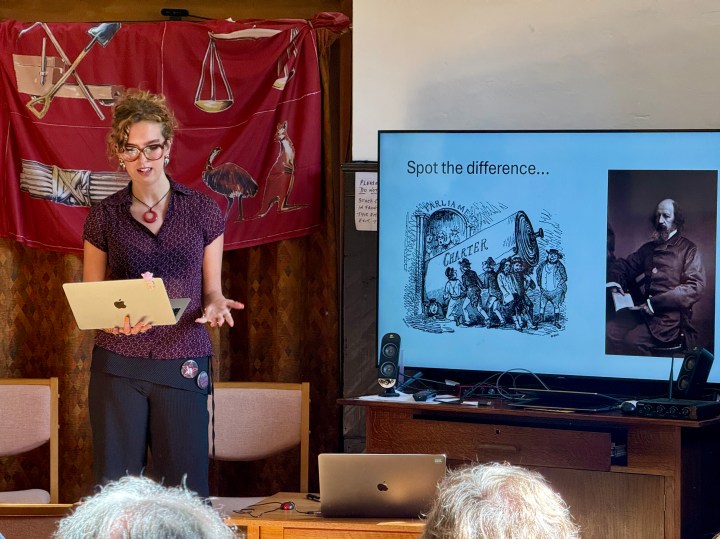
Madison Howarth on class and Chartism: who owns the poetic voice? 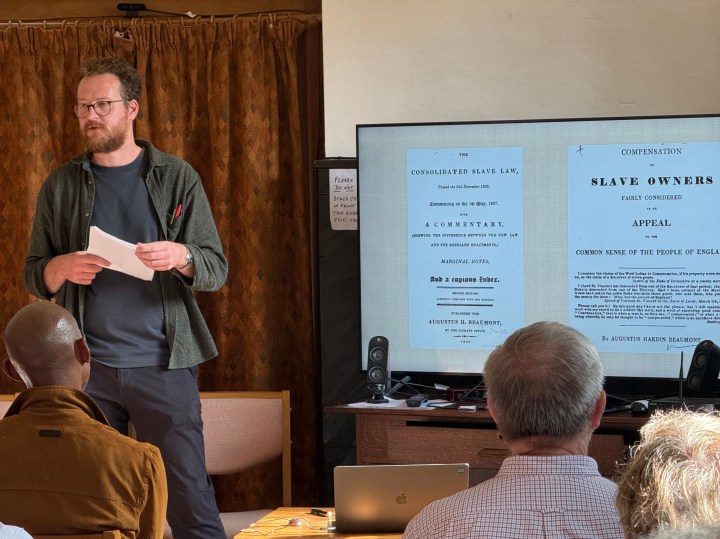
Dr Tom Scriven on Augustus and Arthur Beaumont and Chartist apologias for American slavery. 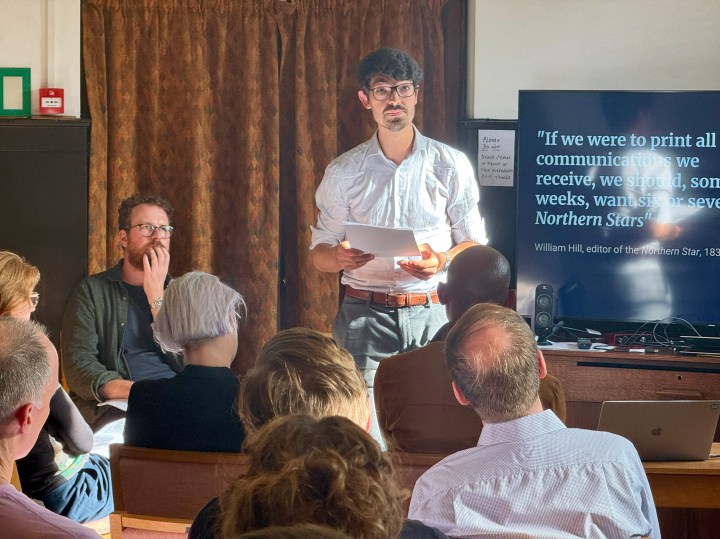
Valentin Baylac on the Northern Star’s local correspondents in 1839, 1842 and 1848. 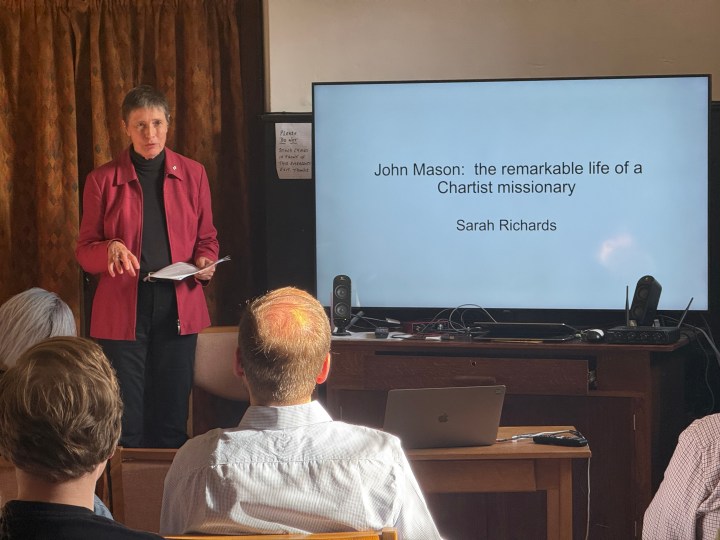
Sarah Richards on John Mason: the remarkable life of a Chartist missionary.
Professor Anthony Taylor paid tribute to Iori Prothero, who died earlier this year at the age of 86. A leading historian of artisan radicalism. Dr Prothero’s books included Artisans and Politics in Early Nineteenth-Century London: John Gast and His Times (Dawson, 1979), and Radical Artisans in Britain and France 1830-1870 (Cambridge, 1997). A regular attendee at Chartism Days, Prothero was, according to Professor Taylor ‘the complete master of the killer question’. But, as he noted, Iori meant it kindly. He was trying to get people to think about their sources and what they were trying to do with them’.
Professor Kevin Morgan took the publication of two books as his starting point for reflections on the making of Chartist studies from the 1940s to the 1980s. Dorothy Thompson’s The Chartists (1984) and John Saville’s 1848: The British State and the Chartist Movement (1986) were major contributions from authors who had played a crucial role in establishing the history of Chartism as a thriving field of study, but had both been long delayed by other commitments. Ultimately, both books had their origins in the communist networks of the post-war years when both historians began to work independently on the Chartist leader, Ernest Jones. Although their work involved shared influences and interests, and periods of collaboration, there was also sometimes robust disagreement between them about what a history of Chartism or of Ernest Jones should look like. Professor Morgan is writing a book on the alternative national histories produced by historians such as Saville and Thompson who emerged from the Communist Party and its post-war Historians’ Group.
Architectural historian, Dr Alex Buchanan, reconstructed the identities and careers of some of the eighteen stonemasons who in May 1841 carried the Chartist petition calling for the release of the Newport prisoners through London. Many of the masons in the procession were employed at the time on rebuilding the Palace of Westminster after the fire of 1834. Their names can be found in an address published in the Northern Star in June 1841 calling for the trades to form their own Chartist Associations. The histories of the men who carried the petition sheds light on the relationship between trade unions and Chartism: several of them played significant roles on both sides of the Westminster masons’ strike that took place that September, and some would continue to be active Chartists, participating in the presentation of the 1842 petition. Dr Buchanan is currently working on a monograph on the construction workers who rebuilt the palace in the years after 1834.
Speaking on class and Chartism, Maddy Howarth contrasted the poetic voice of Alfred, Lord Tennyson, who was to become poet laureate in 1850, with that of the many working-class Chartists who wrote poetry for the Northern Star and whose work emerged in clear opposition to the intellectual supremacy and power harnessed by those who wrote from a perspective above and in ignorance of the working class. She noted that while the rhymes used by many Chartist poets were often ‘painfully simple and often their enraged tone supersedes poetic rhythm’, this was exactly the point: they were reclaiming the poetic voice as ‘a true commons’ of the working class, and through poetry were contributing to a greater sense of their collective struggle and exploitation.
Dr Tom Scriven followed the political careers of brothers Augustus Hardin Beaumont and Arthur Beaumont, Anglo-American Jamaican slaveholders who arrived in Britain in the 1830s and swiftly became involved in working-class radicalism. Dr Scriven argued that both men were influential through their editorship of the London Dispatch and their own Northern Liberator in shaping Chartism’s initial response to American chattel slavery. This they argued was a legacy of British aristocratic rule that was gradually being ameliorated and removed by American republicanism. Their view dovetailed with early Chartist depictions of American slavery as preferable to the ‘white slavery’ of British workers, and along with the sympathy shown by Cobbetite Chartists towards American slaveholders contributed to an Chartism’s ambivalence towards chattel slavery that was not challenged until the 1840s.
Valentin Baylac, currently pursuing a PhD at Sorbonne Université which builds on his master’s dissertation about local correspondents of the Northern Star, presented extensive data about those Chartists who wrote to the paper in the years 1839, 1842 and 1848. His study of primary sources enabled him to understand the turnover of individuals between each of these three peak years for Chartism, and to draw conclusions in the form of a collective biography about the wide array of individuals who contributed to the principal Chartist newspaper, including many lesser known activists.
Sarah Richards spoke on the life of John Mason, a bootmaker of Scottish origin and Chartist for almost fifteen years before he emigrated to the United States. During the late 1830s and early 1840s, Mason had been politically active first on Tyneside and then as Chartist lecturer for Birmingham and the three adjoining counties. In 1847, he published An Inquiry into the Exchange and Distribution of Wealth. By 1856, he had become secretary to the British radical reformers resident in New York, and took a prominent part in welcoming John Frost to the city. He would later help raise a Scottish regiment for the Union army during the civil war before migrating further west to California in the 1870s where he remained politically active.
Dr David Kennerley concluded the conference, speaking on the changing aural experience of the working class during the Chartist period, and in particular the growing inability to hear the sounds of nature. He argued that agricultural enclosure and privatisation of previously common land, the growth of industrial cities, and the incarceration of the poor in workhouses and of radical activists in prisons forced the sounds of nature ever further out of earshot. The sounds of nature – birdsong, the rush of water, the sigh of the wind – became symbols of a freedom of expression and movement increasingly denied by contemporary political and economic forces. In response, argued Dr Kennerley, Chartists cultivated radical forms of listening that tried to preserve their connection with nature, and though activism and campaigning aimed to bring about a better future in which the sounds of nature might be audible again.
Chartism Day is supported by the Society for the Study of Labour History. The organisers are grateful to the Society, and to Warwick Quakers for the use of the Friends Meeting House.
Discover more from Society for the Study of Labour History
Subscribe to get the latest posts sent to your email.

