Academic and independent historians, Chartist enthusiasts and the Chartism curious gathered in Huddersfield for the annual Chartism Day event, the latest in a series of conferences that first ran in 1993.
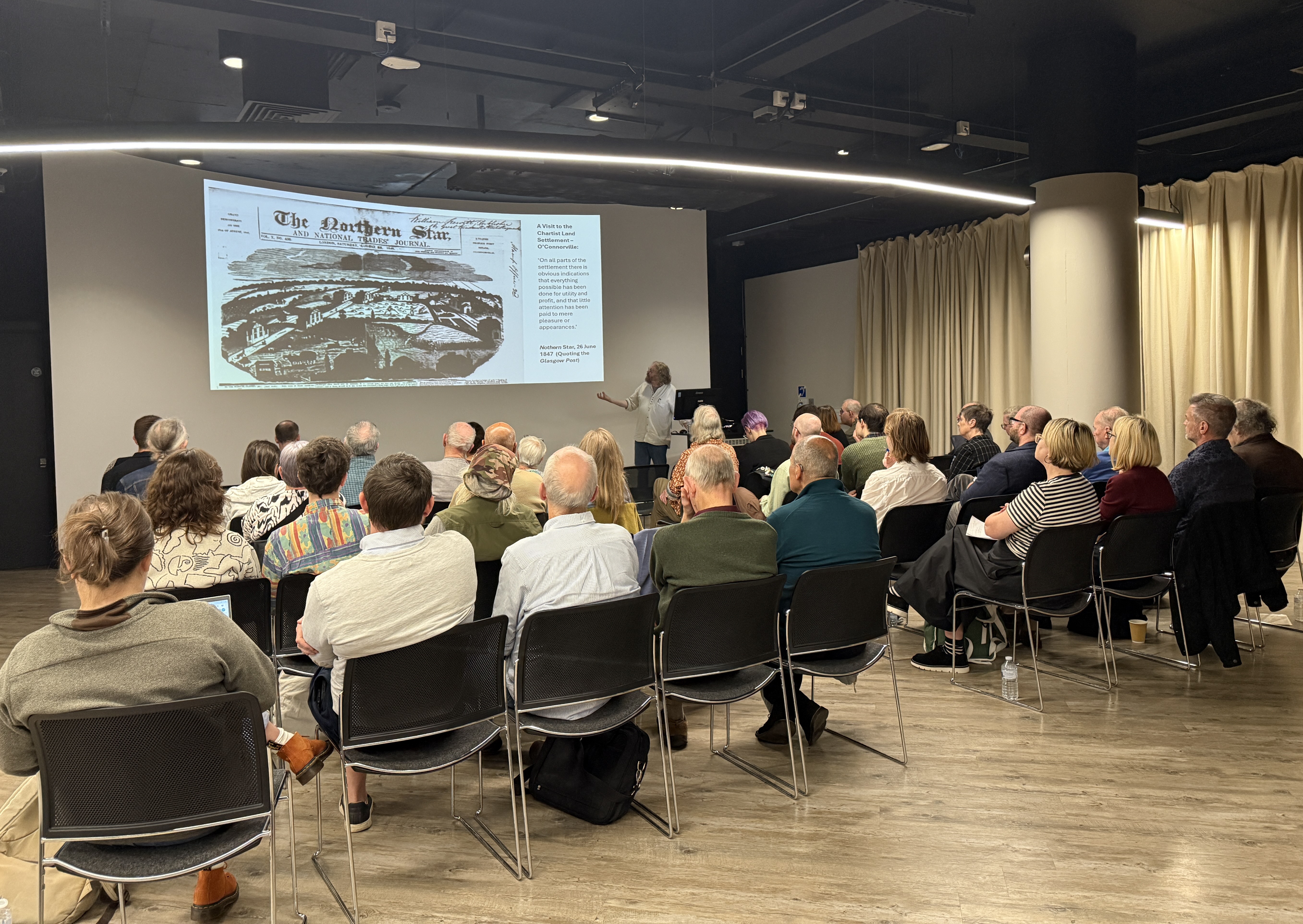
With centuries of history as a site of working-class radicalism from Luddism to Owenite socialism and beyond, Huddersfield proved to be the ideal venue for Chartism Day 2025.
Taking place at Heritage Quay, a part of the University of Huddersfield, on Saturday 6 September, the event drew more than 40 attendees with speakers on the Chartist landscape, on the reputational power of Chartist meetings, and on Daniel O’Connell and contested understandings of the language of emancipation.
Opening the conference, co-convenor Dr Joan Allen also drew attention to the four short papers on Chartist lives – a feature of recent Chartism Days drawing inspiration from the approach used by the late Malcolm Chase in his book Chartism: A New History, and to a series of archive updates planned for the day.
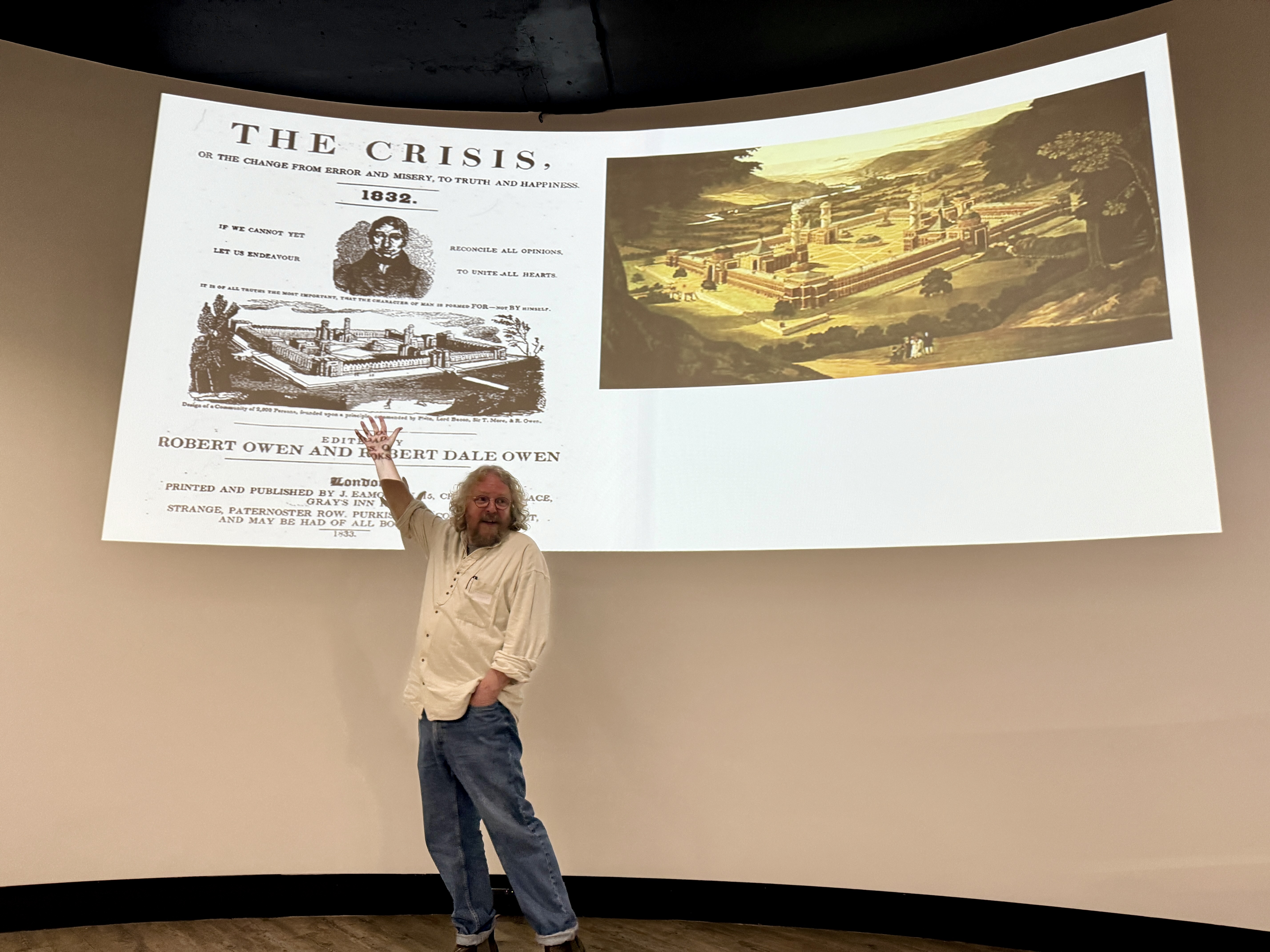
The first speaker, Dr Martin Wright, discussed the ways in which Chartists thought about ‘land’ and ‘landscape’, highlighting tensions between ‘picturesque’ and ‘anti-picturesque’ perceptions. The first of these, he suggested, was heavily influenced by the poetry of Shelley and the Romantics and revelled in the untended wilderness as something to be enjoyed in its own right. The second, based in the ideas of Thomas Spence, and finding its outlet in the Chartist land plan, abhorred untended land as a resource lost to ‘the people’s farm’.
Speaking on ‘The Powerful Crowd: reputational power and Chartist meetings’, Dr Dave Steele revealed how the use of digital techniques and modern understandings of crowd behaviour demonstrated that a number of key radical meetings, from Peterloo to the Kennington Common Chartist rally of 1848, must have had far smaller crowds than have previously been reported.
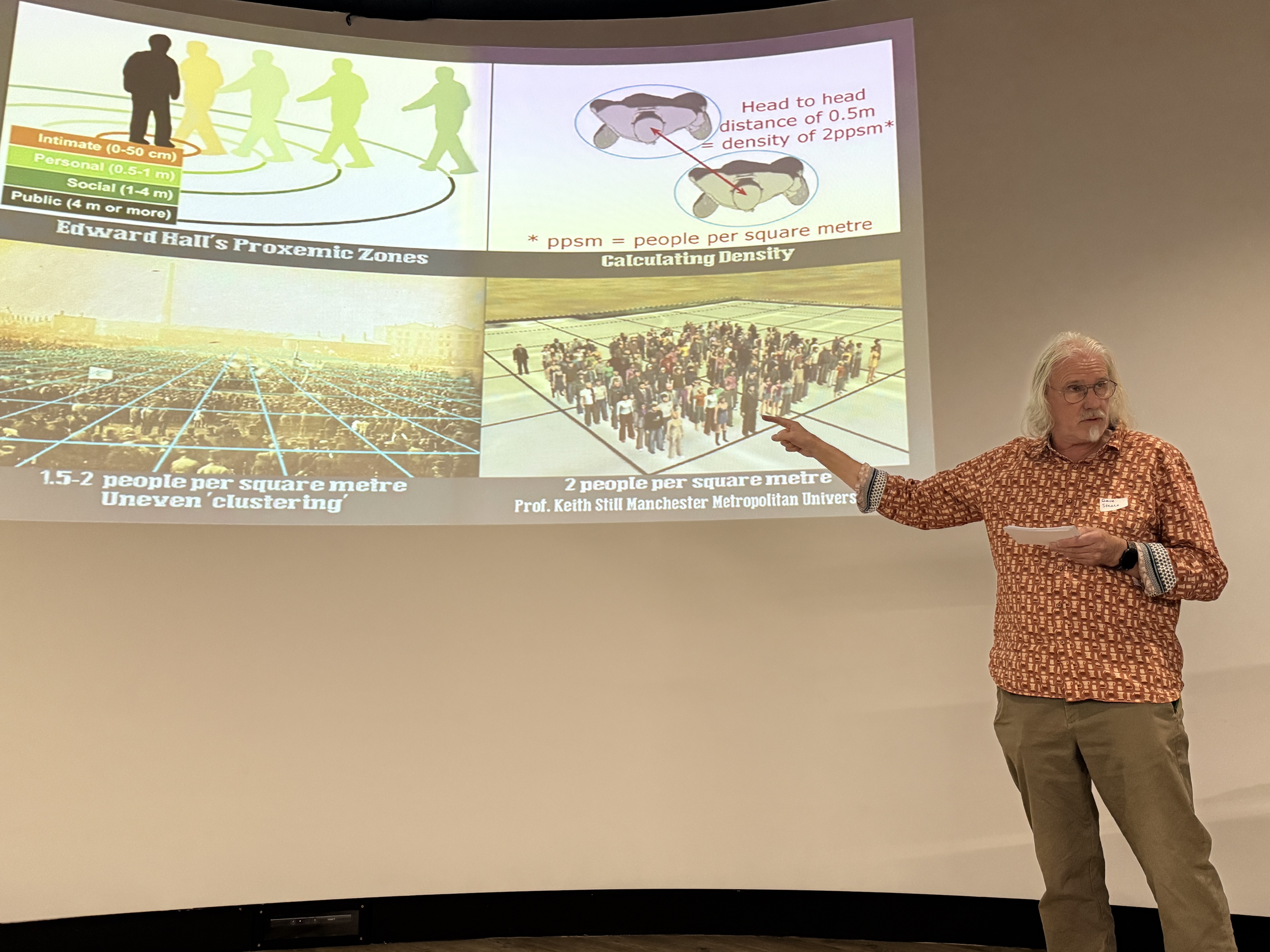
Despite reports that between 60,000 and 100,000 people were at Peterloo, the capacity of the enclosed area was no more than 37,200; and at Newhall Hill in Birmingham, where as many as 230,000 people were said to have been at a Chartist meeting in 1838, in reality no more than 37,200 could have attended, and the upper end of contemporary estimates actually exceeded the then population of Birmingham by some 90,000 people. Some reports suggested as many as 400,000 had been at Kennington Common in 1848, yet the common had a capacity of 114,000, and contemporary photographs and reports suggested that the common was far from packed.
A fixation on numbers was, however, beside the point, suggested Dr Steele. What was important was how the crowd was perceived. Beyond a certain number, all that could be said of a crowd of thousands was that it was very large. The response to them was an irrational and emotional response which gave the crowds power despite their actual numbers. Such crowds were powerful because of the threat to the authorities that they represented, and because of the locations where the meetings took place. Far more press coverage was given to the Chartist meeting in Palace Yard to adopt the Charter in September 1838 because it was in London and immediately alongside the Palace of Westminster, than was given to the much larger meetings over the summer and autumn in the Midlands and North of England. Yet given the constraints of the venue, the Palace Yard meeting must have been far smaller.
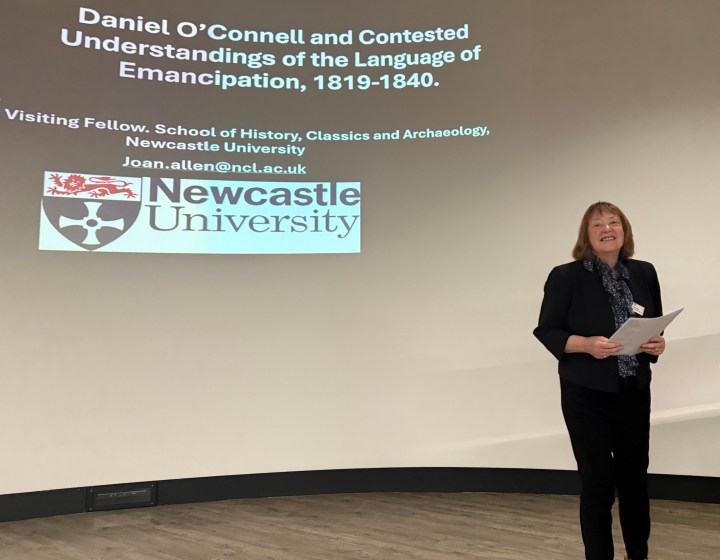
Dr Joan Allen delivered a paper on the Irish radical leader Daniel O’Connell, known as the Liberator, and contested understandings of the Catholic ‘emancipation’ he and his supporters had achieved in 1829. She argued that although many Irish Catholics had benefited from emancipation, others had lost out, and that the cost of this limited emancipation had been to neuter further attempts at reform by tying political rights to an allegiance to the crown. Focusing on Tyneside, where there was a large, established Irish community, she traced the tensions that surfaced between Irish radicals and Chartists between 1837 and 1840, with Chartists arguing that emancipation could only be meaningful within the context of an enlarged democracy. Dr Allen concluded that while O’Connell, who had been one of the original authors of the People’s Charter, had obstructed efforts to build a united front, so too had sections of the Chartist movement thanks to their ingrained anti-Catholicism.
Chartist lives
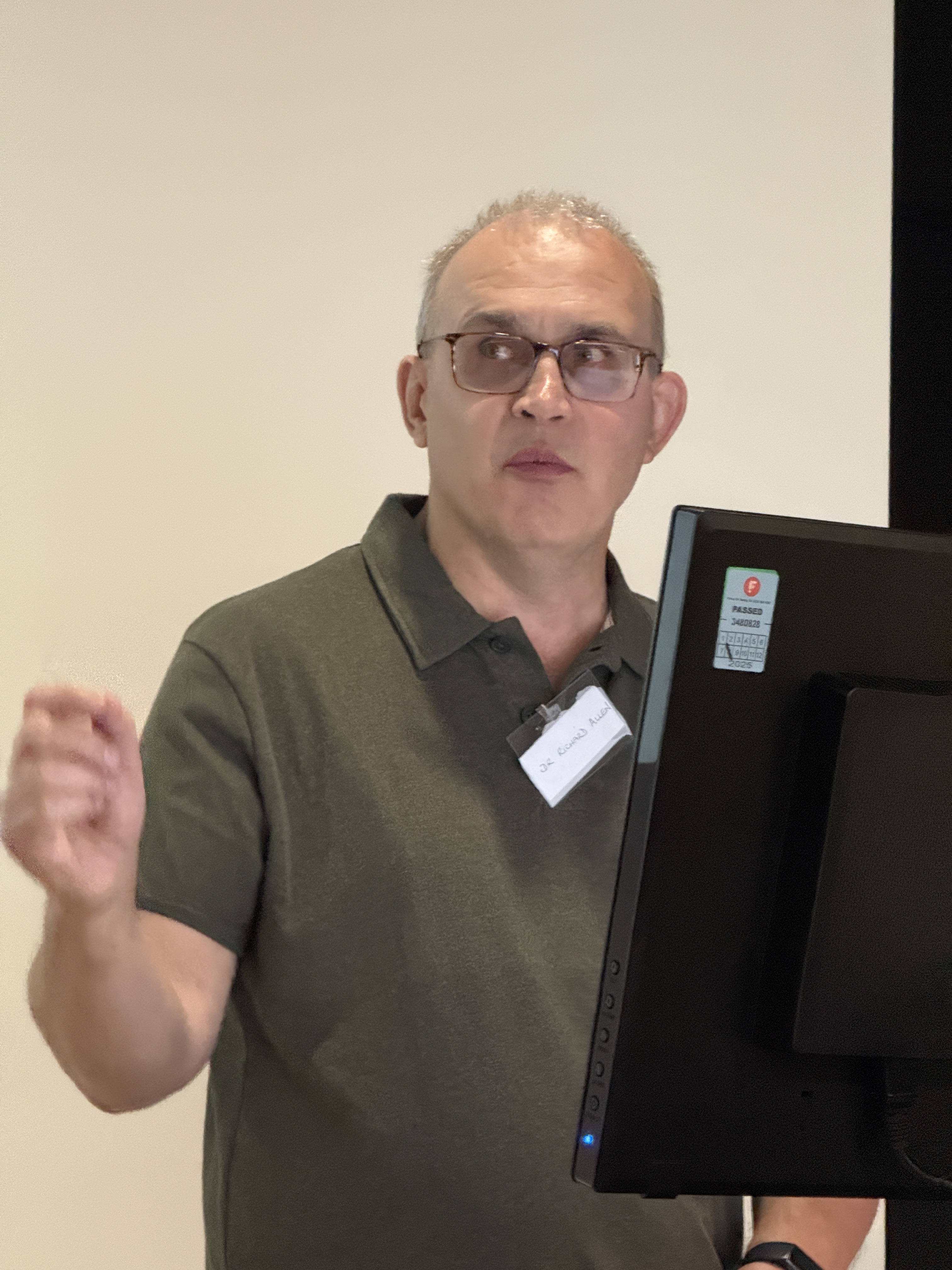
Dr Richard C. Allen talked about the life of Samuel Cook (1786-1861), ‘an unrepentant … and vociferous’ political activist from Dudley in the Black Country, whose radicalism had repeatedly landed him in legal difficulties. A shopkeeper, he had in 1827 posted a notice in his window naming government ministers who he alleged were stealing public money intended for repairs to Windsor Castle. The indictment against him described Cook as ‘a wicked malicious, seditious, and ill-disposed person’. He would go on to promote the aims of the political unions in the 1830s, and of Chartism .
Dr Joe Stanley discussed John Auty (1803-1870), a pioneer of early miners’ trade unionism who served as ‘paymaster general’ of the Friendly Society of Coal Miners of Wakefield in 1833. Auty played a part in intimidating strikebreaking colliers during a violent strike to prevent wage cuts at Alverthorpe, and resurfaced at the height of strike wave of 1842 as a prominent Chartist lecturer.
Tim Malloch talked about the prominent London Chartist William Cuffay and the Treason Felony Act, introduced in 1848 in response to Chartist activities. The Act made it an offence to use ‘open and advised’ speech to excite persons to levy war, including in order to ‘intimidate or overawe’ either or both Houses of Parliament. It was passed despite protests that the wording was vague and that the attempt to conflate government and crown was unconstitutional. The Act effectively blurred any distinction between the use of physical and moral force in campaigning for the Charter by criminalising peaceful moral force campaigns.
Dr Vic Clarke discussed the life of Joshua Hobson (1810-1876). Born in Huddersfield, and now buried in the town’s cemetery, Hobson had cut his political teeth as publisher of the Voice of the West Riding, and from his shop in the town he sold a range of radical publications and other products. He would go on to print and publish the Chartist Northern Star in Leeds and to serve as editor when it moved to London before returning to Yorkshire after falling out with Feargus O’Connor. Hobson continued to edit newspapers in his home town and to serve in local government before his death.
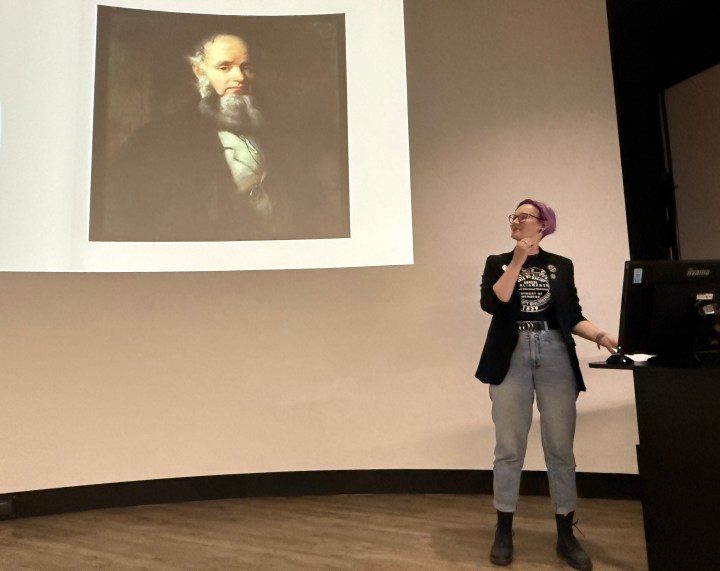
Archives reports
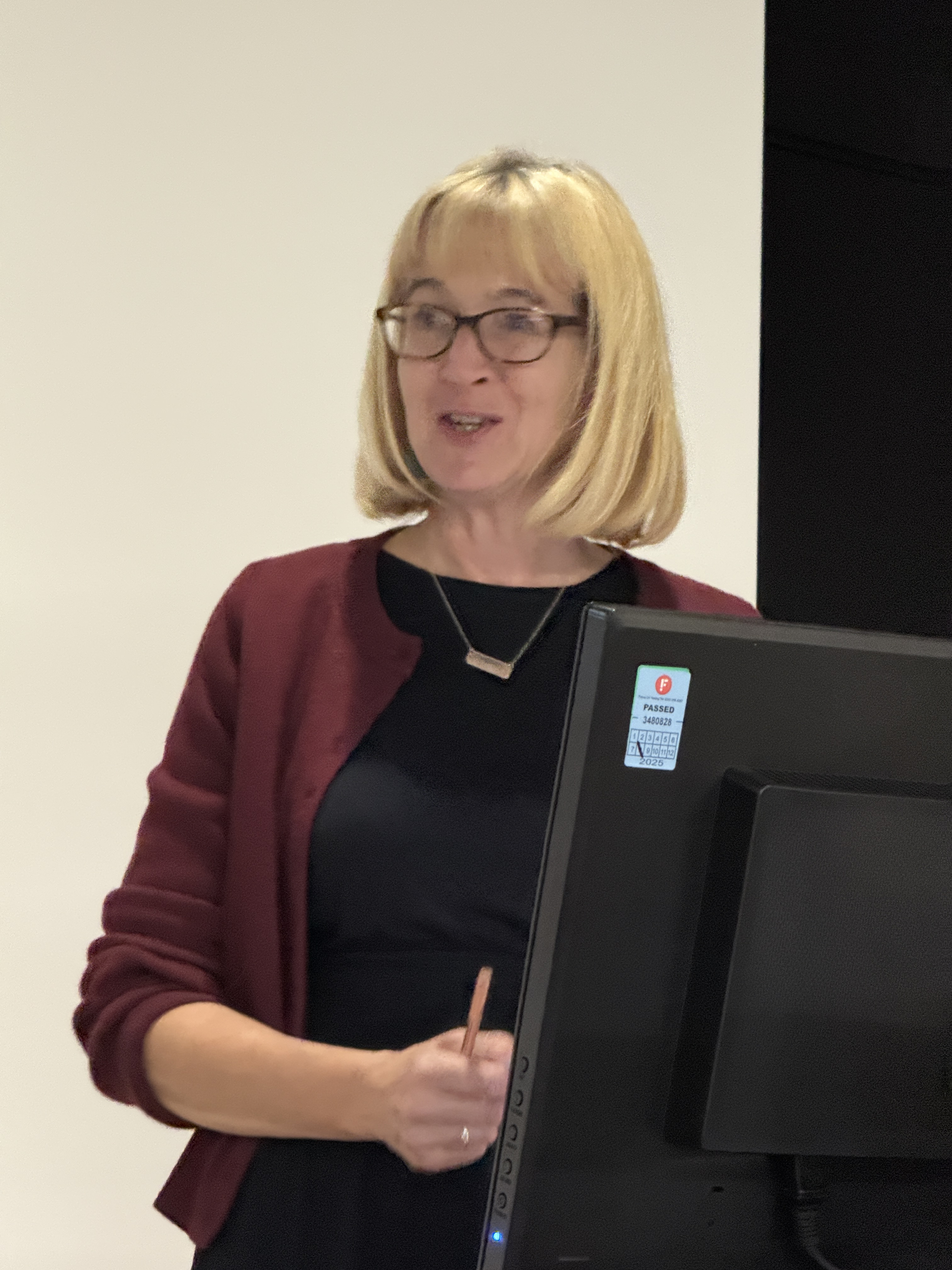
Dr Janette Martin talked about two recent additions to the John Rylands Library connected with the Peterloo massacre of 1819. The first was a white-metal Peterloo medal, now black with age, struck as part of the fundraising activities for the survivors. Dr Martin was able to demonstrate an interactive 3D representation of the medal (see below), and to show a replica of the medal made at the John Rylands Library. The second archive acquisition was a volume of pamphlets and other printed material compiled in 1908, some of it previously unknown. The materials shed light on an earlier attempt to rebuild the Henry Hunt Memorial first erected by the Chartist movement in Manchester but subsequently demolished. Although the committee’s fundraising efforts were unsuccessful, they did lead to the creation of a plaque, now held at the Museum of Science and Industry in Manchester.
Mark Crail discussed three Chartist medals. The first of these was issued in 1838 to raise funds for the factory reformer Richard Oastler, who though not a supporter of the Charter was close to Huddersfield Chartists and had been co-opted into the Chartist ‘pantheon’. The second, also from 1838 and issued to mark the launch of the Great Northern Union, carried a portrait of Feargus O’Connor on the obverse, and ‘the five great principles of radicalism’ on the reverse. The third medal, featuring a very different portrait of O’Connor, was issued in 1841 to mark his release from prison in York Castle, where he had served fifteen months for seditious libel. Attendees were able to see all three original medals on the day.
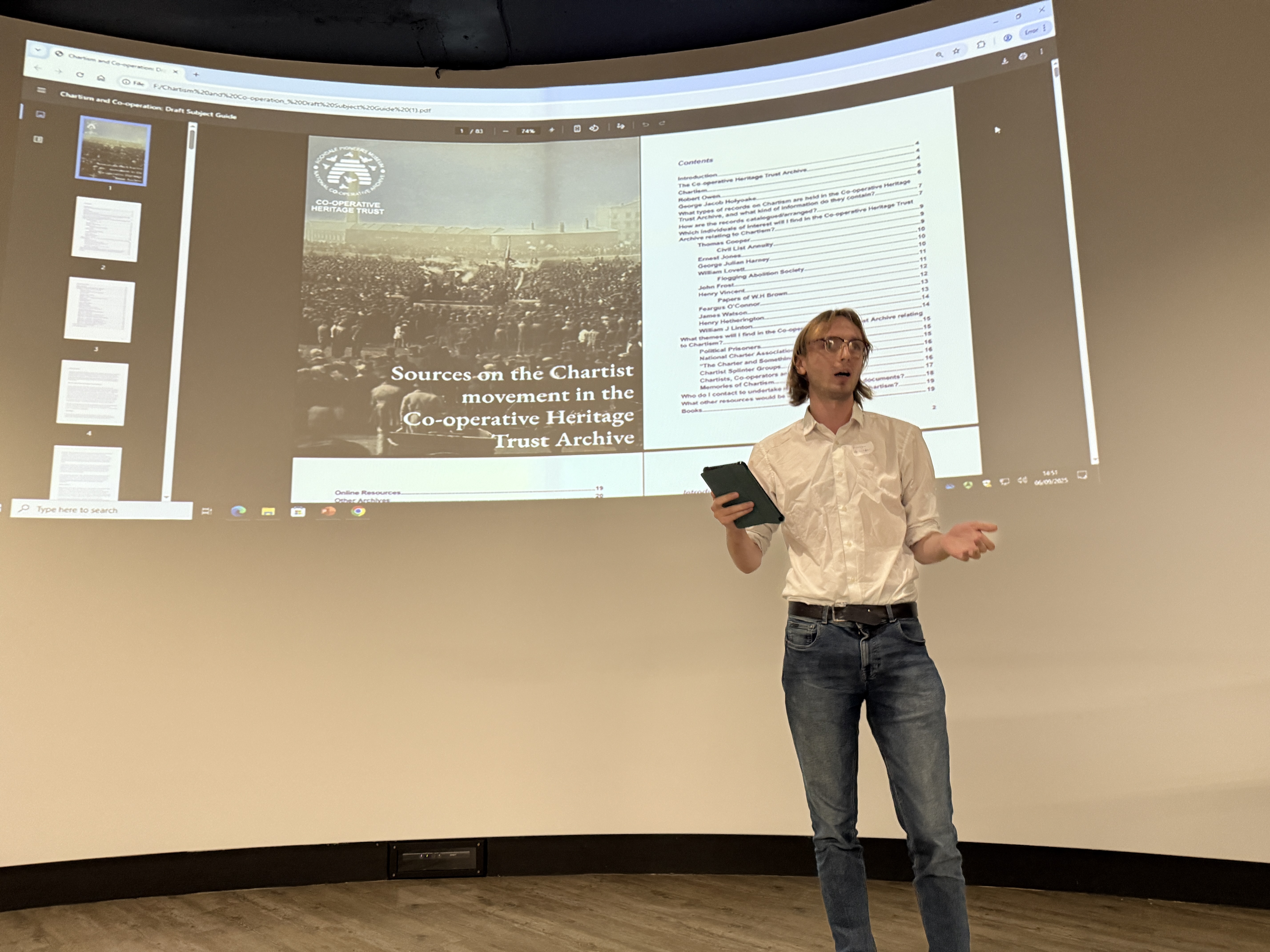
Duncan Hamilton reported on a project undertaken with the Co-operative Heritage Trust to produce a catalogue and guide to Chartism in the National Co-operative Archive. The catalogue includes brief biographies of a number of prominent individuals, including the Chartists Ernest Jones, Thomas Cooper, Henry Hetherington and W.J. Linton, a guide to Chartist ‘splinter groups’, a section on ‘the Charter and something more’ and another on ‘memories of Chartism’, often drawing on obituaries in the later co-operative movement press. The Chartism subject guide is available here on the Co-operative Heritage Trust website.
Alan Brooke of the Huddersfield Local History Society introduced a new edition of the society’s book Liberty or Death: Radicals, Republicans and Luddites, 1793-1823.
Other new titles mentioned during the day included Huw Griffiths’ new biography of Feargus O’Connor titled Feargus O’Connor: Repealer, Chartist, and icon of Plebian Melodrama, and John Baxter and Steven Kay’s life of the Sheffield Chartist Samuel Holberry: Revolutionary Democrat 1814-1842.
Keynote address
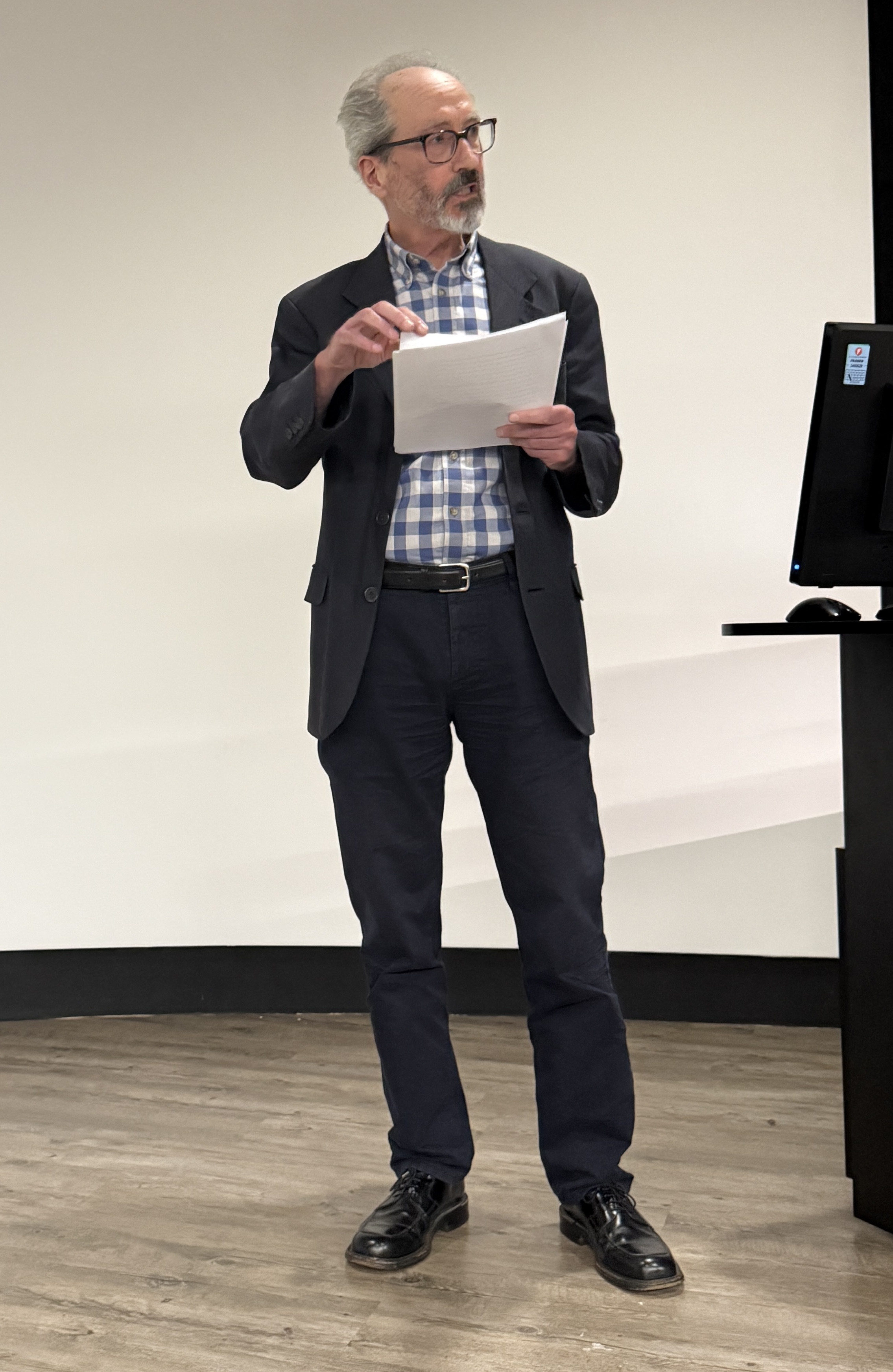
Professor Peter Gurney concluded the day with a keynote address titled ‘The Chartist Revolution: An Argument’.
In it, he took issue with liberal interpretations of Chartism which presented the movement as political reformists whose sensible constitutional demands had in due course been adopted, and whose wilder ideas, including the idea of annual parliaments, had been abandoned.
Rather, he argued, the Chartist movement was revolutionary in nature, not necessarily in its use of direct insurrectionary methods, but in its opposition to the developing system of market capitalism and liberalism. Chartists had raised profound questions about the nature of capitalism that could not be resolved short of a long revolution which sought to separate the economic from the moral or political realm, and to remodel the political, cultural and economic spheres in more humane, democratic ways.
Chartism Day takes place with the support of the Society for the Study of Labour History.

Discover more from Society for the Study of Labour History
Subscribe to get the latest posts sent to your email.

