My dissertation focuses upon relations between Welsh and Irish socialists during the Irish revolutionary period (1910s–1920s) with a focus on newspapers produced in South Wales. Analysing the social history of these nations outside the strict confines of the British state is a developing field of study. The study aims to better understand how each nation’s socialist movement interpreted, supported or, in other cases, hindered the other’s development. My research also considers the wider impact of press censorship on socialist voices during the First World War, and the limitations of newspaper publications as a primary source for historical analysis today.
The 1910s is one of, if not the most significant decade, for both the Irish labour and nationalist movements. The 1913 Dublin Lockout was the largest display of industrial action in Ireland up until that point. Its collapse contributed to a growing divergence between sections of the Irish and British socialist movements. The Trade Union Congress’ (TUC) hesitation encouraged figures like James Connolly to increasingly support an independent route towards social revolution. By 1916, Connolly’s Irish Citizen Army joined nationalist forces in the fight for Ireland’s independence. South Wales’ socialist press closely covered events across the Celtic Sea throughout the period, but the censorship regime imposed by both government fear and opportunism silenced socialist publications.
After 1914, it became increasingly difficult to understand this perspective through newspapers alone. Interviews, on the other hand, provide us with another option for exploring primary sources from the time. The South Wales Miners’ Library in Swansea is home to a large collection of interviews conducted in the 1970s with those who lived and worked during this period. Given the nature of censorship, testimony from individuals is an incredibly valuable source of information for building my own understanding of the topic.
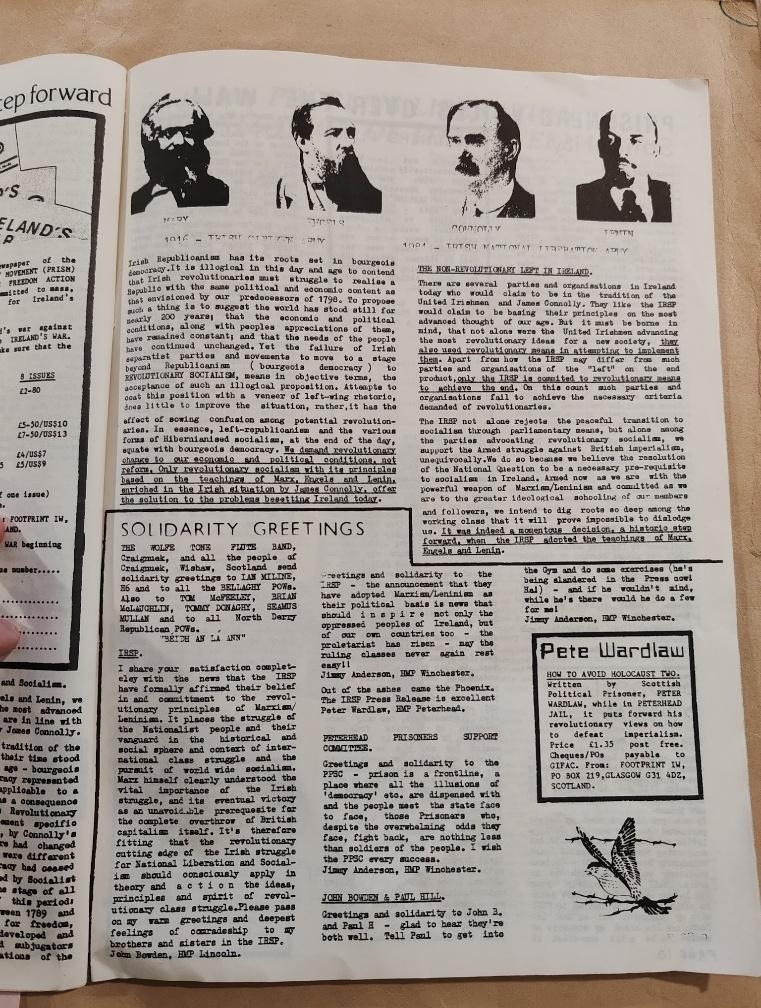
[click to enlarge]
The interviews gave a more personal element to my research, listening to workers discuss the trials of the labour movement and how that was reflected in the world around them. I was able to listen through fifteen individual interviews over three days. Roughly half had been previously transcribed, yet the others were strictly audio-based. Taking time to slowly and carefully listen through dated recording equipment was a new experience for me as a research student.
There were two primary topics that the interviews largely focused on: the perception of the Irish and their contributions to local socialist movements, alongside those from South Wales who fought in Ireland for the revolutionary cause. This dual focus provided a more nuanced framework through which individuals viewed the labour movement and national self-determination as intersecting revolutionary movements. One of the more interesting claims made by multiple interviewees is the presence of Irish nationalists in South Wales following the Easter Rising and how quickly they joined local socialist movements.
Idris Cox, a Welshman working around Maesteg, noted how the local Communist movement was made up of remnants from both socialist organisations and the Irish Republican Army. Mel Thomas, another miner from Maesteg, corroborated this testimony and considered that the Communist Party’s older members came from an Irish contingent. Multiple direct references were given to Morris Nolan, Will Mullins, Patsy Hayes, and Mike Caine, men who would have likely remained invisible within labour historiography.
Militant nationalists quickly integrated into socialist movements in South Wales, placing the Irish revolutionary movement within a greater transnational wave of working-class struggle. These discoveries were in no small part thanks to the bursary provided by the SSLH, which enabled me to travel to Swansea and improve the quality of my academic research through these significant historical contributions. I would like to extend my gratitude towards the SSLH for its contribution in supporting the continued study of Irish and Welsh labour history as important and developing fields of historical research.
Tomas is studying for an MA in Welsh History at Bangor University.
Find out more about the bursaries on offer from the Society for the Study of Labour History.
Discover more from Society for the Study of Labour History
Subscribe to get the latest posts sent to your email.

