In 1896, the veteran German socialist and labour movement activist returned to Britain to lecture and serve as a delegate to the Congress of the Second International. Historian Valentin J. Hemberger retraces his steps.
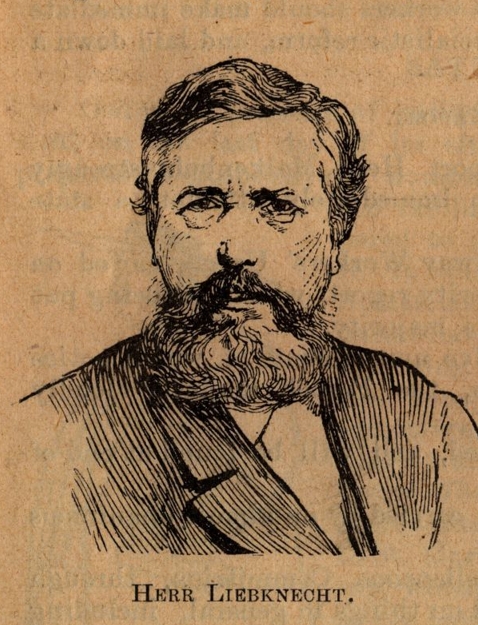
On 29 March 1896, Wilhelm Liebknecht (1826–1900), socialist and political activist in the German labour movement, celebrated his seventieth birthday. Numerous congratulations reached the ‘Old Man,’ as he was respectfully nicknamed: private individuals and left-wing parties alike highlighted Liebknecht’s firm stance against the German authoritarian state, praised his unwavering loyalty to the ideas of scientific socialism, and portrayed him as a combative figure of respect within the Second International.
Even in his advanced age, his political drive remained unbroken. Barely a month and a half after his birthday, Liebknecht set off on an important trip abroad. It took him to Britain, the country that had offered him refuge for over a decade as a persecuted revolutionary in the wake of the revolutions that had shaken Europe in 1848/49.
Lecture tour, May/June 1896
For Liebknecht, the trip to Britain was like returning home.[1] He had lived in Soho for twelve years, very close to the Marx family, where he soon became a regular visitor. Marx and Engels’ influence on Liebknecht’s political worldview grew steadily. His years in London were a constant struggle for survival. He tried to keep his head above water by working as a private tutor and correspondent for a conservative German newspaper. He also gave lectures for the Communist Workers’ Educational Association and edited the entertaining German exile weekly Das Volk. In 1861, Liebknecht moved to Prussia, but remained closely connected to Britain and its labour movement.
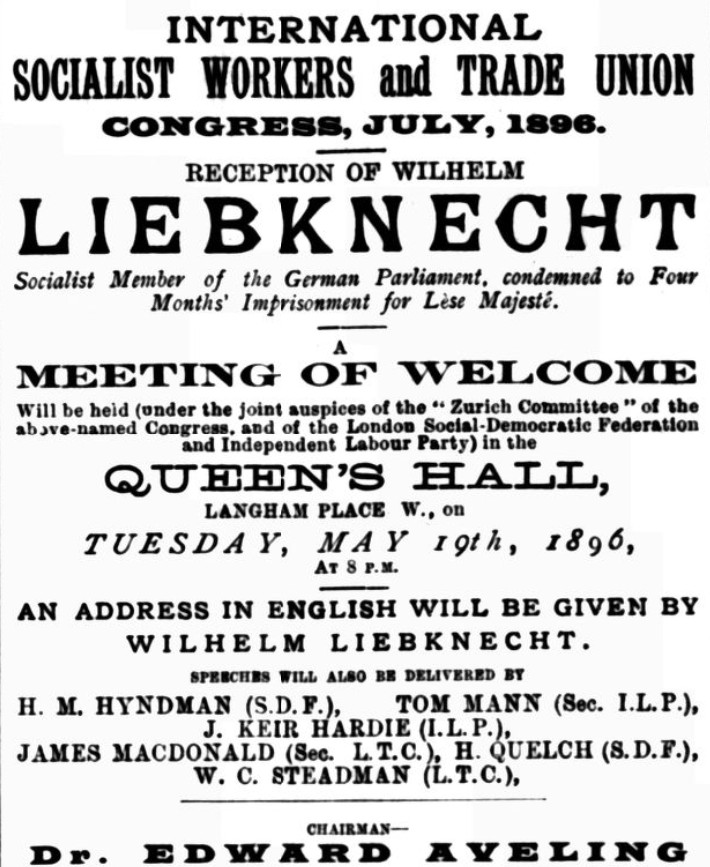
On 19 May 1896, Liebknecht took to the stage at Queen’s Hall (in Langham Place, West London), the first stop on his lecture tour of England and Scotland.[2] The daily newspaper The Morning Leader described the prevailing mood that evening: ‘Men from all nations fill Queen’s Hall and cheer the German socialist leader with prolonged enthusiasm. (…) The walls of Queen’s Hall have witnessed a scene the like of which it has never seen before, and the like of which it may be many days before it sees again.’ In ‘astonishingly good English’, Liebknecht spoke, among other things, about rumours of a new threat of war between the German Empire and France and assured the British audience that ‘there was no hatred in Germany towards England (…), except that which comes from the ruling classes.’ As a tireless internationalist, he concluded that ‘Socialism is the only remedy, because Socialism is international.’[3]
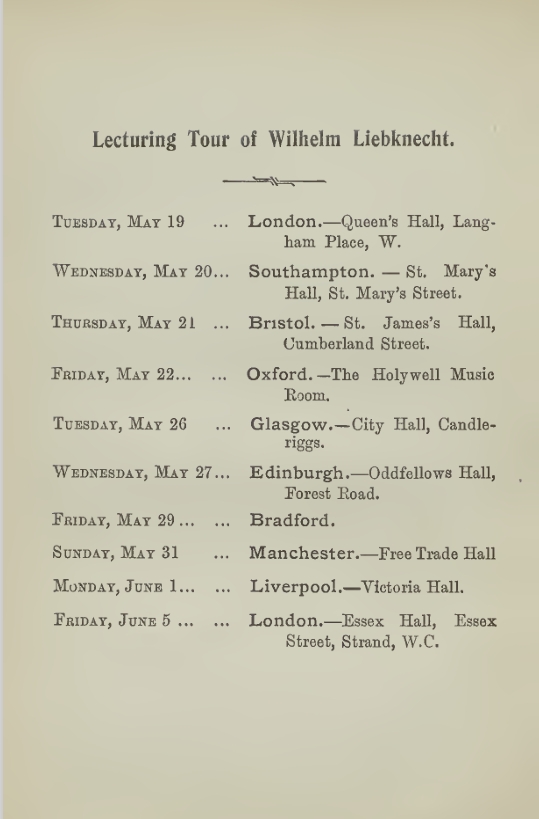
By 5 June, Liebknecht had made a total of eleven appearances in London (19 May and 5 June), Southampton (20 May), Bristol (21 May), Oxford (22 May), Glasgow (26 May), Edinburgh (27 May), Bradford (29 May), Manchester (30 and 31 May) and Liverpool (1 June). Newspaper articles about his appearance in Edinburgh and the concluding reading at Essex Hall (London) describe Liebknecht’s ability to captivate audiences with his rousing and catchy rhetoric. In terms of content, he familiarised British audiences with the recent history of the German labour movement, in particular the persecution of socialists between 1878 and 1890 (the ‘Sozialistengesetze’).[4]
Overall, the lecture tour was notable for reaching a wide audience and receiving a certain amount of media coverage.[5] In the run-up to the tour, advertisements had been placed in well-known left-wing daily newspapers such as Justice, promoting the significance of the event; For example, the advertisement for Liebknecht’s appearance at Queen’s Hall in London pointed out that, in addition to the main speaker, famous personalities from the British labour and trade union movement would also be appearing: the former conservative Henry Mayers Hyndman (1842–1921), who had converted to Marxism; the trade unionist and co-founder of the Independent Labour Party (ILP) Tom Mann (1856–1941); and J. Keir Hardie (1856–1915), who played an important role in the Scottish Labour Party and the ILP.[6]
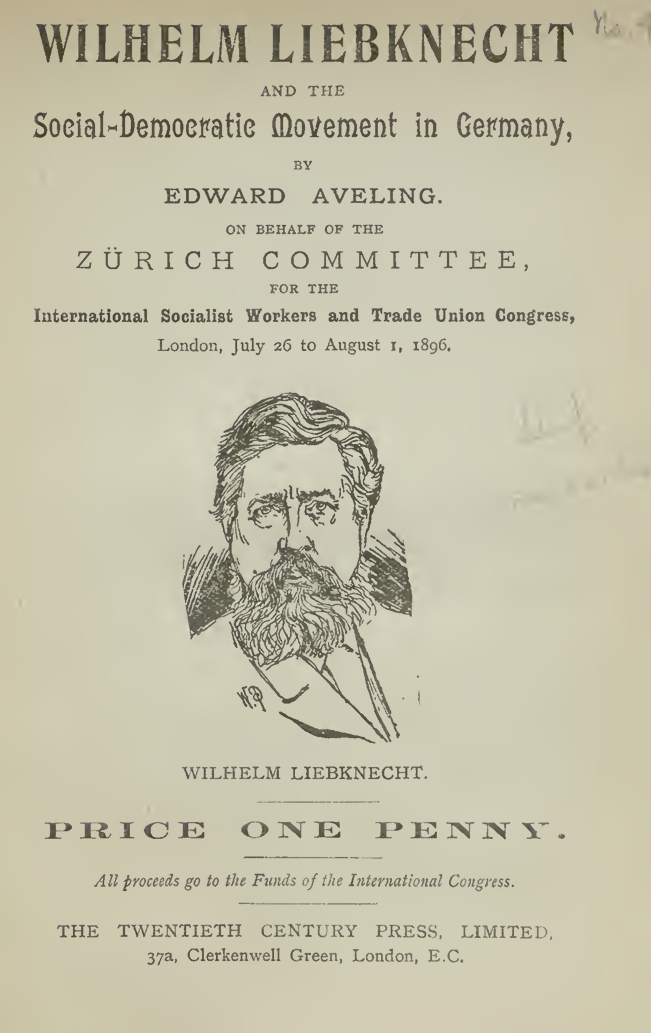
Chairing the event was the socialist Edward Aveling (1849–1898): Karl Marx’s son-in-law had also planned Liebknecht’s Lecturing Tour on behalf of the Zurich Committee (in preparation for the International Socialist Workers and Trade Union Congress in London in 1896).[7] As accompanying material, he had written the brochure Wilhelm Liebknecht and the Social-Democratic Movement in Germany, which was published by Twentieth Century Press Ltd. (London). The proceeds from its sale were to be used to finance the London Congress.[8] The sale of a ‘splendid photograph of the veteran Social Democrat Wilhelm Liebknecht’, which was also advertised in the daily press, served the same purpose.[9] Alongside the modern mass press, photography developed into a powerful tool for spreading socialist ideas at the end of the 19th century.
International Socialist Workers and Trade Union Congress
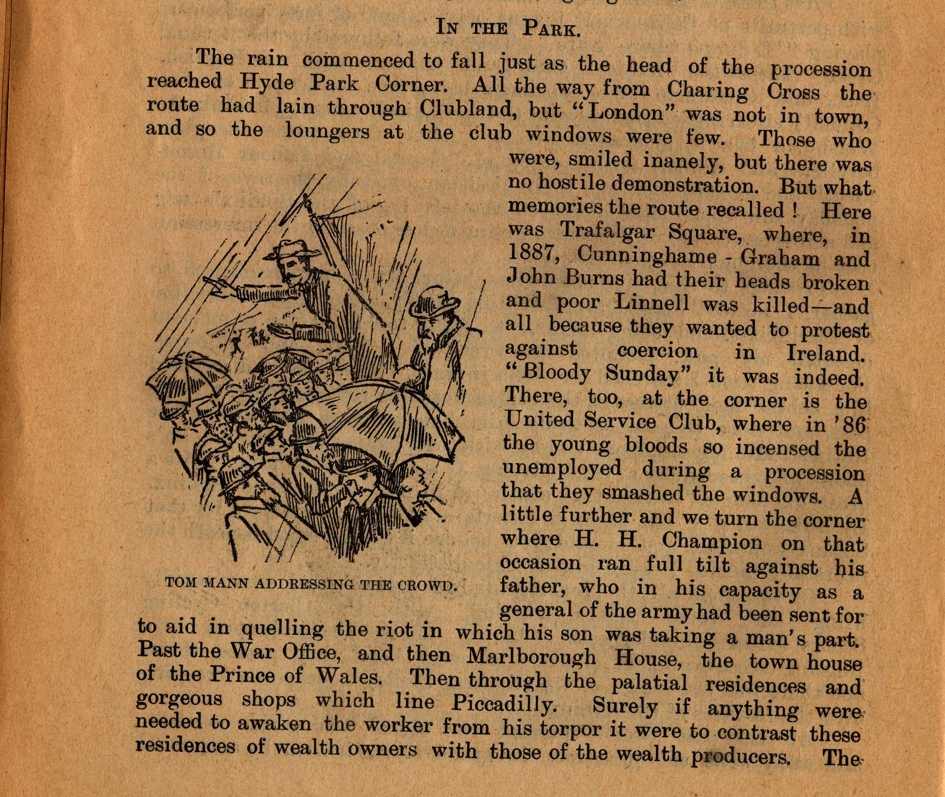
Liebknecht used the time after the lecture tour to roam his old place of exile, London, together with Eleanor Marx and Edward Aveling, refreshing memories and meeting old companions.[10] After this very personal episode, the German socialist returned to big politics: Around 770 delegates from workers’ parties in various countries gathered at Queen’s Hall for the International Socialist Workers and Trade Union Congress. From 27 July to 1 August 1896, London became the heart of the Second International, with Liebknecht serving as part of the German delegation and the Presidium. J. Keir Hardie wrote a comprehensive, but not neutral, report on the event for The Labour Leader. On the eve of the congress, around 15,000 people marched through the British capital in a powerful demonstration, braving heavy rain and listening to the anti-militarist speeches of various socialists.[11]
Due to the unexpectedly high number of participants, the congress was moved from St. Martin’s Town Hall (Charing Cross Road) to Queen’s Hall, which had been inaugurated in 1893 – ‘one of the finest meeting places in Great Britain,’ as Hardie noted. Designed by architect Thomas Knightly, the building quickly became a popular concert hall, hosting the Proms in the decades that followed. The organiser of the International Workers’ Congress had rented the building, with its approximately 3,000 seats and standing room, for £200 a week. The floor space was reserved for the delegations, who were seated at tables separated by nation, while the gallery was open to all visitors who, alongside the international press, followed the political spectacle with great interest.[12]
A decisive resolution of the Congress was to exclude anarchists from the Second International once and for all. This decision had already been taken at the Zurich Conference in 1893. Liebknecht took a decidedly Marxist stance on this issue in London: ‘The International Congress cost too much money for time to be wasted as it had been wasted during the past week. The next Congress would consist only of socialists and representatives of real and not bogus trade unions.’[13] Ultimately, this led to the anarchist socialists and free communists holding a parallel conference in London at the same time.[14]
Liebknecht, who played a central role at the London Conference as a member of the Presidium, as a reporter for the Standing Orders Committee[15], and as a translator into German, was sharply criticised by Hardie in his review. Hardie, who described himself as neither an anarchist nor a ‘cast-iron State Socialist’, spoke in favour of retaining both groups in the International and accused the German socialists around Liebknecht of authoritarian behaviour: ‘In Germany freedom is unknown, and so far as I can see the leaders of the Socialist movement in that country conceive Socialism as a system under which Liebknecht and Singer would take the place of Kaiser Wilhelm and Bismarck, They in power would be quite as intolerant towards all who disagreed with them as their official opponents are towards them to-day.’[16] Shortly after the congress, Liebknecht defended his harsh stance towards the anarchists and contradicted Hardie’s criticism of the German socialists: ‘Nobody has combatted state socialism more than we German socialists, nobody has shown more distinctly than I that state socialism is really state capitalism!’, was Liebknecht’s reply.[17] And it was by no means ‘authoritarian and despotic’ of Singer and him not to want to talk to anarchists whose individualistic ideas were far removed from socialism.[18]
Liebknecht would return to London once more, to speak at the international pro-peace demonstration of the Social Democratic Federation on 8 March 1899, a year before he died. One last time, ‘Marshal Vorwärts’ (as Henry M. Hyndman dubbed him) conquered British hearts: ‘Our old veteran, Liebknecht, looking hale and hearty, evoked a perfect storm of cheering when he greeted the audience as >>old friends<<.’[19]
Valentin J. Hemberger is an historian, lecturer and curator of historical expositions. He has research interests in the history of the Weimar Republic (especially the left wing media of the age), the European labour movement, and the history of the USSR till 1945.
References
[1] Wilhelm Liebknecht arrived in London at 8 a.m. on 13 May 1896 and was warmly welcomed by British comrades, see: Critical Chronicle. Wilhelm Liebknecht, in: Justice 16 May 1896, p. 1.
[2] The bourgeois press also took an interest in the German socialist’s lecture tour. Following Liebknecht’s appearance on 19 May, the ’Newcastle Evening Chronicle‘ published a lengthy biographical description of the speaker (see: A German Socialist Visit to England, in: Newcastle Evening Chronicle, 20 May 1896, p. 3). A representative of the ’Daily Chronicle‘ interviewed Liebknecht about his views on the political situation in the German Empire, see: Parties and Politics in Germany, in: Falkirk Herald 23 May 1896, p. 4. The anarchist monthly magazine “Freedom” reacted to Liebknecht’s speech with mixed feelings: on the one hand, it acknowledged his achievements for the socialist movement, but on the other hand, his sharp rejection of anarchism understandably met with criticism, see T.C.: Liebknecht’s Tail, in: Freedom June 1896, pp. 2-3.
[3] Wilhelm Liebknecht Welcomed by the Socialists of London, in: The Morning Leader 20 May 1896, p. 7.
[4] Report on the speech event in Edinburgh: Enthusiastic Liebknecht Demonstration, in: The Kansas Agitator 10. Juli 1896, Vol. 7, No. 8, p. 2, and Liebknecht in Edinburgh, in: Justice 6 June 1896, p. 5. The text of Liebknecht’s speech at London Essex Hall was published here: The Present Position of the Socialist Movement in Germany, in: The Kansas Agitator, 7. August 1896, Vol. 7, No. 12.
[5] However, during the party conference of the SPD in October 1896 Wilhelm Liebknecht had to defend himself against accusations, that he neglected his work in the party leadership and the editorial board of the party newspaper ’Vorwärts’ for six week because of his stay in Great Britain, see SPD (ed.): Protokoll über die Verhandlungen des Parteitages der Sozialdemokratischen Partei Deutschlands. Abgehalten zu Gotha vom 11.bis 16. Oktober 1896. Berlin 1896, p. 114.
[6] Weekly Times and Echo (London) 3 May 1896, p. 9.
[7] Aveling describes the course of the Lecturing Tour in a separate article for Justice. It is particularly worth reading because of his description of the respective mood, the people he met and the topics discussed (including the audience’s appreciation of his rejection of the colonialistic ‘scoundrels’ Cecil Rhodes and Leander Jameson). see: Edward Aveling: With Liebknecht on Tour, in: Justice 30 May 1896, p.5.
[8] Edward Aveling: Wilhelm Liebknecht and the Social-Democratic Movement in Germany. London 1896.
[9] Justice 6 June 1896, p. 8.
[10] See Wadim Tschubinski: Wilhelm Liebknecht. Eine Biographie. Berlin (GDR) 1973, p. 308.
[11] See: J. Keir Hardie: Full Report of the Proceedings of the International Worker’s Congress London, July and August, 1896. London 1896, pp. 9 f.
[12] Hardie, International Worker’s Congress, p. 13.
[13] Hardie, International Worker’s Congress, p. 29. During the conference of the German Social-Democrats in Gotha (11 – 16 October 1896) Liebknecht repeated his clear position of the needed exclusion of the anarchists from the II. International, see: SPD (ed.), Protokoll, p. 134.
[14] For an overview see for example Hardie, International Worker’s Congress, pp. 63-72.
[15] For his report see Hardie, International Worker’s Congress, p. 31.
[16] Hardie, International Worker’s Congress, pp. 94 f.
[17] Wilhelm Liebknecht: Our Recent Congress, in: Justice 15. August 1896, p. 4.
[18] Wilhelm Liebknecht: Our Congress, in: Justice 29. August 1896, p. 4.
[19] Beside Liebknecht, Jean Jaurès and Émile Vandervelde delivered speeches to this peace meeting at St. James’s Hall; for a full report see: Social-Democracy and International Peace!, in: Justice 11 March 1899, pp. 2-3 and 6.
Discover more from Society for the Study of Labour History
Subscribe to get the latest posts sent to your email.

