The generosity of the Society for the Study of Labour History enabled me to conduct research in Belgium and the Netherlands for my MSt (Modern European History) dissertation exploring the impact of the Second Industrial Revolution (specifically, mechanisation) upon the organisation and politics of gunworkers during the fin-de-siècle.
The global arms trade was highly political at the turn of the twentieth century (this is no less true today). What did the people who sustained the small-arms industry think about their work and its rapidly changing circumstances? More pressingly, my research asks why labour relations were so cordial between gunworkers and gunmakers/employers in this period of change and precarity. The lives and labour practices of gunworkers varied greatly depending on who they were producing for. Part of my research investigates whether these different modes of production engendered differing approaches to politics and labour relations.

My research is centred around Birmingham, alongside the surrounding Black Country region, and Liège, including the surrounding settlements in the Vesdre Valley; though, this trip was centred around gathering sources for the Liégeois perspective. Birmingham and Liège were the two centres of European small-arms production at the turn of the century: the industry was, by that time, split between sporting and military production. The former was largely filled with independent, artisan craftsmen working out of their homes or small workshops. The latter, meanwhile, was conducted in much larger workshops or factories, as one of the first industries in Europe to adopt mechanised practices.
I visited two local Liégeois archives (the Institut d’histoire ouvrière, économique, et sociale (IHOES) and the Musée de la Vie Wallonie) before then travelling to the International Institute of Social History (IISH) in Amsterdam. At IHOES I found a range of corporate archives, though, for many firms, only documents after the First World War had survived. At the Musée de la Vie Wallonie I uncovered an unexpected source base: visual material from the 1905 and 1910 Universal Exhibitions, held in Liège and Brussels. From this, I was able to conclude that the image of an artisan gunworker was the subject of intense debate between the left and right in Walloon politics.
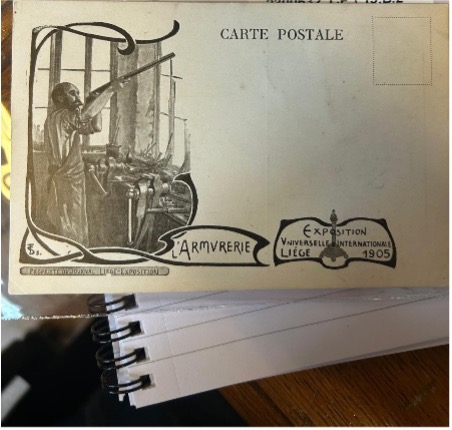
The 1905 Exhibition featured prominent local gunmakers on its promotional committee, leading to greatly romanticised depictions of artisan gunworkers on commemorative material, such as stamps and postcards. In contrast, at the 1910 Exhibition, photographs of the artisan gunworker in his working environment were used to demonstrate the harshness of domestic industry. Neither depiction demonstrated the complete ‘truth’ of the gunworkers’ conditions in Liège. He (and indeed, it was only men who were included in the term gunworker or armurier) was both a toiling precarious worker and a well-respected master of his craft.
The most value from this research bursary was derived from my three days at the IISH, where I discovered a range of relevant Belgian newspapers, pamphlets, and printed works. I discovered, for instance, that one of the Liège Anarchists tried in 1892 was a gunworker by trade. The sources here formed a perfect complement to those I had found in Birmingham, including: reports of labour conflict, speeches from delegations of gunworkers, and external critiques of arms industry workers.
My research, through the sources found here and in Birmingham, suggests that gunworkers willingly chose moderation in their approach to labour conflict, as part of attempts to maintain their craft status rather than abandoning ‘craft consciousness’ and becoming militant proletarians. My findings suggest that gunworkers are an exception to prevailing research on skilled workers and mechanisation. I’d like to, once again, express my gratitude to the SSLH for enabling me to pursue this research.
Isaac Stephenson is undertaking an MSt History (Modern European History) at Corpus Christi College, University of Oxford.
Find out more about the bursaries on offer from the Society for the Study of Labour History.
Discover more from Society for the Study of Labour History
Subscribe to get the latest posts sent to your email.
 Society for the Study of Labour History