Our annual review of labour history anniversaries, stepping back a quarter of a century each time, takes in the shifting legal framework for trade unions, the first legislation on sex discrimination and equal pay, and events that would lead to the General Strike. It starts, however, in 1775 with Thomas Paine, the author of The Rights of Man, and ends in 2000 with the Human Rights Act coming into force.
2000: 25 years ago: Human rights on the statute book
1975: 50 years ago: Equal pay and sex discrimination
1950: 75 years ago: Labour returned to office – just
1925: 100 years ago: ‘Red Friday’ for the miners
1900: 125 years ago: Labour Representation Committee
1875: 150 years ago: Disraeli decriminalizes union activities
1850: 175 years ago: The Red Republican and a Great Stink
1825: 200 years ago: Combination Act returns
1800: 225 years ago: William Pitt makes trade unions illegal
1775: 250 years ago: Thomas Paine in America
2000: 25 years ago: Human rights on the statute book
The Human Rights Act 1998 came into force on 2 October 2000, incorporating into UK law the rights contained in the European Convention on Human Rights. The convention had been drafted by a committee of the Council of Europe chaired by Conservative politician Sir David Maxwell-Fyfe after second world war, and the UK acceded to the Convention in March 1951. The 1998 Act had been promised in the previous year’s Labour manifesto. It protects a number of fundamental human rights, including: the right to life; freedom from torture; protection from slavery and forced labour; the right to liberty and security; the right to a fair trial and no punishment without law; the right to a private life; freedom of thought, belief and religion; freedom of expression; freedom of assembly and association; protection from discrimination; the right to free elections; and the abolition of the death penalty.
Also, The Labour Chancellor of the Exchequer Gordon Brown put an additional £2 billion into the NHS and £1 billion into education, with a pledge of more to come; the government published its NHS Plan 2000, promising an additional 7,500 more consultants, 2,000 GPs, 20,000 nurses and 6,500 therapists, with 7,000 more beds in hospital and intermediate care.
1975: 50 years ago: Equal pay and sex discrimination
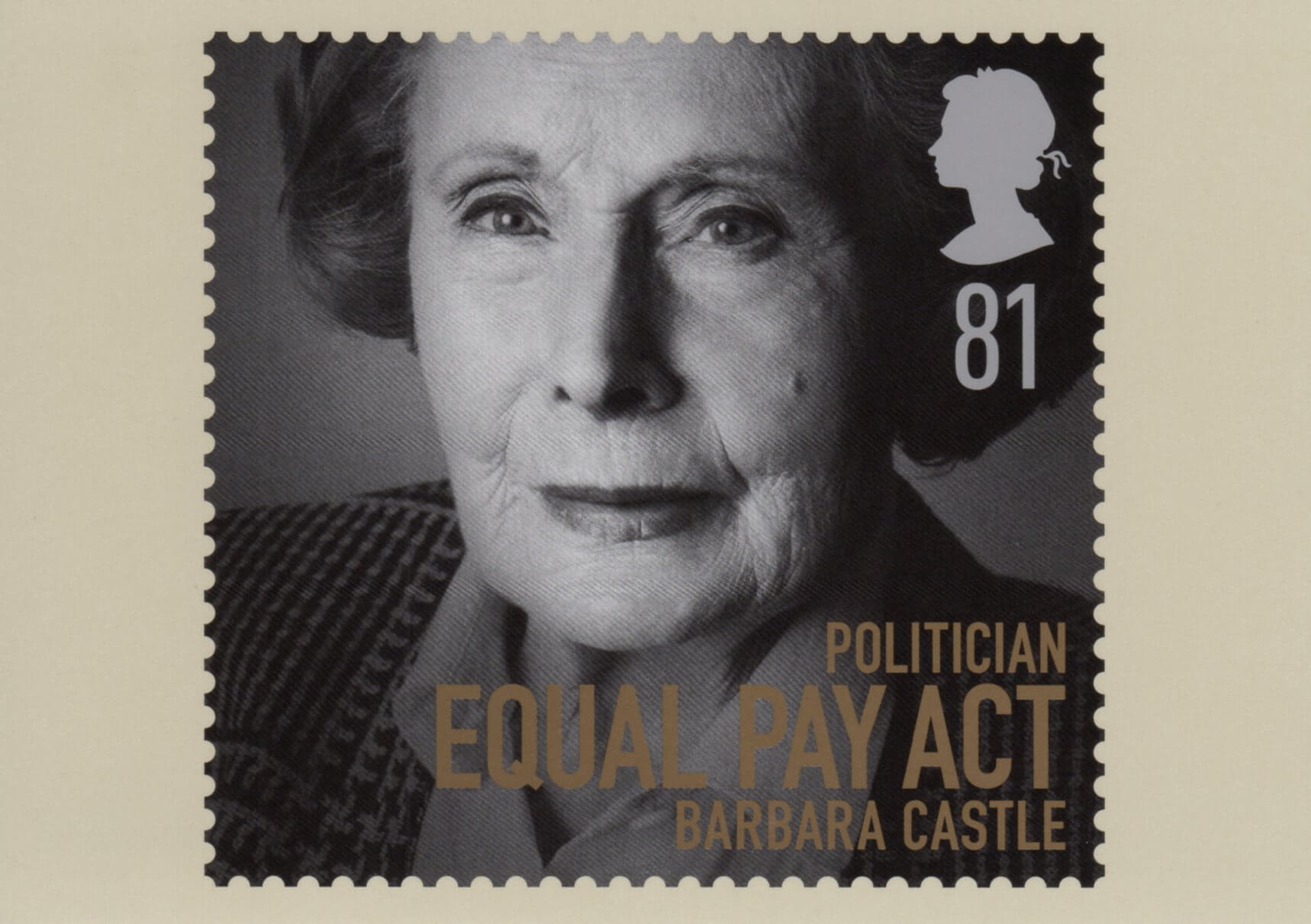
The Labour Government brought the Equal Pay Act 1970 into effect, outlawing differences in pay for men and women for like work, work rated as equivalent, and work of equal value. Legislation had been promised in Labour’s 1964 manifesto and was passed into law shortly before the 1970 general election, but not activated during the 1970-74 Conservative government. The Sex Discrimination Act 1975 widened the scope of discrimination law, outlawing discrimination on the grounds of sex or marital status. The Act covered employment, training, education, harassment, and the provision of goods and services. It also established the Equal Opportunities Commission, which was able to help individuals bring cases before the tribunals and courts. Both Acts came into effect on 29 December. At the time, Ronald Bell, QC, the Conservative MP for Beaconsfield, said that the law exposed Parliament to ridicule: ‘The good it will do will be microscopic and the harm will be immense’. The Guardian reported: ‘The areas covered by the Sex Discrimination Act have, in recent weeks, lent themselves to heavily jocular questions about persons (is Santa a man or a woman?). Dr Shirley Summerskill, Minister of State at the Home Office, was driven this month to protest that the Act had not been designed to be a magnet for grammatical trivia.’ The paper added that ‘a number of unions, particularly the white collar unions with a large membership of women are preparing to test cases which could, if taken up by the commission or legal process, radically alter present attitudes towards women at work’. The Low Pay Unit doubted that the new law on equal pay would do much for the poorest paid. As the BBC reported: ‘Despite the gradual introduction of equal pay until its final implementation today women’s earnings have risen to only 55.5% of men’s earnings from 51.1% in 1972.’ Both Acts (and other subsequent legislation) were repealed and subsumed by the Equality Act 2010.
Also, Denis Healey as Labour Chancellor of the Exchequer used his April budget to cap pay rises at £6 a week (or zero for those earning more than £8,500) in line with the government’s social contract with the TUC; inflation peaked at 26.9% in August before falling by half within a year; unemployment rose from 678,000 to 1,290,000 over the year.
1950: 75 years ago: Labour returned to office – just
The general election on 23 February saw the Labour Party, led by Clement Attlee, returned for a second term but with a much-reduced majority of just five seats – in contrast to the 146-seat overall majority of five years earlier. Following the devaluation of the pound and other measures the previous year, some opinion polls had put the Conservative Party ahead. Among the seats lost by Labour were Bexley in Kent (taken by a 33-year-old Edward Heath). Both seats held by the Communist Party fell to the Labour Party, marking the end of the CPGB’s presence in the House of Commons. This was the first general election after the abolition of plural voting, which had previously allowed business and shop owners an additional vote in the constituencies where their business was based, and graduates additional representation through twelve university constituencies. It also saw the introduction of postal voting, and for the first time, the BBC televised the count.
Also, the Iron and Steel Act 1949 came into effect with a commencement date of 23 October 1950 – the last major industry to be nationalized in the post-war period; petrol rationing came to an end after eleven years; India became a republic, severing its constitutional ties with the UK.
1925: 100 years ago: ‘Red Friday’ for the miners
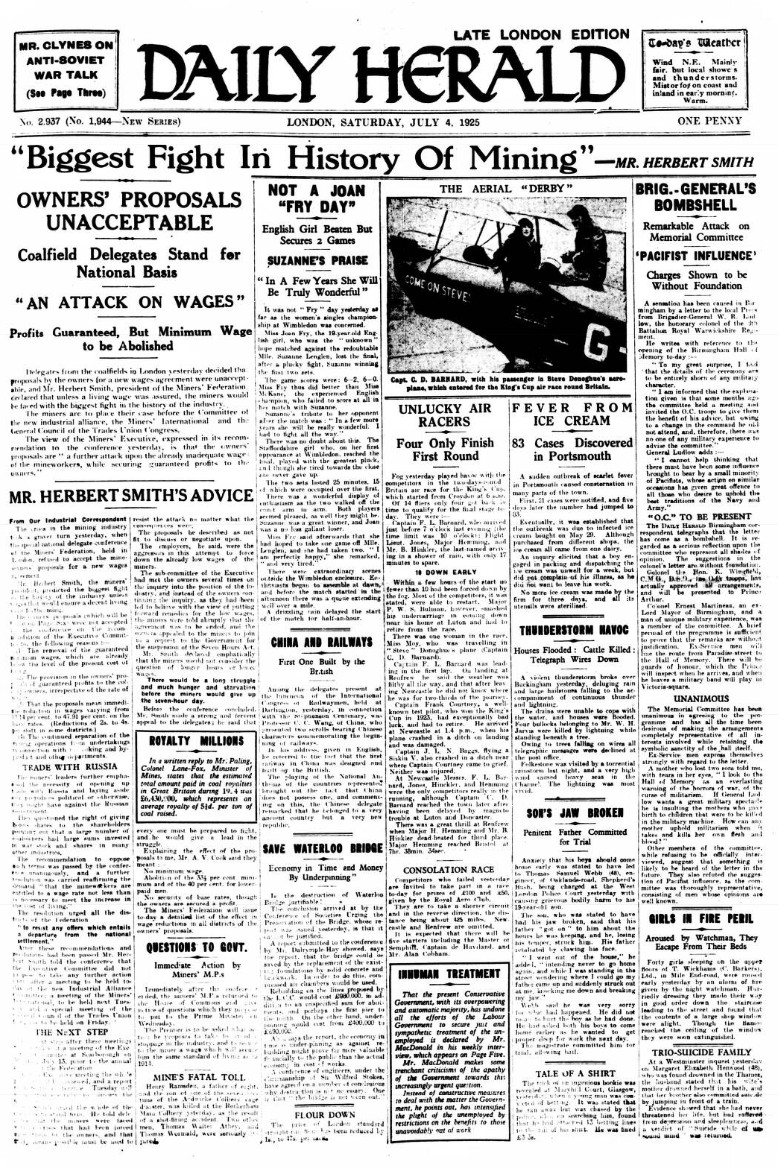
After the fall of the first Labour government at the end of 1924, Winston Churchill as the incoming Conservative Chancellor of the Exchequer returned Britain to the gold standard. This made UK exports prohibitively expensive for overseas buyers and hit the coal industry, now also facing competition from German producers, especially hard. Mine owners sought to maintain profits by cutting pay, with average weekly wages for miners having fallen from £6 to £3 18s since the end of the First World War. Faced with further cuts, the Miners’ Federation of Great Britain rejected the proposal and adopted the slogan ‘Not a penny off the pay, not a minute on the day’. When the Trades Union Congress resolved to support the miners, Stanley Baldwin’s Conservative government intervened, and on ‘Red Friday, at the start of July 1925, offered a nine-month wage subsidy while establishing a Royal Commission under Sir Herbert Samuel to conduct an inquiry into the industry’s problems. When the Samuel Commission issued its report the following year, the scene was set for the General Strike.
Also, the first TUC Women’s Conference took place at Leicester; Walter Citrine became acting general secretary of the TUC – he would be confirmed in post the following year and serve for a further twenty years; the Labour politician Tony Benn was born on 3 April.
1900: 125 years ago: Labour Representation Committee
The Labour Representation Committee (LRC) was formed at a conference in London sponsored by the Trades Union Congress. The LRC was to act outside Parliament as a coalition, with James Ramsay MacDonald as secretary, to sponsor candidates for the House of Commons. Among those taking part were the Independent Labour Party, Social Democratic Federation, Fabian Society, Fawcett Society and more than sixty trade unions. Keir Hardie and Richard Bell were to become the first MPs elected as LRC candidates in that year’s general election. Bell, the general secretary of the Amalgamated Society of Railway Servants, was elected in Derby; Hardie in Merthyr Tydfil.
Also, the Mines (Prohibition of Child Labour Underground) Act 1900 banned children under the age of thirteen from working underground – affecting an estimated 3,000 boys. On 22 November, 2,800 men at the Penrhyn slate quarry in Bethesda, Snowdonia, began a three-year-long strike.
1875: 150 years ago: Disraeli decriminalizes union activities
Benjamin Disraeli’s Conservative government embarked on a programme of social reform which included two Acts of Parliament which decriminalized the work of trade unions. The Conspiracy, and Protection of Property Act 1875 established that a trade union could not be prosecuted for an act which would be legal if conducted by an individual, and decriminalized activities such as picketing. This was buttressed by the Employers and Workmen Act 1875, which was intended to place both sides of industry on an equal footing by allowing all breaches of contract to be covered by civil rather than criminal law. Disraeli claimed, ‘We have settled the long and vexatious contest between capital and labour.’
Also, the Artisans’ and Labourers’ Dwellings Improvement Act 1875 gave local councils in large towns power to destroy slum buildings for sanitary reasons and replace them with new ones for artisans; new public health and factories acts consolidated previous legislation; Emma Paterson became the first woman delegate to the TUC, representing the women’s bookbinders’ and upholsterers’ unions formed the previous year at the Glasgow Congress.
1850: 175 years ago: The Red Republican and a Great Stink
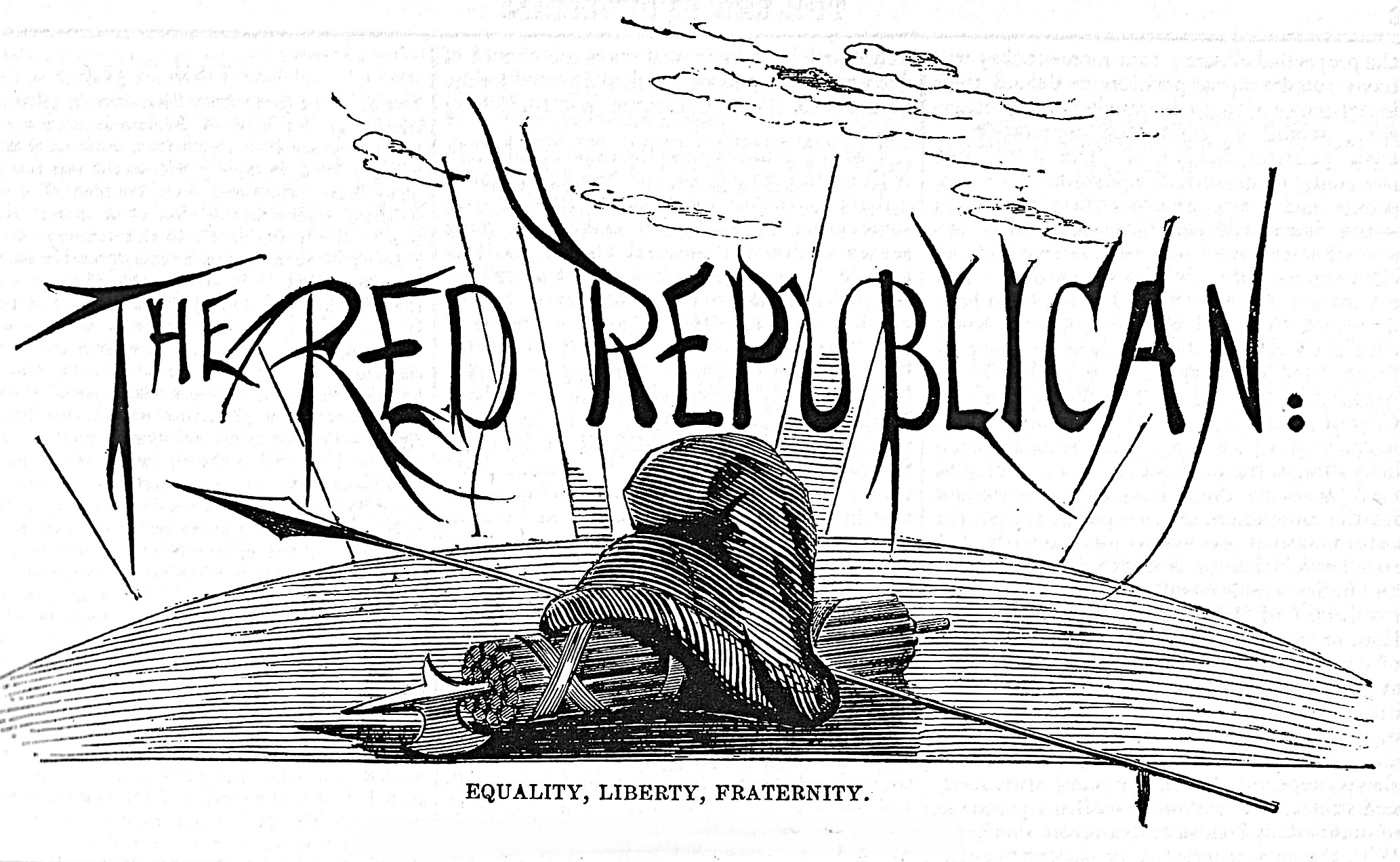
The Chartist journalist and activist George Julian Harney launched the Red Republican. Running from June to November that year, it published the first English translation, by Helen MacFarlane (writing under the name Harold Morton), of the Communist Manifesto of 1848. The paper gave over significant space to covering industrial matters from a left perspective. However, with many newspaper vendors taking fright at the paper’s provocative title, Harney was forced to relaunch it as The Friend of the People before the end of the year.
Also, John Cleave, a leading London radical publisher, veteran of the ‘war of the unstamped’ press, and founder member of the National Union of the Working Classes, died on 19 January aged 55. The Great Stink of July/August drew the attention of MPs to the sanitary problems of the capital.
1825: 200 years ago: Combination Act returns
The Combinations of Workmen Act 1825 reimposed criminal sanctions for picketing and other union activities, just a year after they had been repealed. The new legislation was, however, less draconian than that which had governed trade unions before 1824. The 1825 Act reinstated the crime of conspiracy except, importantly, for combination on wages or hours. Workers were liable to prosecution, most commonly for ‘intimidation’ within the workplace or when picketing outside, but also for the vaguer offences of ‘molesting’ or ‘obstructing’.
Also, the Cotton Mills Regulation Act 1825 limited children under the age of sixteen years to a twelve-hour working day between 5am and 8pm with half an hour off for breakfast and one hour off for lunch.
1800: 225 years ago: William Pitt makes trade unions illegal
Just a year after William Pitt’s government extended the reach of the legal ban on trade unions, a second Combination Act of 1800 made it illegal for workers to form any combination ‘for obtaining an Advance of wages […] or for lessening […] their Hours of working’. Although intended in part to prevent the spread of revolutionary ideas from France, the historian E.P. Thompson would later declare (in The Making of the English Working Class, 1963) that the legislation ‘served only to bring illegal Jacobin and trade union strands closer together’.
Also, William Lovett, secretary of the London Working Men’s Association, author of the People’s Charter, was born on 8 May.
1775: 250 years ago: Thomas Paine in America
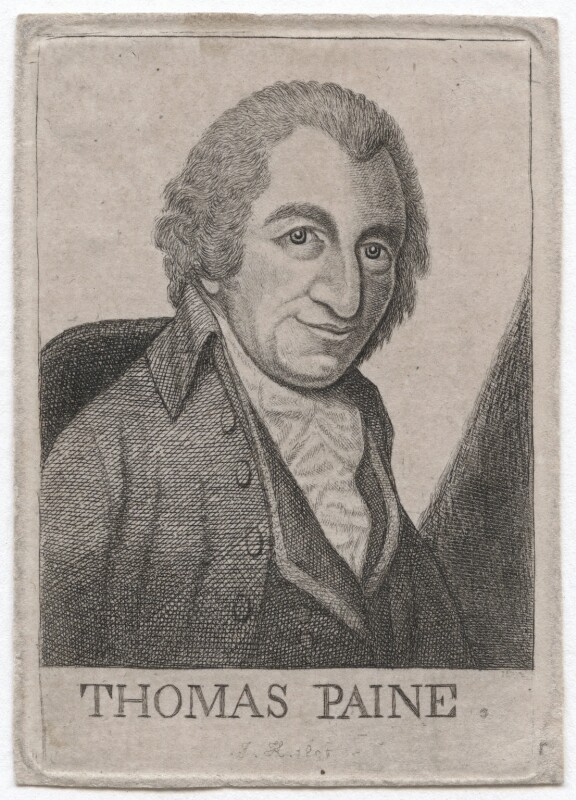
The Norfolk-born radical thinker and activist Thomas Paine began his political career in America, becoming editor of the Pennsylvania Magazine soon after his arrival from England. In the paper’s issue of 8 March, Paine published an essay titled African Slavery in America, which attacked slavery as an ‘execrable commerce’ and ‘outrage against Humanity and Justice’. Paine deliberately spoke to a broader and more working-class audience, using the magazine to discuss workers’ rights, and adopting a strong political perspective that appealed to readers. He would soon become a leading intellectual figure in the American Revolution, publishing the influential pamphlet Common Sense in 1776. Paine maintained his political involvement for the remainder of his life, and he was a significant figure during the French Revolution. Generations of British radicals revered Paine especially for his later works The Rights of Man and The Age of Reason.
Further reading
The Human Rights Act (and the UK’s adherence to the European Convention on Human Rights) remain politically contentious. The full text of the UK Act can be found on the legislation.gov.uk website. Amnesty International offers a series of resources focus on Human Rights in the UK. The Act has the support of the current Labour government – the party’s 2024 general election manifesto promising that ‘Britain will unequivocally remain a member of the European Convention on Human Rights’; but in 2022, the previous Conservative government had set out plans to replace the Human Rights Act with a ‘modern bill of rights’, and the possibility of withdrawal from the convention has been raised by a number of Tory politicians.
Journalist Lindsay Mackie’s report Equal pay act – with strings, (The Guardian, 29 December 1975) can be found on the paper’s website.
The 1950 Labour government was relatively shortlived, falling at a further general election twenty months later, and is generally included in histories of the post-war or Attlee governments covering the period from 1945-51 as a whole. The National Archives includes a selection of posters, leaflets and other documents on Attlee’s Britain 1945-1951 in its online education resources. Recent books covering the period include Richard Toye’s Age of Hope: Labour, 1945, and the Birth of Modern Britain (Bloomsbury Continuum, 2023); and Nick Thomas-Symonds’ Attlee: A Life in Politics (Bloomsbury Academic, 2nd ed. 2023) and NYE: The Political Life of Aneurin Bevan (Bloomsbury Academic. 2024).
‘Red Friday’ and events of 1925 are generally discussed in hindsight as part of the build-up to the General Strike of 1926. There are numerous older books, now generally out of print, covering these events, including Robin Page Arnot’s General Strike, May 1926: Its Origin and History (1926). David Brandon’s The General Strike 1926: A New History (Pen and Sword Transport, 2023) deals with the background to the strike, and it seems likely there will be more books on the subject as the centenary of the strike approaches.
The official Report of the Conference on Labour Representation (in effect, the minutes of the event, published in 1900) can be found on the University of Central Lancashire website. The report includes a list of delegates and the organisations represented.
There are numerous histories of trade unionism. One of the few that confidently spans the period from the imposition of the Combination Acts in the 1790s to the further imposition of restrictions on trade unions by the governments of Margaret Thatcher in the 1980s is Keith Laybourn’s A History of British Trade Unionism (Stroud: Sutton Publishing, 1992) which tells the story of trade unions from the 1770s to the end of the 1980s for a generalist reader.
Three hundred years of strikes: contours, legal frameworks, and tactics by Dave Lyddon is a long-term overview that gives both an overview of the continuities and breaks in UK industrial relations in the modern era and numerous examples of strikes and their place in the broader pattern of events. It is open access.
In Early Trade Unionism (Routledge, 2000), the late Malcolm Chase uncovered a history of trade unionism in the late eighteenth and early nineteenth century that his often overlooked. With an emphasis on trade union mentality and ideology, rather than on institutional history, the book provides a critical focus on the politics of gender, on the demarcation of skill and on the role of the state in labour issues.
Thomas Paine’s own writings have long been out of copyright, and there are numerous editions of his work available. In 2022, the Society for the Study of Labour History supported publication by Paul Fitzgerald (Polyp) of the graphic book PAINE: A Fantastical Visual Biography.
See also
- Ten labour history anniversaries in 2024
- Eight labour history anniversaries in 2023
- Seven labour history anniversaries in 2022
Discover more from Society for the Study of Labour History
Subscribe to get the latest posts sent to your email.

