This year has seen a flurry of events, broadcasts, and publications marking the centenary of the 1926 General Strike. Amongst all the books and articles published, one powerful account of 1926 is in danger of being overlooked or forgotten. Mike Mecham recounts Idris Davies’s ‘The Angry Summer: a poem of 1926’.
I was introduced to Idris Davies, like many others I suspect, by the American folk singer and political activist Pete Seeger and his setting of one stanza from Davies’s poem sequence, ‘Gwalia Deserta’ (meaning ‘Wales, a Wasteland’). The power of the stanza comes from its outwardly simple lines which follow the pattern of the old nursery rhyme, ‘Oranges and Lemons’. Published in 1938, it is another extended poetical work. The verses it contains were inspired partly by such mining disasters as that at Marine Colliery at Cwm near Ebbw Vale in 1927, and by the failure of the 1926 UK General Strike, the Great Depression and their combined effects on the South Wales valleys. Seeger called his song, ‘The Bells of Rhymney’ and it has since been recorded by countless singers and groups, including Bob Dylan, The Byrds, Judy Collins and even Cher. Perhaps it was no coincidence that the Welsh rock band The Alarm chose to give it an acoustic airing on Channel 4’s ‘The Tube’ in November 1984 during the 1984-1985 miners strike.
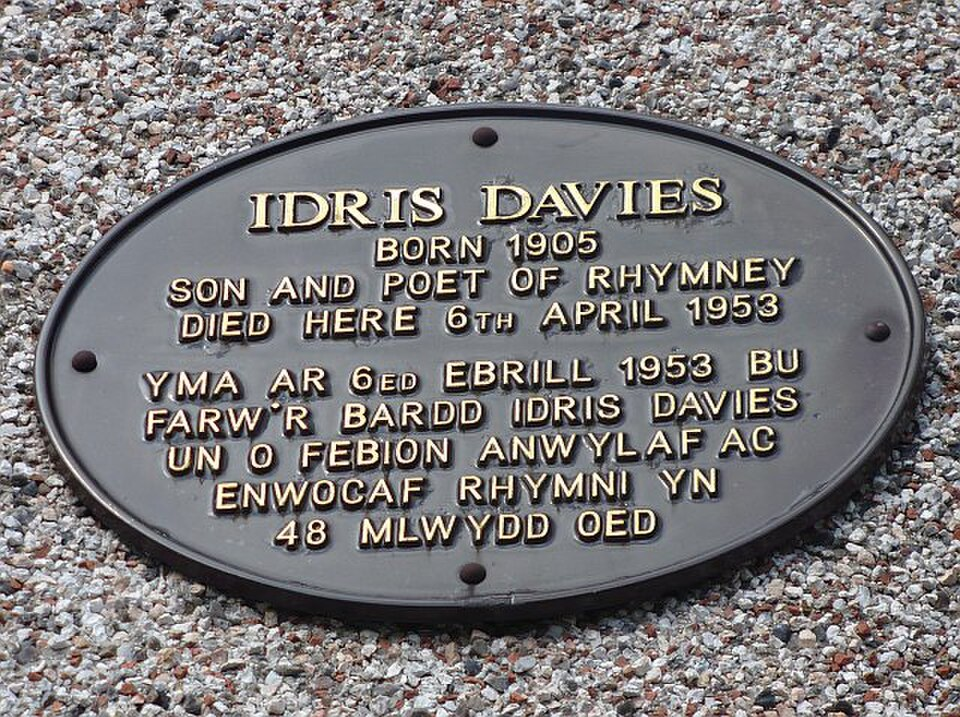
Idris Davies was born in the town of Rhymney in 1905 and died there, aged forty-eight, from abdominal cancer in 1953. Originally writing in Welsh he later wrote principally in English. After leaving school at fourteen, he spent seven years at the coalface until a serious accident underground in 1925. After years of fitful employment and study, he qualified as a teacher in 1932 and came to London. He returned to teaching in the Rhymney Valley in 1947 until the onset of his abdominal cancer in 1951. He is buried in Rhymney and memorialized there.
One of the most prominent supporters of the poet’s work is Lord Neil Kinnock, former leader of the Labour Party. He tells how he would give world leaders he met a copy of Idris Davies’s collected poems. Kinnock wanted them, he says, “to learn about resilience and hope, courage and cynicism, fun and ferocious values in the way that the man from Rhymney taught of these things.”
Lord Neil Kinnock on Idris Davies
‘The Angry Summer’ was written after the event and published by T. S, Eliot through Faber and Faber in 1943. The fifty sections are not uniform but vary in form, structure and length. They can therefore be considered a collection of poems although Idris Davis describes them in the singular as ‘a poem of 1926’. The opening section begins in hope and expectation, a common sentiment at the onset of the strike:
Now it is May in the minds of men,
Days for vision and for marching,
Days for banners and for music,
And beauty born of sacrifice.
There is an echo here of W. B. Yeats great poem of the Irish uprising, ‘Easter, 1916’, with its piercing repeated line: ‘A terrible beauty is born.’ Davies was a great admirer of Yeats, his ‘hero’ he said, and wrote about him in poetry and prose. However, ‘The Angry Summer’ also ends, after the seeming failure of the General Strike, with a sense of hope:
But the battle’s end is not defeat
To that dream that divided the broken feet
And roused to beauty and to pride
Toiler and toiler, side by side,
Whose faith and courage shall be told
In blaze of scarlet and of gold.
Along the way, the poem reads like a socialist ‘Under Milk Wood’ with its array of vivid and colourful characters such as Dan the Grocer, Dai and John, the ‘dropsical’ and cheating employer Viscount Bag, Mrs. Evans, Shinkin Rees the little tailor. But the intent is deadly serious as it recounts the struggles and deprivations of the miners and their families. None more so than in the central figure of Dai, who embodies the spirit of the miners and their communities in the poem as well as in ‘Gwalia Deserta’:
What will you do for your butter, Dai,
And your bread and your cheese and your fags,
And how will you pay for a dress for the wife,
And shall your children go in rags?
Lord Kinnock reflects:
’The Angry Summer’ is a marvellous, epic mixture of poetry ranging from fierce rage to lyrical soothing, with irony, nobility, cowardice and humour probing and exposing in between. The personal pain that 1926 inflicted was remembered by millions, including my collier, father, nineteen at the time, and four of his brothers. They worked and fought to ensure that the conditions which caused and followed it never returned. The best memorial that later generations could therefore have offered to 1926 was that the gradual progress after 1945 was perpetual. Instead, acceptance of poverty, fear, impotence, inequality, ignorance and exploitation began to seep back in again and are with us now. They always will be unless people show the stubborn collective valour of 1926 and use the power of determined democracy to eradicate their miserable dominion and emancipate every individual. Idris would like that.
Mike Mecham
I am grateful to Lord Kinnock for his generosity in assisting in the preparation of this piece and for his contribution. His excellent 2015 Radio 4 profile of Idris Davies can be accessed here.
Additional resources:
The Collected Poems of Idris Davies, edited by his friend Islwyn Jenkins (Llandsul: Gomer Press, 2003 – first published in 1972) is still in print. Jenkins also produced the only biography in a personal memoir of the poet, Idris Davies of Rhymney (Llandysul: Gomer Press, 1986) which is sadly now out of print.
Idris Davies, poet of the Depression
Discover more from Society for the Study of Labour History
Subscribe to get the latest posts sent to your email.

