Michael Herbert (ed.), “M.A.L” The Journalism and Writing of Madeline Alberta Linford, self-published through Lulu.com and available here, 2024, p/b, pp. 540, £15.99, ISBN 978 14452 05465
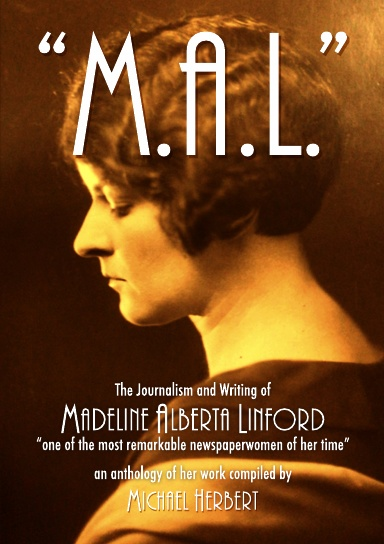
Madeline Linford (1895-1975) was a pioneer. She was the first woman on the editorial staff of the Manchester Guardian and edited the first women’s page for the paper from 1922 to 1939. (‘Women’s World’ columns, often merely sops to advertisers, had been common in the provincial press from the 1890s.) She worked as a picture editor in the 1940s, and was then editor of the ‘Backpage’ opinion column until she retired in 1953. Michael Herbert is the man behind the Red Flag Walks website, and has been researching, writing and teaching the history of Manchester’s radical women for many years. He has written Up Then Brave Women: Manchester’s Radical Women 1819-1918 (2012) and “For the sake of the women who are to come after”: Manchester’s Radical Women 1915 to 1945 (2019). The book noted here is a carefully edited anthology of Madeline Linford’s journalism from the whole length of her writing career from 1916 to 1965 supplemented by a collection of her short stories, reviews of her novels and her biography of Mary Wollstonecraft, and, finally, her obituary from the Guardian of 1975.
This is a huge book covering a huge range of topics and I won’t pretend I’ve done anything more than sample it. Linford was sent on a mission to Austria and Poland with the Society of Friends Relief Mission in 1919-20 and returned to Poland in 1921. Her reports describe the privations suffered by the civilian populations, devastated by food shortages and a rampant epidemic of typhus vividly and with compassion. Her writing becomes more fluent as the months pass by. She offers much insight into the havoc created in the Polish countryside by the Russian Red Army. It was these reports that got her noticed by the Guardian’s editorial staff but she never became a fully-fledged foreign editor or a war reporter.
Her work for her women’s page covered everything from ‘spring cleaning, the Manchester sales, [to] the dress of the Victorian child’ (349), and reviews of theatre, films, and books. The book reviews (I’ve not looked at the film and theatre reviews) are well written and review a lot of the fiction and general non-fiction that is now still virtually unknown but is gradually being rediscovered. I was delighted, for quite different reasons, to read reviews of books by Leonora Eyles (1889-1960), previously unknown to me, a single mother who worked in Woolwich Arsenal in the First World War; and of a 1927 etiquette book written for people who ‘count’ which we are told would be just right for Mister Salteena.
While the editor has had to publish this book himself, it has been carefully proof-read (I only saw one typo in all the pages I scanned) and professionally produced. It has a forty-page introduction which takes the form of an illustrated biography of Linford. Regrettably, it has no index. At £15.99 it is remarkably cheap (unless –don’t do this!– you go to Amazon who will charge you £26.60.) I recommend it.
Quentin Outram is Secretary of the Society for the Study of Labour History.
Discover more from Society for the Study of Labour History
Subscribe to get the latest posts sent to your email.
 Society for the Study of Labour History