This fine rosette carries at its centre the badge of the Dock, Wharf, Riverside and General Workers’ Union. Originating as the Tea Operatives and General Labourers’ Association in 1887, the union played a central role in the London dock strike two years later, becoming that same year the Dock, Wharf, Riverside and General Labourers’ Union of Great Britain.
The rosette and badge shown here, however, can be dated to some time between 1899, when the union substituted ‘workers’ for ‘labourers’ in its name, and 1922, when under its long-serving general secretary Ben Tillett it led the formation of the Transport and General Workers’ Union in a complex fourteen-union amalgamation.

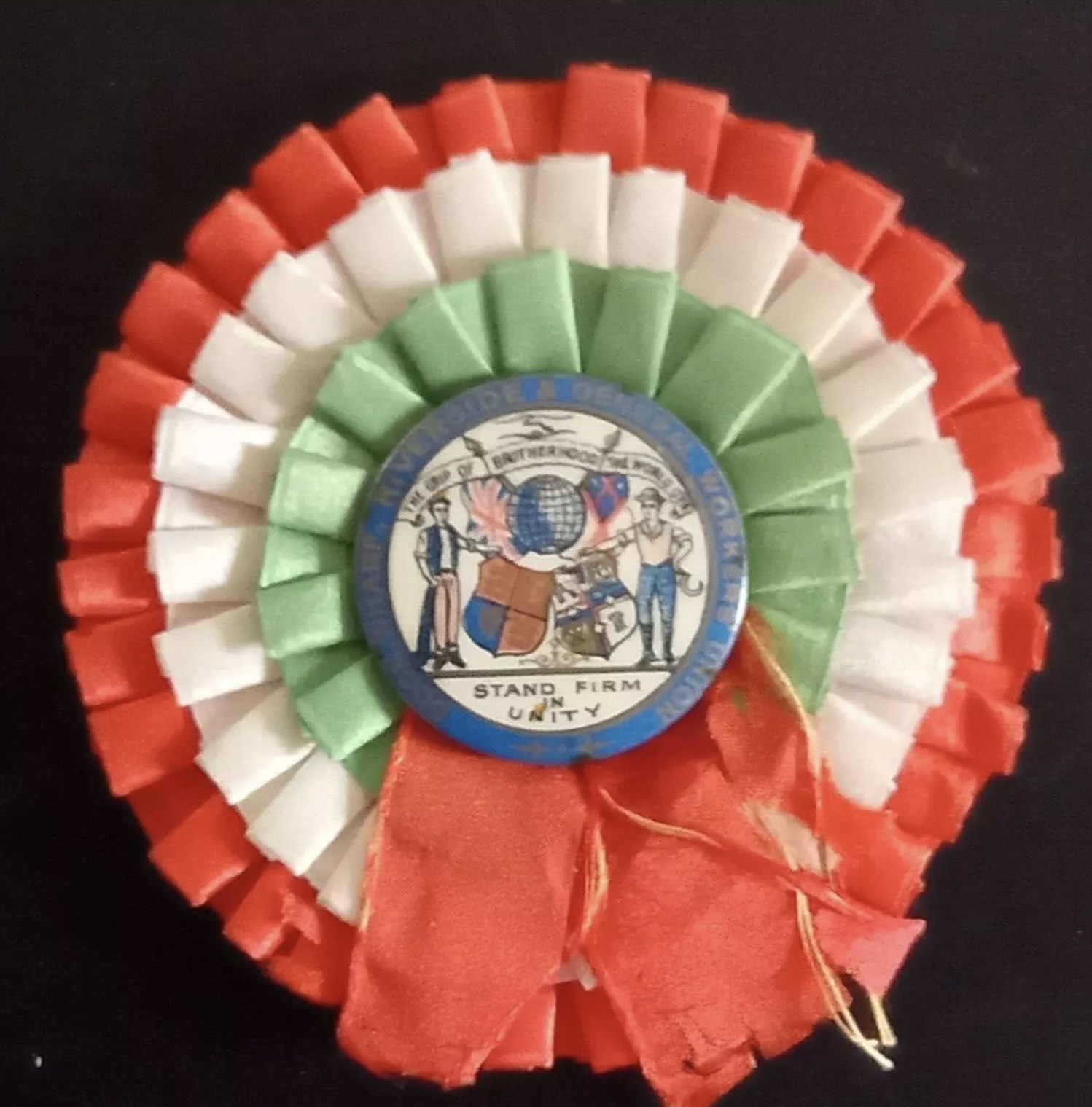

The colours of the rosette hark back to the red, white and green tricolour first used at the Spa Fields meetings in London addressed by the radical leader Henry Hunt in 1816, and later adopted by the Chartist movement. Of equal interest, however, is the manufacturer’s label on the reverse. Tutill’s was the largest and most influential manufacturer of trade union banners in the latter part of the nineteenth century and into the early twentieth century, and there are numerous surviving examples of the company’s work in museums – and in trade union offices.
The national trade union banner collection can be found in People’s History Museum in Manchester. Visit the 2024 banner exhibition.
The archives of the Dock, Wharf, Riverside and General Workers’ Union of Great Britain and Ireland can be found in the Modern Records Centre at the University of Warwick. The Labour History Archive and Study Centre, Manchester, and the TUC Library at London Metropolitan University also hold printed material relating to the union.
At the time of writing, the rosette is for sale on eBay.
Discover more from Society for the Study of Labour History
Subscribe to get the latest posts sent to your email.
 Society for the Study of Labour History