Labour’s policy document offers a radical programme for government, and presents it in persuasive language and an attractive package. But Mark Crail wonders whether anyone can put a firm date on it.
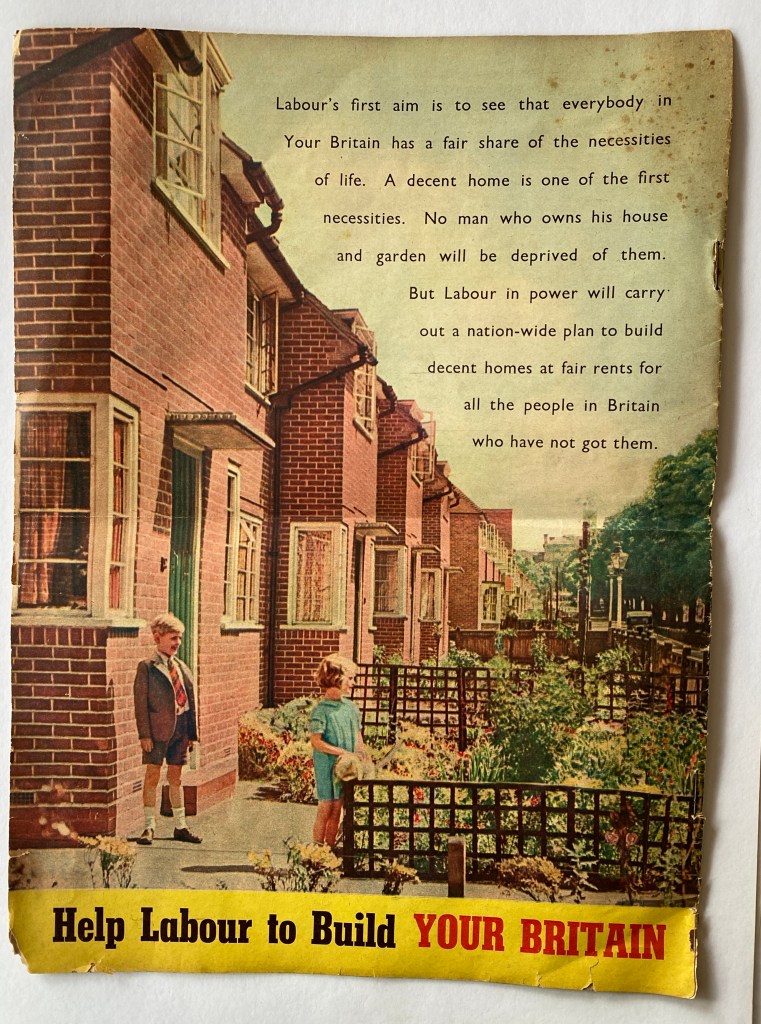
‘A Labour Council has built this pleasant estate of happy homes for the people,’ declares the caption on the front of this vintage Labour Party magazine. Printed in bright colours, and with its smiling nuclear family in the front garden of a brand new suburban housing estate, this cheerful and uplifting publication could easily be mistaken for something from the 1950s.

A closer look inside at the policies it outlines, however, reveals that this must have been a pre-war publication. Aimed at explaining the party’s policies in the run-up to a general election. Something from the 1930s – but when exactly? The magazine is completely undated, so I am wondering if anyone can pin it down more precisely.
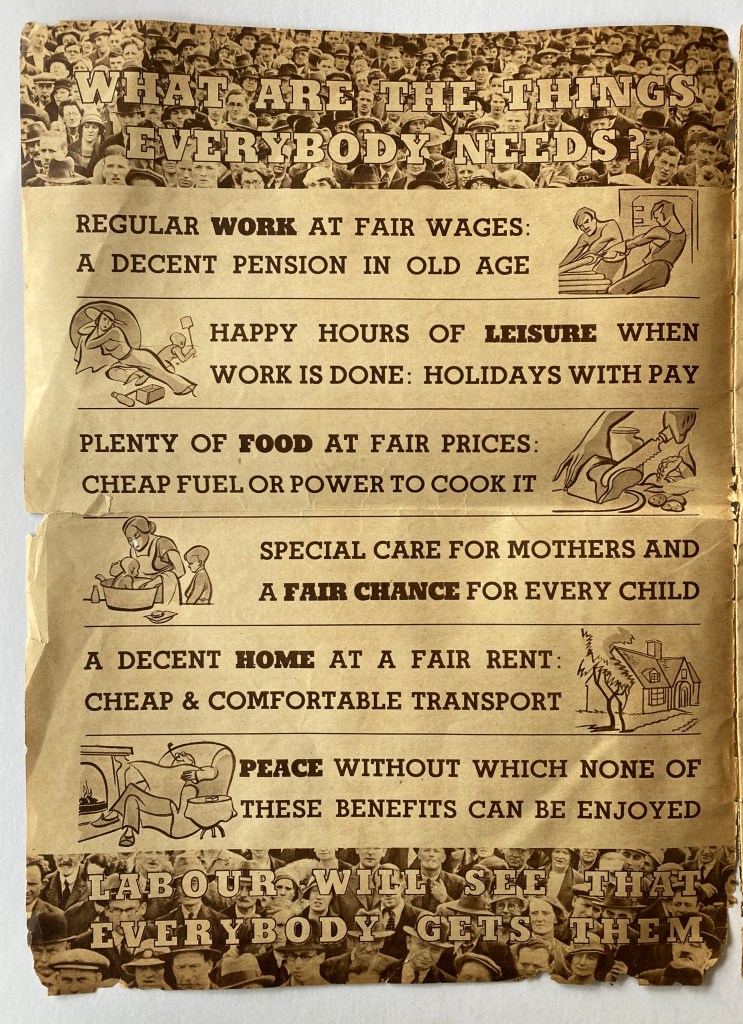
Move beyond the front cover, and the sixteen-page magazine begins with a snappy programme of the six ‘things everybody needs’ and how ‘Labour will see that everybody gets them’. Setting out a list that could equally well apply today, it lists:
- Regular work at fair wages: a decent pension in old age
- Happy hours or leisure when work is done: holidays with pay
- Plenty of food at fair prices: cheap fuel or power to cook it
- Special care for mothers and a fair chance for every child
- A decent home at a fair rent: cheap & comfortable transport
- Peace without which none of these benefits can be enjoyed
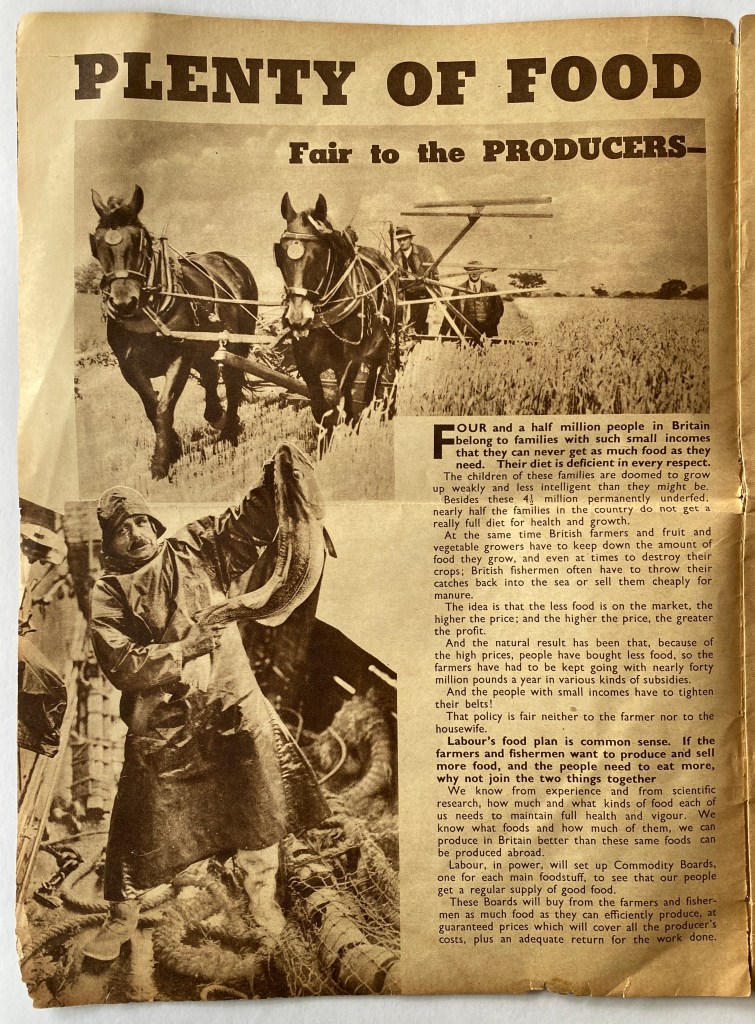
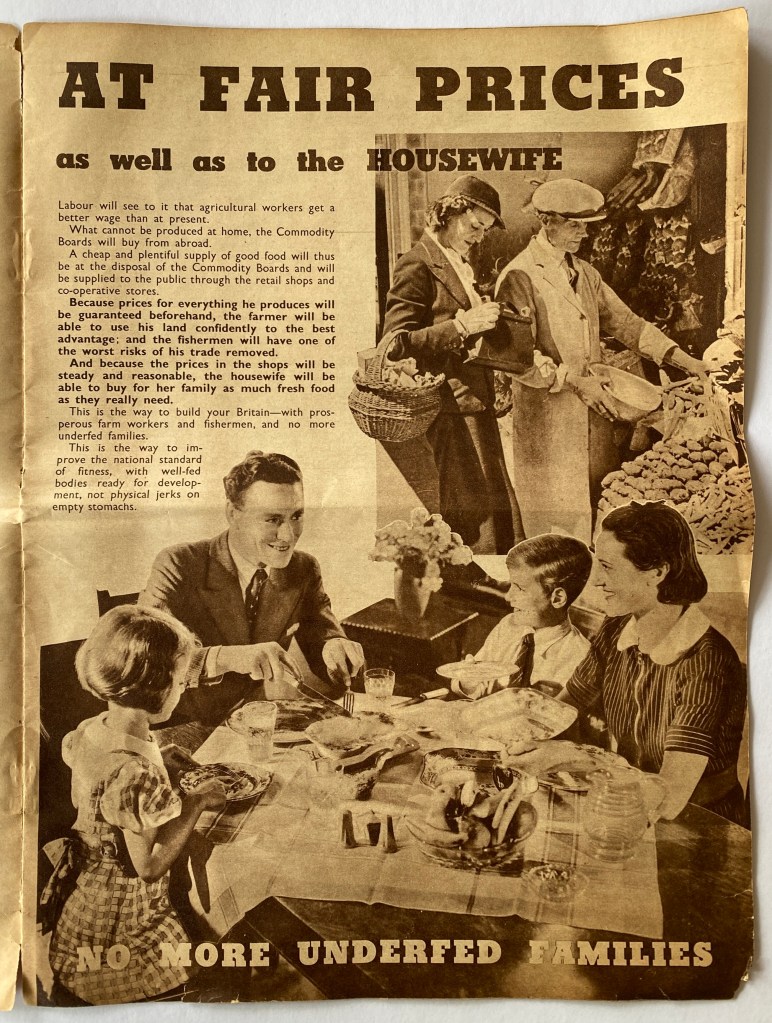
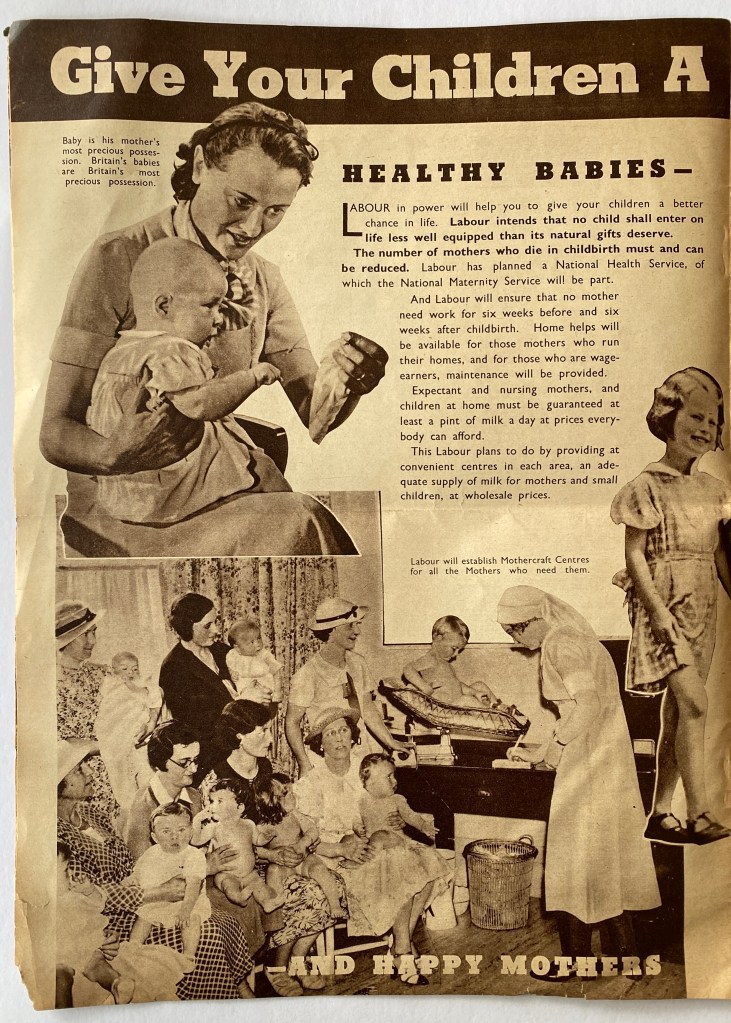
It then goes on to talk about Labour’s commitment to strengthen the League of Nations as a means of securing a permanent peace, its plans to set up ‘commodities boards’ to ensure everyone can buy enough of the right kinds of food at affordable prices, its promise of a National Maternity Service within a new National Health Service, and its proposal to limit class sizes while raising the school leaving age to sixteen.
All of these policies, and others set out in the document, mean that it cannot have been published in the 1950s (by which time the NHS was already in existence), or even for the general election of 1945 (by which time its peace proposals would have been ludicrously out of date). But while the programme is broadly consistent with the Labour Party election manifesto of 1935, there do appear to be real differences between the policies in this magazine and what was then on offer to voters.
In the normal course of events, the 1935 general election should have been followed by another no later than 1940. But war intervened and there was no further election for a decade. I wonder whether this document might have been drawn up, and even found its way to the public, in the late 1930s in anticipation of that general election that never was.
Download the full document in PDF format – or view images of all pages below.
If you know when Your Britain was published, or can spot further clues in the text, please email us and we will add your answer below. Send email.


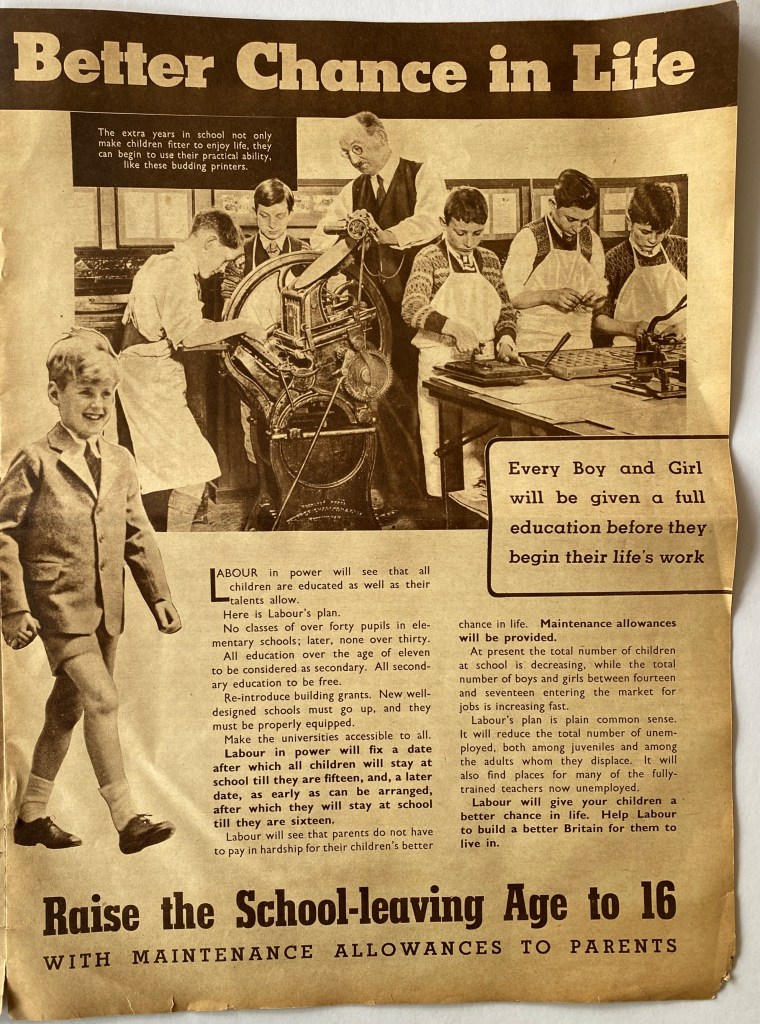
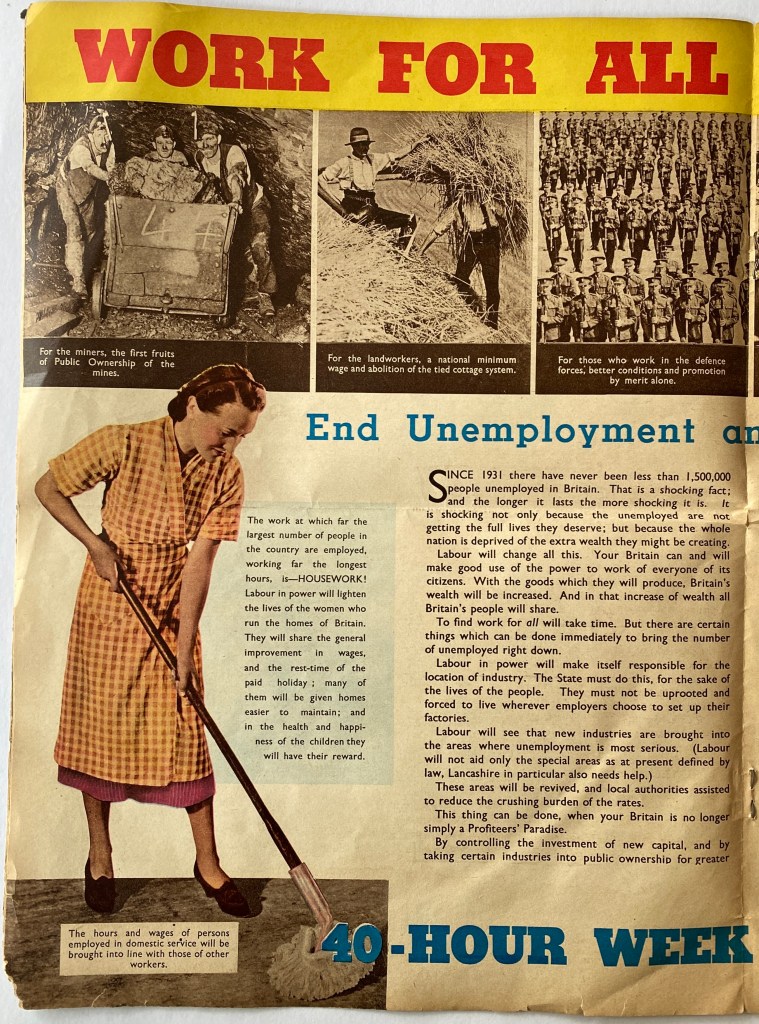

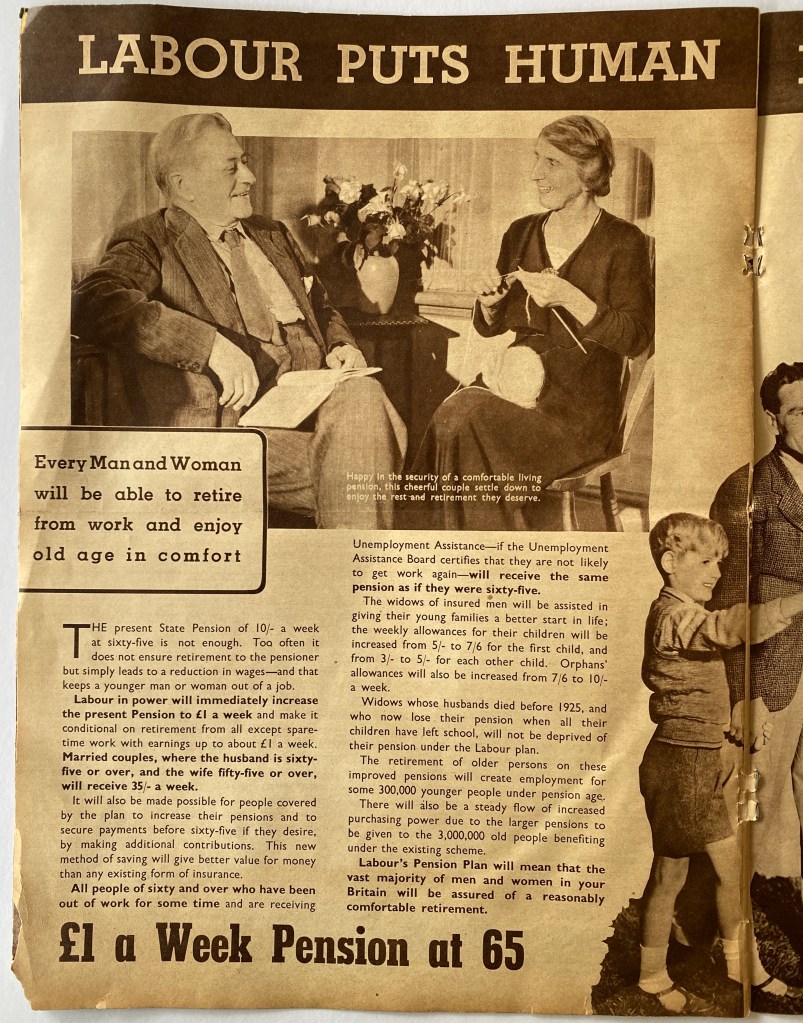
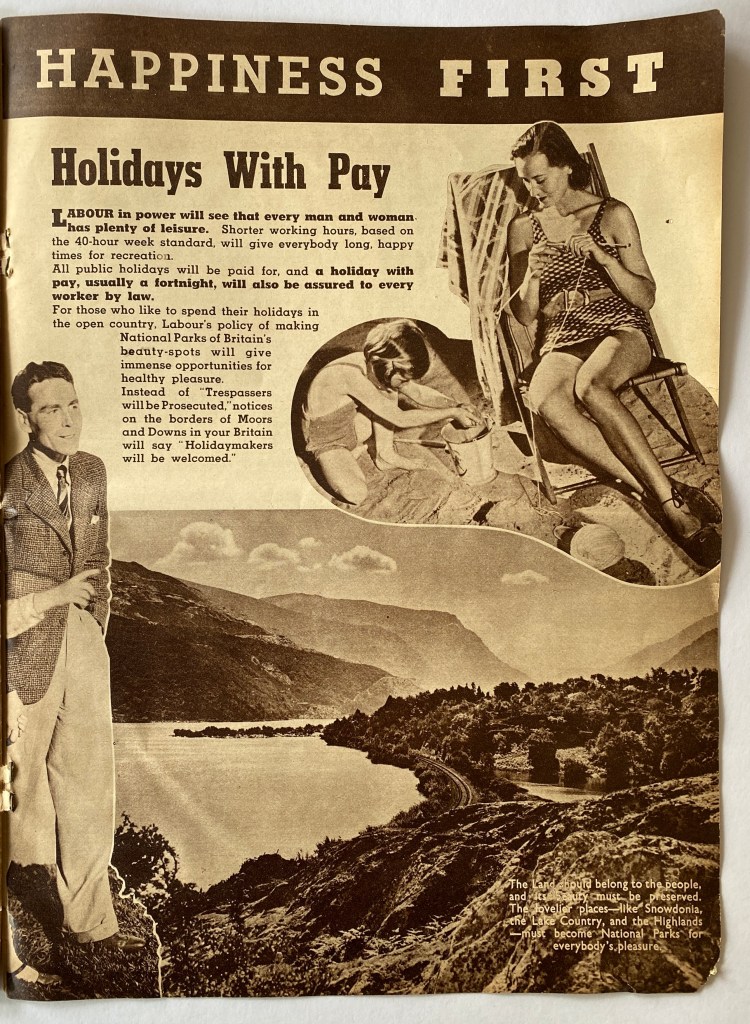


Chas Townley responds to the challenge…
The trick in dating documents is to try to position them in time from other sources. Your Britain can be no later than September 1939 and certainly no earlier than October 1937 and would have been in preparation for the expected General Election due no later than November 1940 – which like the similar election in 1915 was delayed for the duration of the war.
The most evocative and datable photograph is the photo of aerial bombing on page 3 which is most likely inspired by the bombing of Guernica, which took place on 26 April 1937. This is probably a photomontage of three images. I cannot trace the photo of the bombed-out building – but buildings similarly damaged by this Nazi atrocity, in support of Franco, can be found very readily on the internet.
There is an interesting article in Reynolds News (then owned by Co-op Press) on 14 March 1937 p10 which poses the question ‘Can Labour Win?’, it also provides an interesting commentary on the development of party propaganda and crediting the London and Arsenal Co-ops as being the leaders of this:
‘It is to the credit of the London and Royal Arsenal Co-operative Political Committees that they were the first to perceive how, in an age when public meetings, at street corners or elsewhere, could no longer be always depended upon to get propaganda over to the mass of the population, very much could be done through the mass distribution, every month over a period of years, of well-produced and amply-illustrated broadsheets, featuring local as well as national topics and attaining to the technical standards set by the popular newspapers of the day.’
Whilst Your Britain is a more general publication it is clearly well produced, including the use of a good colour image on the front. There are plenty of ‘word search bingo’ opportunities within this document. For example, page 3 promotes the adoption of the ‘International Air Force Police’ and certainly Clem Attlee is reported talking of this in November 1939, but the expression had been advocated from a number of sources during the mid to late 1930s
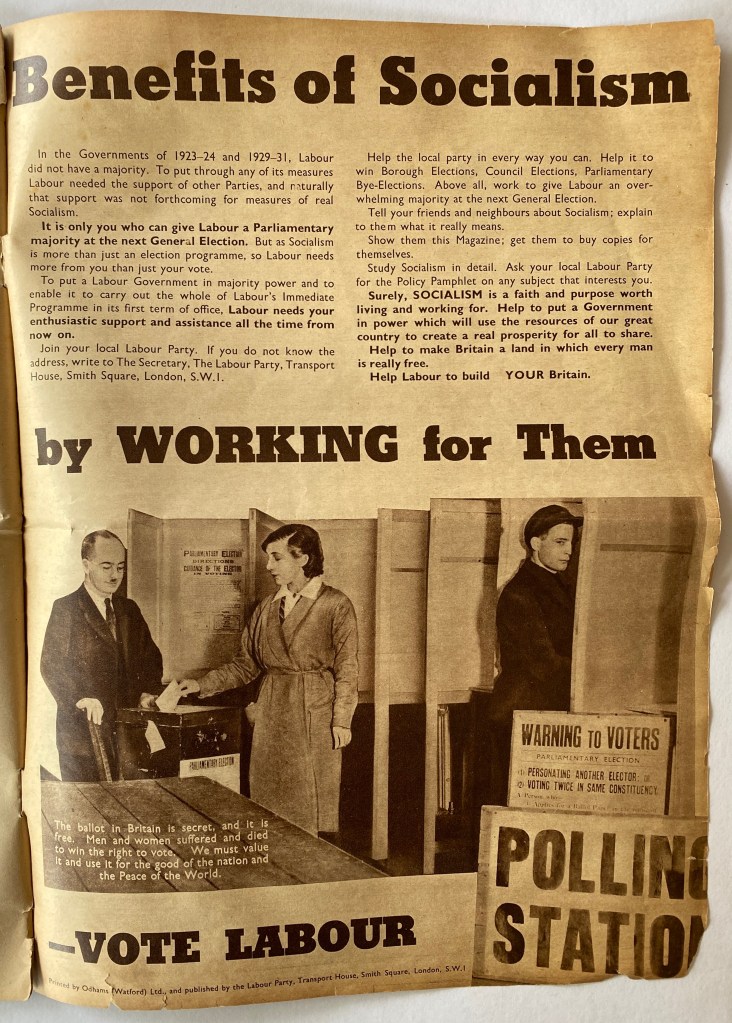
Perhaps the most telling phrases is ‘Labour’s Immediate Programme’ used on page 14. This was a policy document approved by Labour’s NEC on 24 February 1937 and subsequently approved at the Labour Conference held at Bournemouth in October 1937. The Herald report of the 25 February 1937 (p2) concludes by noting, “The appointment of full-time Party officer, to secure the largest possible distribution and sale of Party literature, was also approved.” Perhaps an indication that the Your Britain was the outcome of this new approach.
The Hull Daily Mail on 8 March 1937 (p6) reports it as a ‘10 point policy launched’ adding:
‘Dr. Hugh Dalton MP speaking with Mr. Attlee, the Leader of the Parliamentary Labour Party at Cambridge on Saturday, said; We are endeavouring this year to possess the mind of the Labour Party with positive, practical ideas —to get rid of negative stuff and of useless doctrinaire disputations. We are endeavouring instead come down to practical programme and arouse interest in it.’
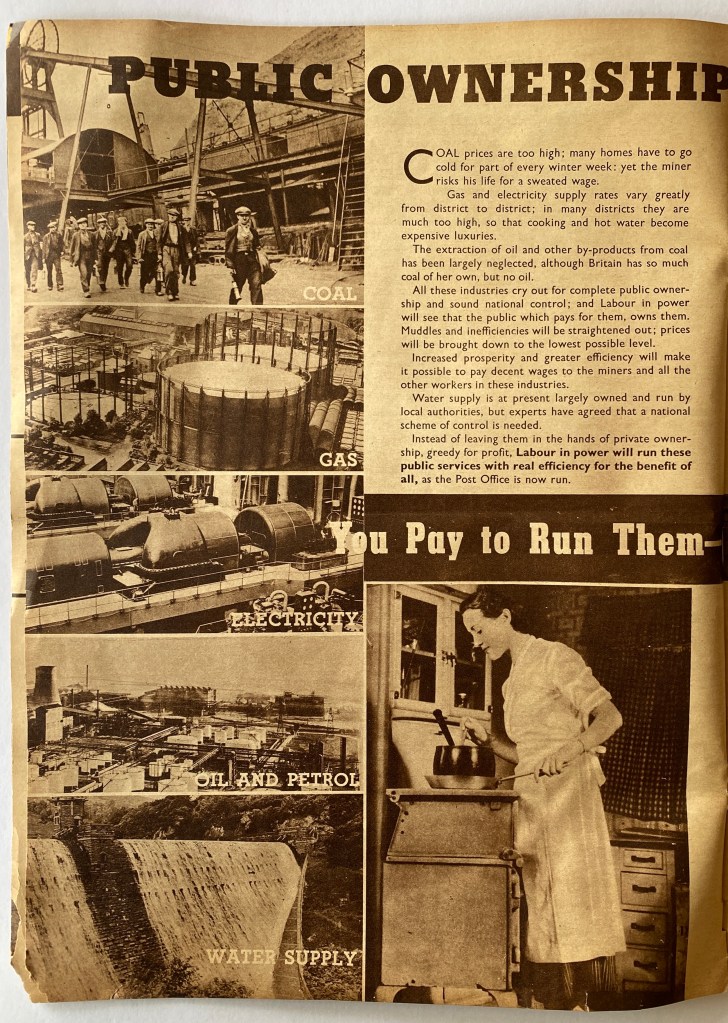
Policies highlighted in the that report including the Bank of England becoming a ‘public institution’ as well as the nationalisation of electricity, gas and coal. Large schemes of development were also envisaged including electrification, housing, transport and oil from coal. In terms of defence it struck a balance between maintaining forces to defend the country alongside support for international disarmament including the establishment of the ‘international air force police’.
Perhaps for me personally, the most interesting is that the Labour Party saw the creation of National Parks as important to feature in Your Britain. This would be only a few years after the mass trespass of Kinder Scout.
Much was to change before the General Election was eventually fought in 1945 but it is very striking how much of this looks like the origins of the Manifesto on which Attlee led Labour into Government in 1945.
Chas Townley is a retired social housing manager, a former district councillor in Gloucestershire, and a keen local historian. Email Chastownley@myphone.coop
Notes and sources
Front/Back Cover Photograph – stated to be Vivex Natural Colour Photograph – this was a new process introduced in 1928. Read more.
Page 3 proposal to create an ‘International Air Police Force’ – this appears to have been advocated for some time in the 1930s. For example Hull Daily Mail – Thursday 4 July 1935, p6, carries report of a meeting of a League of Nations meeting addressed by Lord Allen of Hurtwood (former ILP chair but a supporter of the national government) who spoke in support of its creation.
Page 4 ‘Labour’s Food Plan is common sense’ – Daily Herald, Wednesday 25 May 1938, p4 – By-Election News reporting on Frank Lloyd’s campaign at Stafford includes a sub heading ‘Labour’s Plan’ – The Labour government will organise home production and control imports so as to ensure to the home producer a fair price for his produce and make available to all a plentiful supply of good food, “And a living wage for the worker on the land will be the first charge on British agriculture.”
Leeds Mercury – Thursday 8 December 1938, p3, story headlined ‘Promises to Farmers Labour Chairman at Hull.
‘Labour’s agricultural policy was explained to the East Yorkshire Farmers Union at Hull today by Mr George Dallas Chairman of the party’s National Executive”. … The first step would be the setting up of commodity boards ….
Page 6 mentions National Maternity Service as part of an NHS – Western Daily Press, Saturday 25 June 1938, brief report on the development of a proposal for a National Maternity Service jointly by BMA and TUC
See also Sheffield Independent – Friday 17 May 1935, report of meeting of National Labour Women’s Conference meeting in Sheffield: ‘A demand for a national maternity service was made’ refers to a 44-page report by ‘industrial women’s organisations’.
Page 8 Work for all at fair wages – Mentions that ‘since 1931..’ also specific proposal to increase state pension to £1 – it was then currently 10 shillings.
Herts and Essex Observer – Saturday 21 August 1937, p2, ‘State Pensions Labour’s Plans for Increase’ reports on proposals to increase state pensions to £1 for single people and 35s for married couples. ‘These pensions are conditional on retirement from wage earning employment…’ Also reports that 300,000 young people would be employed as a result.
Page 10-11 – mentions proposal to create National Parks – Daily Herald – Saturday 27 April 1935 p10, Leader column headed National Trust specifically mentions ‘National Parks which Labour plans to create’.
Page 12 Public Ownership – See info box about public ownership proposals in ‘Can Labour Win’, Reynolds’s Newspaper, Sunday 14 March 1937, p10.
Page 14 – phrase ‘Labour’s Immediate Programme’ – Hartlepool Northern Daily Mail, Monday 8 March 1937, p6.
Discover more from Society for the Study of Labour History
Subscribe to get the latest posts sent to your email.
 Society for the Study of Labour History