Who wrote The Red Flag – and are you singing it all wrong? This brief history of a labour movement classic has some answers.
Jim Connell was travelling the short distance home with friends by train from Charing Cross to New Cross after a meeting one evening shortly after the London Dock Strike of 1889 when he wrote the first two stanzas and chorus of what would become one of the great socialist and labour movement anthems.
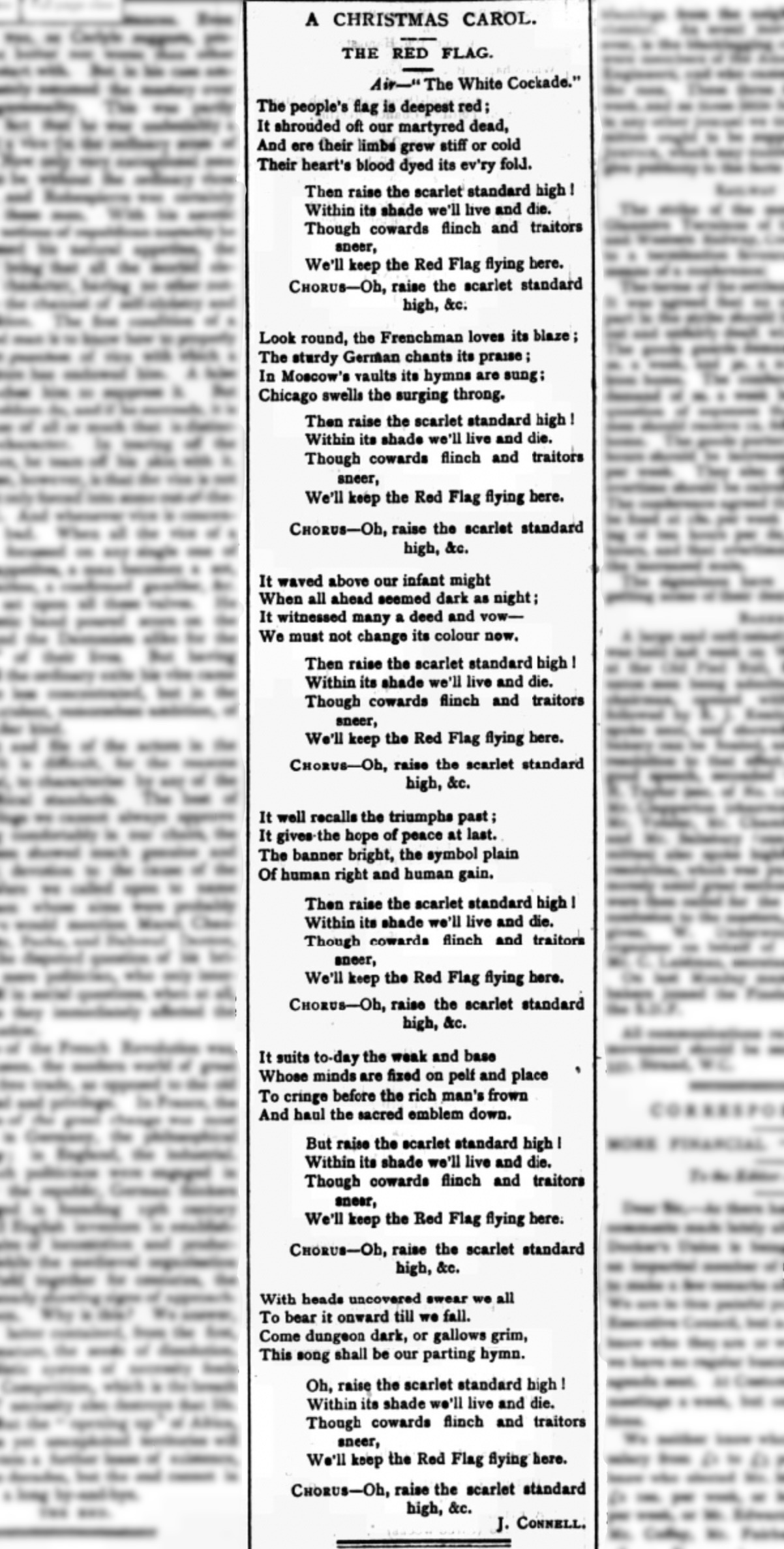
Running eventually to six verses and a rousing chorus, the completed version of The Red Flag was first published a few months later in the Christmas issue of Justice (21 December 1889), the newspaper of the Social Democratic Federation, of which Connell was then a member.
Connell had been inspired, as he later explained in the British Socialist Party newspaper The Call (6 May 1920, p.5), by the London dockers and the smouldering ‘Land War’ in Ireland, but also by the execution of the Chicago anarchists in 1887 and the persecution of revolutionary Nihilists in czarist Russia. The now little-know second verse references these international influences.
The Red Flag was taken up by parties on the Left almost immediately it appeared. When Parliament assembled after the 1945 general election, Clement Attlee and nearly 400 Labour MPs rose to sing it in the House of Commons, and it is still sung every year at the end of Labour Party conferences.

This was neither the first nor the last song that Jim Connell had written, and he was a well-known figure in London socialist circles before his death in 1929. But for decades, he was almost forgotten.
It was only thanks to the pioneering work of the Irish historian Andrew Boyd in the 1960s that anything of Connell’s life story came to be known, resulting in a BBC programme titled The Man Who Wrote the Red Flag, which was broadcast on 27 January 1962.
But that broadcast was heard by Norah Walshe, then in her late seventies and living in retirement at St Leonard’s on Sea. In a letter to Boyd, she explained that she was Connell’s only surviving child; she was able to confirm and expand on Boyd’s research, and offer personal memories of those years.
Today it is known that Connell was born into a farming family in County Meath in 1852. The family moved to Dublin when Connell was a teenager, and in 1875 he decided to try his luck in London, where he found work labouring.
After starting to attend political meetings, he founded the first London branch of the Irish Land League, and was an early member of the Social Democratic Federation, in which he remained active for a decade. His daughter would recall that, ‘Keir Hardie, Tom Mann, Pete Curran and many other pioneer socialists came to our house and over a roaring fire sat up talking half the night’.
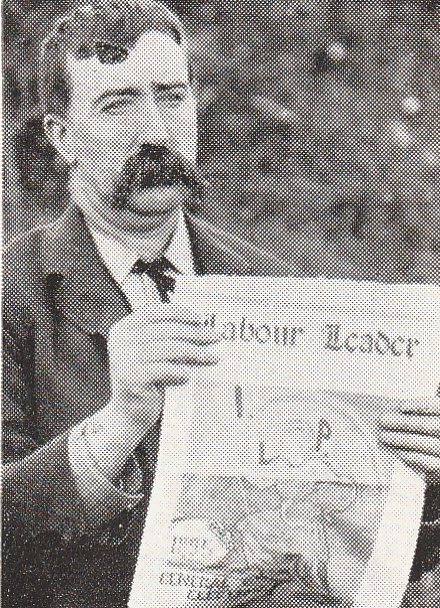
He would later switch his allegiance to the Independent Labour Party, writing a regular column for the Labour Leader, and lecturing for a number of organisations and causes close to his heart.
But his greatest work was almost abandoned by the Labour movement shortly before his death. In 1925, the then Labour leader James Ramsay MacDonald declared that there was ‘not one good line’ in the song. To Connell’s dismay, the Daily Herald took up the challenge of finding a replacement.
Hugh Robertson, director of Glasgow Orpheus Choir, and John McCormack, a well-known tenor, were asked to judge a competition to find its successor, with the Herald putting up a prize of £50. After a year-long search, they decreed that not a single suitable replacement could be found, and The Red Flag continued to fly.
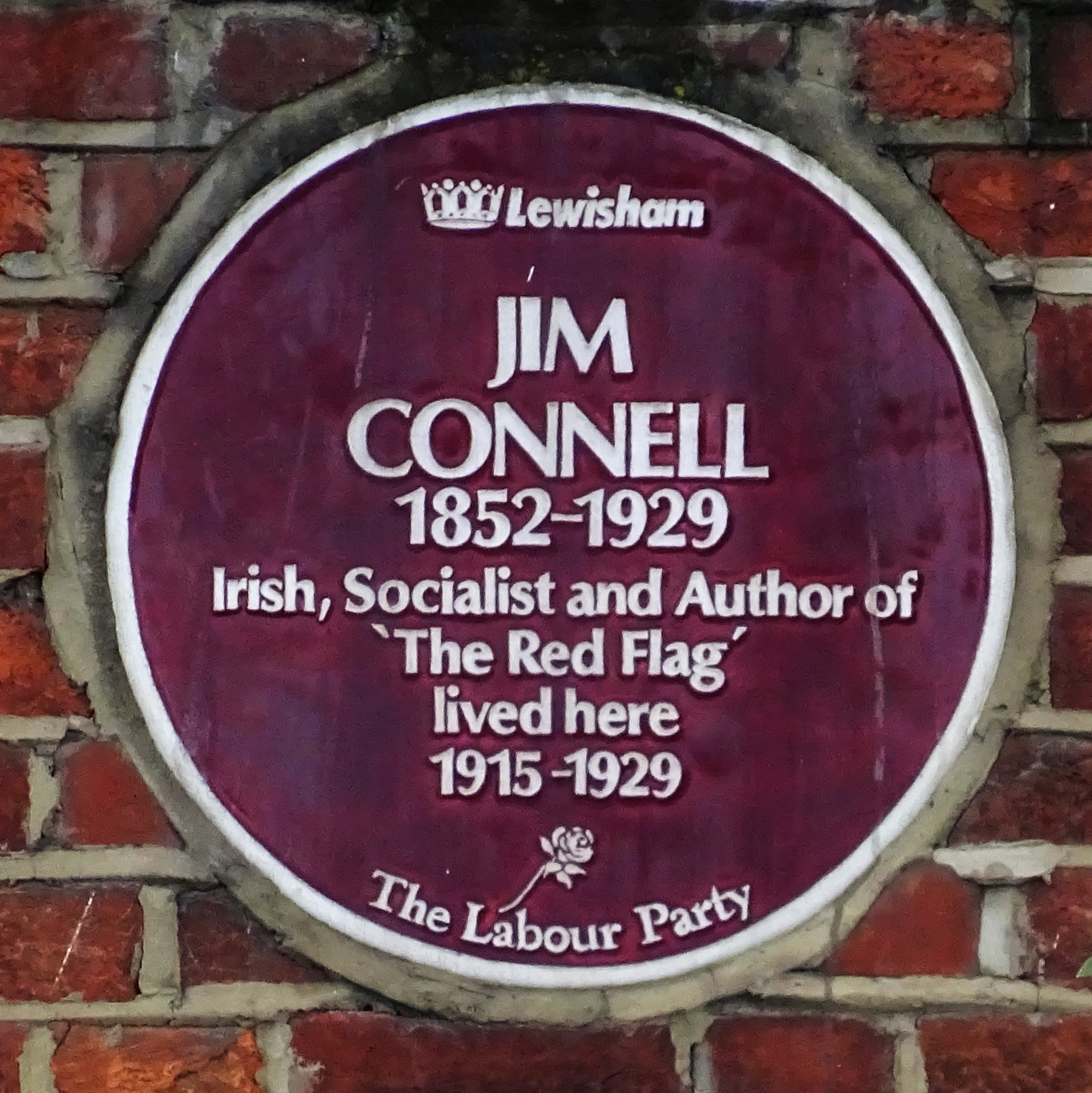
When Connell died, a funeral service was held at Golders Green Crematorium. Tom Mann officiated, and ‘old friends rallied round the coffin and covered it with a scarlet flag,’ according to his daughter. ‘Then we all sang The Red Flag together and his coffin disappeared from view.
The song, of course, has endured – and even rewritten to parody the changing Labour Party. But it is seldom sung to the tune favoured by Connell, who, as he wrote it, imagined it set to an Irish air called The White Cockade. He felt that the Tannenbaum or Maryland tune that became standard, was not suitable, dubbing it ‘Church music’. ‘It made him very angry.’
Sources and further reading
‘Norah Walshe and the Rescue of Jim Connell’ by Andrew Boyd, Francis Devine, and Tommy Grimes. Saothar 24 (1999), pp.91-94 (on JSTOR)
‘James Connell: A Biographical Sketch by his Daughter, Norah Walshe’, Saothar 24 (1999), pp.95-99 (on JSTOR)
Jim Connell and the Red Flag, by Andrew Boyd, History Ireland Vol. 9, issue 2 (2001)
Red Flag, Green Roots, by Ronan Burtenshaw, Tribune, 17 March 1999
Justice and The Call have been digitised and can be found on the British Newspaper Archive website.
A version of The Red Flag sung to the tune of The White Cockade and performed by Billy Bragg can be heard below.
Discover more from Society for the Study of Labour History
Subscribe to get the latest posts sent to your email.

