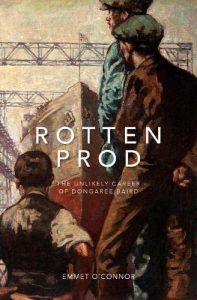
Rotten Prod: The Unlikely Career of Dongaree Baird,
Emmet O’Connor, University College Dublin Press, 2022.
The Irish labour historian Austen Morgan dedicated his study of Belfast labour ‘to the “rotten Prods” of Belfast, victims of unionist violence and nationalist myopia.’ A derogatory label used by loyalists/Unionists against Protestant labour activists, it was laced with venom that brought threats, violence and loss of work. For Unionist leader Edward Carson in 1920 such people aimed to deliver the Protestant community into ‘the same bondage and slavery as is in the rest of Ireland.’ Shortly after, ‘loyalists’ began to expel hundreds of them from their workplaces, alongside thousands of Catholic workers. History was to marginalise them until a recent growth of interest in their plight eg Parr and Edwards (2018 and 2021), Morrissey (2018) and Mecham (2019). Emmet O’Connor’s, welcome contribution to their rehabilitation focuses on the life of James ‘Dongaree’ Baird (1871-1948). A soubriquet he acquired by entering Belfast City Hall in his working clothes following election to the City Council in 1920.
While O’Connor admits that Baird’s biographical material has serious gaps, what he has gathered is skilfully woven into the more extensive narrative of events with which Baird was embroiled – notably the massive engineering strike (1919), his election to Belfast City Council (1920), the workplace expulsions (1920) and their aftermath. His years of prominence largely covered Belfast’s ‘two red years’ (1918-1920) when ‘he rose without trace and disappeared just as mysteriously’ [xi]. Most of the book’s narrative, therefore, narrates the social, industrial and political context of Baird’s life in Belfast and later in the south-east of the new Irish Free State. Both were antipathetic towards Baird’s brand of socialism, particularly in Belfast with his support for Irish Home Rule. A contrary, ‘breaking from the herd’, politics in Belfast where the shipyards in which he worked were a bastion of loyalism and Orange Lodges[15].
Baird was a boilermaker, one of the ‘black squad’ artisans of heavy iron workers. Although favoured as a Protestant he did not have the family lineage in the industry, coming instead from tenant farming stock. How he came to be a socialist is not clear and while he dabbled with the emerging Labour politics in Belfast and its Trades Council, it was only in 1918 that he ‘emerged from the obscurity of his [trade union] branch as a shop floor leader’ [20]. He became more prominent, and exposed, during the 1919 engineering strike. But he was one of the expelled workers in 1920, became their voice, while suffering ‘pauperism’ until brief employment with a local trade union before moving to the Irish Transport and General Workers Union as an organiser in south-east Ireland. This involved him in a bitter farm strike in Waterford in 1923. The same year he just failed election to the Irish parliament and in 1927 emigrated with his family to Australia.
O’Connor’s study offers a detailed account of the turbulent years surrounding the emergence of a partitioned Ireland, and an insight into a marginalised group of labour activists who paid a heavy price for their commitment. Almost in their entirety, like Baird, ‘consigned to the dustbin of history’ [97]. But his story, though fragmentary, is representative of hundreds of unrecognised subalterns and foot soldiers who were always vital to the labour movement. In a sad postscript, however, Baird found it impossible to secure work in Australia’ [viii]. A proud man to the last he would always describe himself as a ‘boilermaker’.
Dr Mike Mecham, St Mary’s University, London
Discover more from Society for the Study of Labour History
Subscribe to get the latest posts sent to your email.
 Society for the Study of Labour History