Financial support from the Society for the Study of Labour History allowed me to fund several research trips to the Labour History Archive and Study Centre at the People’s History Museum in Manchester in 2024 and 2025.
These visits were used to research and draft the final chapters of my PhD thesis – an exploration of the Labour Party’s relationship with Zionism in the middle decades of the twentieth century. My research challenges the prevailing view that Labour’s ‘traditional’ position before 1967 was one of friendship with the Zionist movement and support for the Israeli state. It argues instead that this relationship was far more complex; defined by a combination of factors including the prioritisation of British strategic interests, wider ideological considerations over Labour’s attitudes towards socialism, internationalism and imperialism, as well as a spectrum of opinion towards Zionism that ranged from admiration to vociferous hostility.
This was apparent in the immediate years following the Suez Crisis in 1956. Indeed, while a previous study of this topic has argued that between Suez and the Six Day War a decade later, the defence of Israel’s existence was ‘the touchstone of Labour’s Middle East policy’ defined ‘entirely on the terms demanded by the Israeli government’, my research – and the material from the Party’s archives that I consulted during these trips – suggests a reconsideration of this view.[1] This included records from Labour’s International Department, the correspondence of its General Secretary’s office, the proceedings of its National Executive Committee and International Sub-Committee, as well as reports from Labour’s Annual Conferences, all of which are held at the Labour History Archive.
The period following Suez saw repeated attempts by Labour to restate its Middle East policy, with the stability of the region, improved relations with the Arab states – and the protection of Britain’s oil supply – invariably prioritised over other considerations.[2] This was recognised by Labour’s International Department, which noted the ‘growing conviction in the Party that we must come to terms in some way with the forces of Arab nationalism if we are ever to have a settlement in the Middle East which is satisfactory both to the peoples of the area and to our own vital interests – particularly oil’.[3]
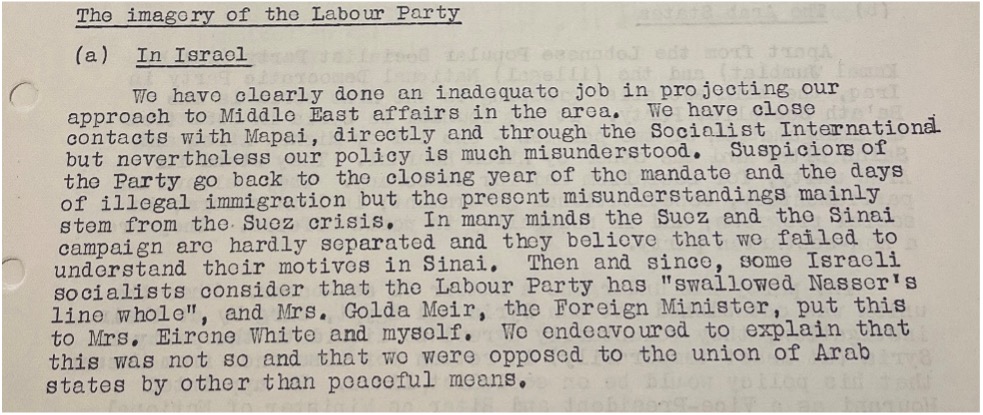
Therefore, after a Middle East Working Party was convened by Labour’s International Secretary, David Ennals, in 1958, it recommended that a future Labour government should re-establish diplomatic relations with Egypt, reconsider British involvement in the Baghdad Pact, revise oil concessions to give oil-producing nations more control over their reserves, and increase funding for Palestinian refugees through UNRWA.[4] Furthermore, it called for a settlement to the Arab-Israeli conflict built on ‘negotiation’ and compromise, with the recognition of Israel by its Arab neighbours matched by Israeli compensation for refugees left homeless since 1948. This was far from unequivocal support of the Israeli position.
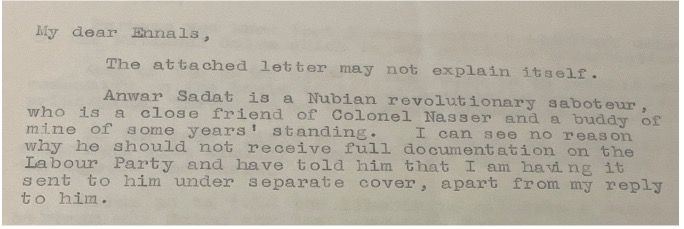
During his period, Labour also increasingly developed relations with Arab organisations. For example, in 1958 the MP and NEC member Richard Crossman facilitated contact between the Party and the future President of Egypt, Anwar Sadat, who sought ‘a solid relation between our Union and the Labourers [sic] Party’.[5] A few months later, fellow MP Tony Benn organised a meeting with the Syrian Ba’athist Party, with the aim to ‘make progress with . . . relations between the British Labour Party and Arab Nationalist Movement’.[6]
In 1959, Ennals received an official invitation to Israel.[7] There, he found opposition to Labour’s Middle East policy, noting that Israeli suspicions of Labour dated back to Ernest Bevin’s postwar Palestine policy, as well as its more recent response to the Suez Crisis.[8] Ennals then visited Lebanon and Syria ‘to make contact with the socialist groups and to see the Palestinian refugee problem at first hand’. There, he encountered a similar hostility based on the memory of the Attlee Government’s record, yet found that the Party’s stance since Suez had been ‘greatly admired’ and that his Arab contacts were ‘extremely encouraged to hear of our active interest and our sympathetic approach to Arab nationalism’.
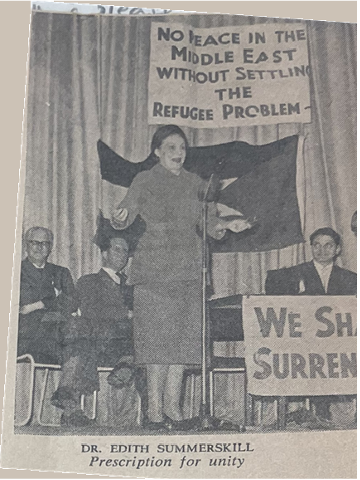
This increased receptivity to Arab interests – as well as evidence of hostility to Israel and Zionism from senior figures within the Labour Party – was further demonstrated during an event organised by the Palestine Arab Students’ Society in London in 1960. The MPs Edith Summerskill and Fenner Brockway, as well as Ian Campbell – the International Department’s specialist in Middle Eastern affairs – represented Labour at the meeting, which commemorated the twelfth anniversary of Israel’s establishment and the Palestinian Nakba.
Brockway called on Israelis – or as he called them ‘Jewish people in Palestine’ – to ‘shoulder the responsibility for the rehabilitation, repatriation and compensation’ of a refugee population that had ‘originated from a war they perpetrated’.[9] He went on to note that he had ‘always been against the establishment of a Zionist state’. While Brockway still stated that ‘Israel was a fact which could not just be “brushed away”’, Campbell countered that it ‘should not be accepted as an established fact – just as the regime in South Africa should not be accepted’. Summerskill – a former Chair of the NEC who was already well known for her anti-Zionist views – suggested that Brockway and Campbell had accurately represented Labour Party policy.
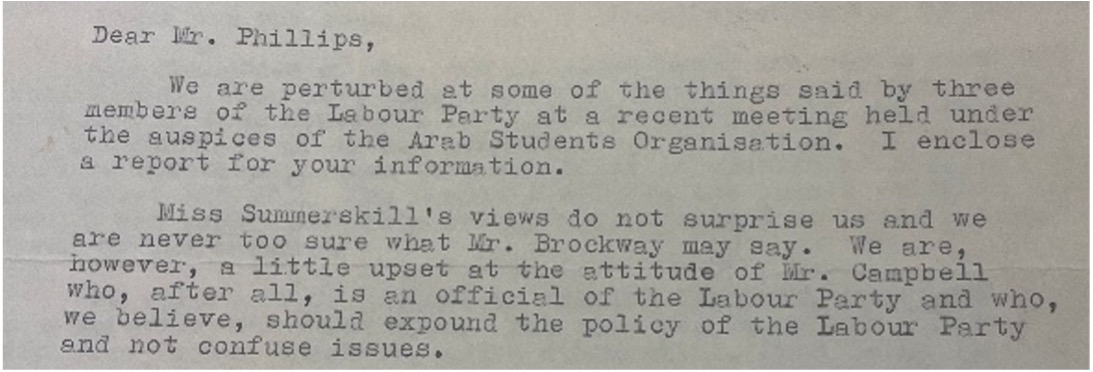
Labour’s Zionist affiliated socialist society, Poale Zion, complained to the Party’s General Secretary Morgan Phillips, about the statements the speakers had made, and was especially ‘upset at the attitude of Mr. Campbell’.[10] While Campbell argued that he had been ‘careful not to say anything contrary to Party policy’, his interpretation of his comments – which presented a ‘middle view’ of the Arab-Israeli conflict that still questioned Israel’s right to exist – suggests that its defence was far from ‘the touchstone of Labour’s Middle East policy’ during this period.[11]
The material consulted during these research trips proved invaluable in reassessing the Labour Party’s Middle East policy at a critical time in the development of its relationship with Zionism. The findings of this research trip greatly contributed to the framing of the overall argument of my thesis. I am extremely grateful for the generous support of the Society for making this possible.
References:
[1] Paul Kelemen, The British Left and Zionism: History of a divorce (Manchester: Manchester University Press, 2012), 142.
[2] Labour History Archive and Study Centre, Manchester. Labour Party Archive [LP], International Department [ID], LP/ID/134, International Sub-Committee of the National Executive Committee, ‘The Middle East’, November 1957.
[3] LP/ID/134, John Clark to Frank Hooley, 24 July 1958.
[4] LP/ID/134, ‘Summary of the Conclusions on which a Report will be based’, undated, Int/ME/1958-6/6 Rev.
[5] LP/ID/134, Anwar Sadat to Richard Crossman, 16 November 1958.
[6] LP/ID/134, Tony Benn to David Ennals, 12 February 1959.
[7] LP/ID/134, Eliahu Elath to David Ennals, 12 February 1959.
[8] LP/GS/NEC, General Secretary’s Office [GS], National Executive Committee papers [NEC], Middle East Visit’, International Sub-Committee of the National Executive Committee, Int/1958-9/34, 12-26 August 1959.
[9] ‘Hate-wave in Hammersmith’, Jewish Observer and Middle East Review, 20 May 1960; ‘A wave of reason’, Arab Review 3:2 (July 1960), 21-22; 32.
[10] LP/GS/JEWS/51, Sidney Goldberg to Morgan Phillips, 23 May 1960.
[11] LP/GS/JEWS/52, Ian Campbell to Morgan Phillips, 1 June 1960.
Find out more about the bursaries on offer from the Society for the Study of Labour History.
Discover more from Society for the Study of Labour History
Subscribe to get the latest posts sent to your email.
 Society for the Study of Labour History