The ‘Celtic Fringe’ is a somewhat unorthodox location for a labour historian to conduct archival research. Beyond the dynamics of agrarian protest between the 1880s and the 1920s, studied by historians such as Jim Hunter, Eric Hobsbawm, Iain Robertson, and Neville Kirk’s study of industrial unrest in Ballachulish, rural Scotland has received little attention from labour history. My PhD thesis aims to challenge the prevailing view, and recover the rural labour movement in Scotland from ‘the condescension of posterity’. It aims to understand how the labour movement approached rural communities, how they interacted with distinct localised cultures and how rural communities responded to the emergence of left-wing politics as a national electoral force. In order to explore the distinct socio-economic conditions across rural Scotland, my thesis considers a number of constituency based case studies, those being: Central Aberdeenshire, Berwickshire and Haddingtonshire, Argyllshire and the Western Isles.
Thanks to the generosity and support of the SSLH, I was able to conduct a significant research trip to gather archival material concerning electoral politics in the Western Isles, between 1918 and 1935. Owing to the lack of surviving Constituency Labour Party or local trade union minutes, my work is reliant on local newspaper holdings, many of which are housed within regional local libraries. As such, my research trip encompassed a significant journey which included accessing collections in Inverness, Stornoway and Oban. This is a reflection of print culture in the Western Isles during this period where newspapers based on the Scottish mainland were also geared towards island communities. The Oban Times, for example, provided coverage across the West Highlands and claimed a circulation encompassing much of western Scotland, including Glasgow.
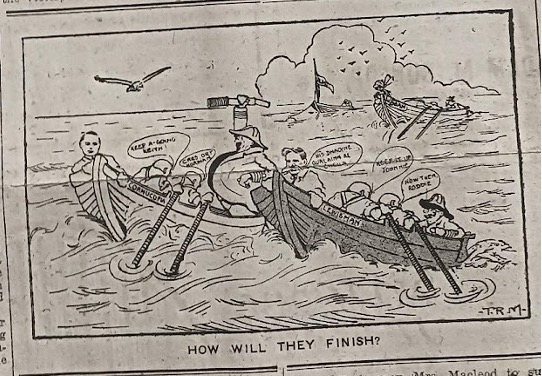
Cartoon showing the electoral candidates for the 1918 Western Isles General Election. The two boats at the forefront show National Liberal Candidate, William Cotts (left), and, eventual winner, Independent Liberal, Dr Donald Murray (right). Someway at the back, Labour and Land League candidate, Hugh MacCowan, can be seen.
The crews of both boats are providing words of encouragement in both English and Gaelic: ‘Nis Dhaoine Gualainn Re Cheila’ – Now Men, Shoulder to Shoulder.
I found the newspaper’s coverage of politics to be incredibly rich. However, the Stornoway Gazette was detailed to an extent I have not come across in other local newspapers. Beyond reporting on electoral meetings and hecklings, the printing of candidates’ manifestos and electoral expenses was revealing about aspects of the local political culture. Additionally, while much of the press coverage was anglophone, there was a good degree of Gaelic language material, which was the majority language of the Isles during the period. This allows for greater insight into the wider – crucially non-anglophone – local political landscape, which cannot be found within the national or labour press.
Candidates’ manifestos were also often published in Gaelic but, in many cases, with distinct content from the English, as opposed to a direct translation. A further theme that emerged was the difficulties of the labour movement organising in a deeply religious community. The ILP’s practice of holding Sunday meetings in Glasgow alongside the Socialist Sunday School movement was deeply controversial for many in the Western Isles, and a delegitimising force for the local labour movement. These unique cultural dynamics produced a local labour movement that was distinct from that present on the Scottish mainland. This is pertinent to my overarching thesis and informative as to how the labour movement approached and organised within rural Scottish communities.
A further aim of my research trip was to speak to individuals in the community involved in the contemporary Labour Party. The Stornoway Labour Party Branch holds a limited number of historical documents, such as the branch’s founding document, which will be of some use. However, beyond this, it was incredibly valuable to have conversations about how electoral campaigns are presently conducted in the Western Isles, and how candidates have to overcome quite distinct obstacles, such as small tight-knit communities, ferry travel, and bad weather. While this may have limited direct application for my PhD, it was nonetheless informative to learn about the day-to-day issues of Western Isles politics.
I would like to thank the SSLH again for making this research trip possible. It was not only a valuable opportunity to access vital archival material, but also gave me a greater appreciation of the communities upon which my PhD focuses.
Find out more about the bursaries on offer from the Society for the Study of Labour History.
Discover more from Society for the Study of Labour History
Subscribe to get the latest posts sent to your email.
 Society for the Study of Labour History