Concluding our series on places in labour history, Greg Billam takes us to St George’s Plateau, where crowds have gathered for more than a century for key social, political, and cultural episodes in the city’s history.
As visitors arrive at Liverpool’s Lime Street Station, they are greeted by the large, open public space that is St George’s Plateau. The flat area between the hall and the railway station may at first glance appear to pale in significance compared with the towering hall and grand station on either side. Lime Street Station, originally designed in 1836 (and subsequently rebuilt twice), underlined the city’s transformation from a provincial town to Britain’s unofficial ‘Second City of Empire’. St George’s Hall similarly signified Liverpool’s rapid expansion. The renowned historian Nikolaus Pevsner once described St George’s Hall as ‘the finest neo-Grecian building in England and one of the finest in the world’. The space between these two buildings exists on its own accord. The area has undergone significant reconstruction and change in recent years, but its importance as a public history site has not diminished.
1911 was a watershed moment for the city’s working classes. Liverpool was at the centre of a series of ‘interwoven strikes involving at one time or another every section of transport workers in the port’, culminating in a general strike in early August. On 31 May 1911, a ‘monster demonstration’ was organised by the Transport Workers’ Federation at St George’s Plateau, as supporters marched from one end of the city to the other in support of strike action. Key figures in the movement, including Tom Mann, Will Thorne MP, Ben Tillett, and Havelock Wilson, delivered ninety-minute speeches. St George’s Plateau was a key organisational site for the city’s nascent trade union movement. The ubiquity – and indeed the centrality – of its demonstrations underlined the increasing strength of the city’s workers. In June, Liverpool’s seafarers went on strike and were soon joined in rank-and-file solidarity action by the city’s dockers. Reciprocal joint action was the order of the day. Liverpool’s waterside workers had effectively shut down the docks and enjoyed total control for a short period.
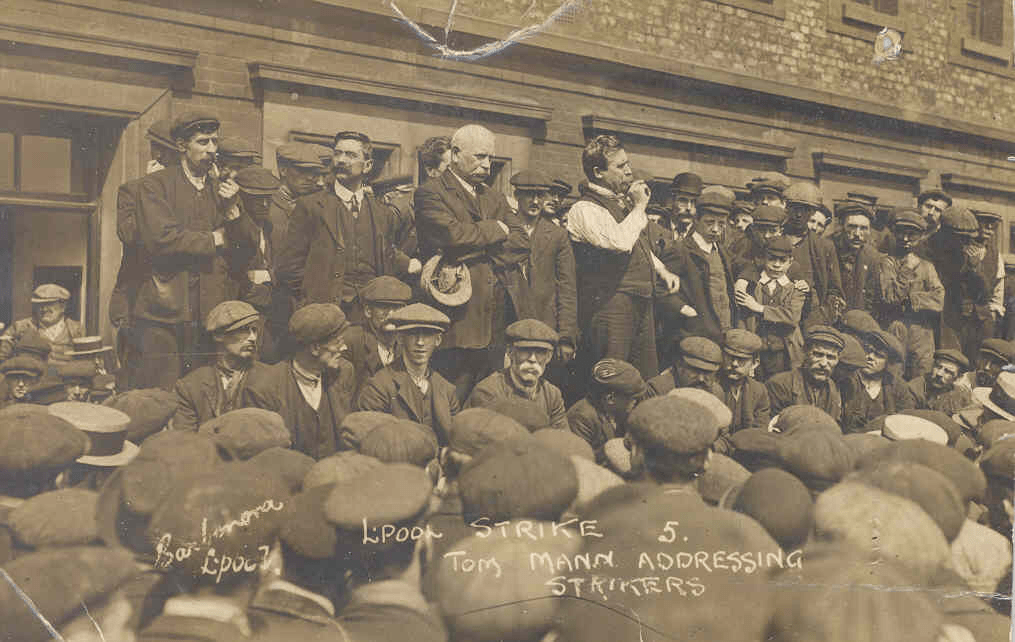
By the beginning of August, both the seamen’s and dockers’ unions were recognised by the employers, leading to a sharp increase in union membership. Little time was left to let the dust settle, as the city’s railway workers soon organised unofficial strike action, leading to a city-wide general transport strike. ‘In Liverpool’, the historian Ralph Darlington has explained, the ‘immediate issue was the question of solidarity action by other transport workers, despite the fact that dockers and other waterside workers had just returned to work’. A joint strike committee, led by the legendary trade unionist Tom Mann, organised the city’s largest public demonstration at St George’s Plateau. Around 80,000 people gathered for a rally on 13 August 1911, with Mann (pictured above) the main speaker, calling for unity amongst the city’s industrial workers. The event set the scene for what became known as ‘Bloody Sunday’, when a violent riot between demonstrators and the police broke out in front of Lime Street Station. The police, Darlington notes, ‘used a scuffle on the outskirts of the rally as an excuse for launching indiscriminate baton charges’, whilst the press focused on the supposed alcoholism of the striking workers as an explanation for the eruption of violence. Over three hundred people received injuries and close to one hundred were arrested in the aftermath. A few days later, two civilians were fatally shot by troops and ten others were injured. After much violence, the government entered negotiations, and on 22 August the city’s railway workers went back to work, with most of their demands met. The event was an important moment in the city’s self-perception and, for many of the city’s unionists and radicals, a symbol of Liverpool’s potential to overcome sectarianism and achieve material gains through joint action.

Eight years later, St George’s Plateau was the site of another significant strike, this time led by the city’s police. The police strike exposed long-standing grievances over pay and working conditions. The ‘unrecognised’ National Union of Police and Prison Officers (NUPPO) demanded improved pay and conditions, as well as the right to belong to a union. Nine hundred and fifty-five members of the NUPPO went on strike, which severely impacted the force’s ability to maintain public order. After widespread looting along London Road in the city’s Islington district, the government stationed a battleship on the River Mersey and positioned armoured cars and bayoneted troops on St George’s Plateau, crushing the strike and, along with it, the union.
Large crowds have gathered in the space for key social, political, and cultural episodes in the city’s local and broader national history. People have assembled to mourn the death of the seminal Beatle John Lennon, to await the verdicts of murder trials, to herald the arrival of successful football teams, and to celebrate the declaration of governments. In recent years, the area has been a contested site for those staking a claim to Liverpool’s identity. In the mid-2010s, anti-fascist protestors successfully gathered to prevent the arrival of far-right activists from the proscribed group National Action, whilst more recently, in the aftermath of the Southport Riots last year, demonstrations have been held to denounce the far right’s exploitation of the event and to affirm the city’s anti-fascist and anti-racist activism. St George’s Plateau has been a key space in Liverpool’s recent history. The creation of St George’s Hall and Lime Street exemplified the confidence of a booming city. In the present, it exists as a contested space for Liverpool’s self-perception and outward identity.
References
Ralph Darlington, Labour Revolt in Britain, 1910-1914 (Pluto Press, 2023).
Sam Davies, ‘Crisis? What Crisis?’: The National Rail Strike of 1911 and the State Response’, Historical Studies in Industrial Relations (2012), 33, 97-125.
H.R. Hikins, The Liverpool General Transport Strike, 1911 (1961). Accessed at: https://www.hslc.org.uk/wp-content/uploads/2017/05/113-7-Hikins.pdf
David Isserman, ‘Labour Insurgency: Transnational Syndicalism and Industrial Unionism among Maritime Workers in Liverpool, 1911-1926’, (2024), Doctoral Thesis, Edge Hill University.
Tony Lane, Liverpool: City of the Sea (Liverpool University Press, 1997
Read more articles in the series ‘A Place in Labour History’.
Discover more from Society for the Study of Labour History
Subscribe to get the latest posts sent to your email.
 Society for the Study of Labour History