In our continuing series on places in labour history, Quentin Outram recounts the story of the Northumberland miners who came to be known as the Cramlington train wreckers.
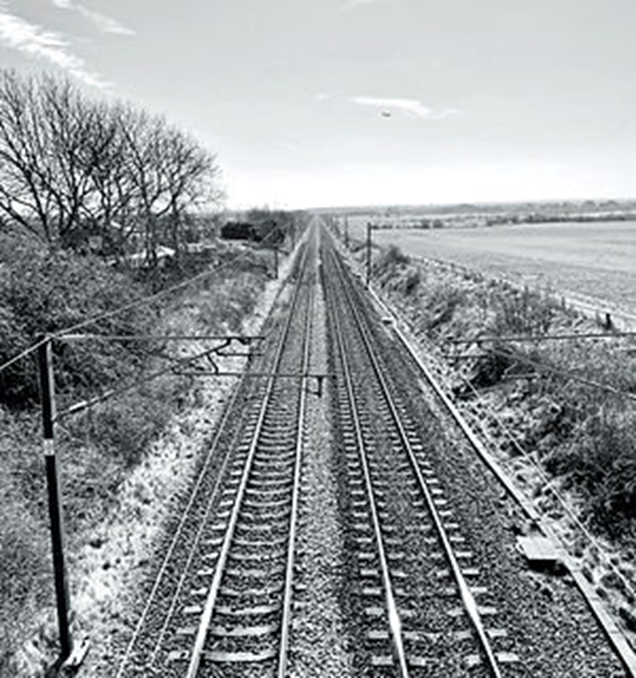
This lonely stretch of the East Coast Main Line, nine miles north of Newcastle and still well over a hundred miles from Edinburgh, seems an unlikely site for history making. But during the 1926 General Strike it saw destruction on a large scale.
Just east of the main line lay West Cramlington Colliery and the village which had grown up around it. The village consisted only of four streets, laid out around the four edges of a large, square field: Lane Road, nearest the railway line, then Cross Road along the south side of the pit and its heaps, Blue Bell Road to the east, and an unnamed track to the north. Beyond these lay green fields, though the green was blighted by coal dust and soot. There were a couple of shops, an off-licence, The Blue Bell Inn, two Methodist chapels (one Primitive, one United) and a Mechanics Institute.
On the morning of Monday 10 May, already a week in to the Strike, William Golightly, a member of the Executive Committee of the Northumberland Miners’ Association, arrived at the Institute to address his members in the village. There were rumours (though largely false) that the strike was weakening. Although news from the districts told a different story, the rumours were enough to rattle the strikers and their leaders. It was essential, the bespectacled Golightly said, to stop the coal trains running completely. ‘If you can’t stop them at the stations, stop them between stations.’
Golightly was a local man. He had spent most of his life in Seghill just a couple of miles to the south-east of West Cramlington. Many years later, shortly before his untimely death, a friendly local newspaper columnist, William Poulton, described him as ‘blunt’, despite the spectacles; another, ‘Wansbeck’ described him shortly after his death as ‘energetic and outspoken’, ‘a sturdy fighter’, capable of lashing ‘his own class with his caustic tongue’, a forceful writer who spoke with ‘punch and pep’, the product of ‘a full-blooded masculine temperament’. ‘Let no wheels turn,’ he had said at the West Cramlington Institute to cheers and applause.
That afternoon at least ten and probably twenty or thirty miners broke entry into a former signal box that was now used as a platelayers’ hut. It provided a little shelter and a place to store the platelayers’ tools. Maintaining the track was a constant labour. This was long before the advent of continuous welded rails held on concrete sleepers with Pandrol clips and, while the line was engineered for expresses, it was not rated at the current 110mph. The 45-foot steel rails were held in cast iron ‘chairs’ with wooden chocks or wedges; the chairs were fixed to wooden sleepers laid on a bed of broken-stone ballast. Each rail was bolted to the next with a fishplate.
It was a steam railway. As trains ran over the rails, the small expansion-gaps between the rails produced the characteristic ‘diddly-dee, diddly-der’ sound immortalized in the 1930s by Reginald Gardiner’s monologue ‘Trains’. The passage of trains on the tracks led to a flexing and movement. Chocks would work loose; the track would ‘creep’ out of alignment; sometimes, as the steel fatigued or cracked, rails would break. Platelayers patrolled the lines daily, fixing faults as they came across them with sledge-hammers, long-handled spanners, forks and spades, lifting rails with pairs of tongs that enabled several pairs of men to apply their combined strength to moving the 1,425 lbs (646 kg) that each rail weighed.
The plan was to take out one or more rails to stop the trains running. It was hard work. The Wreckers had managed to remove the outside rail of the eastern of the two tracks which was used for trains running in a southerly, London, or ‘up’ direction when they heard the sounds of a train approaching from the north. All except one man ran and hid; the other ran to Cramlington Station to warn the station master. The train was stopped before this point however, 300 yards north of Cramlington Station, by a gang of middle-class volunteers playing at plate-laying who flagged it down.
Instead of a black-painted engine heading a line of coal trucks they saw it was a class A1 express engine, No. 2565, painted apple-green and called Merry Hampton hauling twelve carriages forming nothing less than the Flying Scotsman bound for London. The volunteers warned the train crew, also volunteers, of the miners they had seen further down the line and the train got on its way again. It is likely that the train crew were expecting no more than some stone throwing, because this is what they had experienced before, but they proceeded slowly nevertheless probably at only about 20mph.
After the Merry Hampton reached the gap in the track, it carried forward, pulling the first few carriages after it, wobbled, and then fell on its side. The volunteer fireman was scalded at his wrists; two passengers were injured though not seriously. The tremendous sound of the crash brought women running from the village carrying towels and sheets to give first aid. They were rebuffed. ‘Go home and wash your dirty selves and your dirty homes, we don’t want help from the likes of you,’ said one survivor. There was class hatred on both sides.
The Merry Hampton was named after a racehorse as were most of this class of locomotives; hence the rather odd collection of names they had, from Sandwich and Salmon Trout,through Dick Turpin and Captain Cuttle, to Shotover and Gay Crusader. But this name was peculiarly fitting. Merry Hampton won the Epsom Derby in 1887 when his owner was George Alexander Baird (1861-1893) a.k.a. ‘Mr Abington’. The timorous call him a ‘controversial’ figure; bolder writers call him a scoundrel. He was cited as a co-respondent in two divorce cases; he was implicated in a prize-fight match-fixing scandal at a time when prize-fighting was illegal in Britain, and he was banned from riding competitively by the Jockey Club for two years because of his excessively aggressive riding. He had no occupation other than horses and riding. His pseudonym was originally adopted to cover his horse-riding activities from the trustees of his estate. His wealth was derived from the fortune of William Baird & Co, Scottish coal and iron masters, at one point the biggest pig-iron producers in the world. The Bairds were antagonistic to trade unions and in the 1930s industrial relations at some of their collieries, at least as measured by the number of strikes, became among the worst in Britain. Merry Hampton was emblematic of wealth in general and that derived from the exploitation of coal and iron mines and miners in particular. It was fitting it was felled in the General Strike. The engine was repaired and continued through alterations, refits, and rebuilds until it was taken out of service in 1963.
Police inquiries over who was responsible for removing the rail met with only silence for some weeks. Then a twenty-six-year-old striker called Lyle Sidney Waugh was pressured into turning King’s evidence, probably aided by the fact that his elder brother was a police constable and an uncle was a police inspector. On Saturday night on 5 June Billy Baker (28 years old), Jimmy Ellison (29), Bob Harbottle (21), Bill Muckle (25), Tommy Roberts (25), Ollie Sanderson (25), Bill Stephenson (22), Joseph Wallace (27), and Arthur Wilson (27) were all arrested. Wallace was later discharged through lack of evidence. The others were convicted and Harbottle, Roberts and Wilson were sentenced to eight years’ imprisonment, Ellison and Stephenson to six years’ and Baker, Muckle and Sanderson to four years. Waugh, though plainly involved, was not charged. In 1928 the Home Office announced that the Crown was releasing Ellison, Stephenson, Baker, Muckle, and Sanderson at the beginning of September ‘as an act of clemency’; Harbottle, Roberts and Wilson had to wait another year.
That the ‘Cramlington Train Wreckers’ were prosecuted was no surprise. What was perhaps also no surprise and occasioned little comment then or later but should have done so was that the train crew and their managers and supervisors were not prosecuted, despite the fact that they had recklessly endangered their own and their passengers’ lives.
The greatest element of risk driving trains during the General Strike was not from the volunteer drivers. Such drivers were either established staff on the books of the train companies who had failed to join the Strike or were men who had acquired some knowledge and experience in driving locomotives by other means, for instance while working for the army’s Railway Operating Division during the First World War. The driver of Merry Hampton at Cramlington was Robert Cornell Sheddon a regular driver for 36 years with the North British and then the London and North Eastern Railway (LNER), assisted by Thomas Wedderburn, another regular driver, with 39 years’ service who knew the road south of Berwick (which Sheddon did not). The two firemen were volunteers, however, one named Robert Aitken, a student at Edinburgh University, and another called Hird. Firemen had safety functions being required to keep a look out, not to simply shovel coal, so this is of some significance.
But the greatest risk came from the collapse of the signalling system. Many signal-boxes were unstaffed. Instead, drivers were instructed to maintain a 15-minute gap between their train and the train in front. This was the inherently dangerous operating system that had been employed before the telegraph had enabled one signal-box to communicate with the next. From the 1860s railways were increasingly run on the ‘absolute block and telegraph’, later the ‘block and telephone’, system under which a line was divided into sections or ‘blocks’ each guarded by a signal post and a train was not allowed to progress into a block until it had been cleared of all traffic. It meant that it was impossible for more than one train to occupy the same section of track at the same time and, in theory, a collision between two or more trains was impossible. This was the system that was over-ridden during the General Strike. Its adoption by all railway companies on all lines at all times had finally been made compulsory by the 1889 Regulation of Railways Act after passenger outrage at the continuing loss of life on the rails had become intolerable.
The Cramlington Wreck was not the only train crash during the General Strike: three occurred on 10 May: a collision at Bishop’s Stortford in which one person was killed, another just outside Edinburgh’s Waverly Station in which two were killed, and the Cramlington smash in which no one died. At least in the Edinburgh crash, the block and telephone system was in operation. The scene was an operational nightmare with a freight yard split across the two sides of the main passenger line requiring frequent movements of goods wagons and trains across the paths of passenger trains. Such was the case on the afternoon of 10 May when a passenger train from Berwick staffed by a volunteer crew crashed into freight wagons, killing three passengers and injuring fifteen others.
At Bishop’s Stortford a non-stop goods train with a volunteer driver crashed into the rear of a stopping passenger train. The volunteer driver, Ernest John Bell, was assisted by two volunteer firemen, J.A. Burn and A.G.G. Marshall, both students of Cambridge University. Bell, 38 years old, had worked for the Railway Operating Division. He had been instructed to drive according to block-working principles if possible. If it was not, time-interval working with a 15-minute gap was to be adopted. Instead of doing so, Bell steadily gained on the passenger train in front of him of which he was entirely ignorant. He appears to have been a poor judge of speed. When he rounded the curve into Bishop’s Stortford Station he saw the passenger train for the first time, no more than 100 yards ahead of him, and was unable to stop before his train crashed into its rear.
Bell was not prosecuted. Nor was the Divisional Superintendent who chaired the Cambridge District Control committee for the LNER for the duration of the Strike and issued the instructions to adopt time-interval working. Prosecutions of drivers involved in accidents were not unheard of. A couple of years later, Henry Aldington, the driver of a London, Midland and Scottish Railway (LMSR) express passenger and mails train, passed a signal at danger in conditions of patchy but dense fog at Charfield on the way from Gloucester to Bristol. His train crashed into a Great Western Railway goods train and then an LMSR goods train. The gas-lit mail train caught fire and the wooden coach bodies burned furiously. Sixteen passengers died and a further 24 were injured as were 13 travelling post office mail sorters, the GWR driver and fireman, and two LMSR guards. At the inquest Aldington was charged, not with ignoring LMSR rules and regulations, nor with negligence, but with manslaughter. That he was acquitted when the case came to trial at the magistrates’ court was not because the charge was impermissible in the circumstances but because he was deemed to be not at fault. Implicitly, as the driver and the fireman of the GWR goods train told the magistrates, the signalman should have called out the fog men, they should have set detonators on the track to warn enginemen, and the enginemen were entitled to rely on these procedures to protect them and their passengers. That Bell, the driver in the Bishop’s Stortford crash, was not prosecuted cannot be attributed therefore to the vagaries of the law.
The tone of the accident inspector’s report on the Bishop’s Stortford crash is suggestive, however. The inspector wrote of ‘circumstances of great difficulty’, meaning the Strike, and admiringly of the 531 passenger and 30 freight trains that the Company’s officers had succeeded in running despite it; he writes that ‘considerable risks had to be taken’; that Bell’s possible ‘over-confidence and enthusiasm’ was motivated ‘solely by a desire to avoid delay’; and that but for the efforts of Bell and his colleagues the collision ‘might have had more serious results’ and so on. The writer was Lt.-Col. A. H. L. Mount of the Railway Inspectorate. Like all railway inspectors until recently he had been commissioned as an officer in the Royal Engineers. This source of recruitment had been established at the beginning of the Inspectorate in 1840 in order to avoid a conflict of interests between the inspectors and the railway companies. Mount, born in 1881, the son of ‘a gentleman’ according to his own description, was educated at the Royal Indian Engineering College in Egham, Berkshire, a facility run by the India Office, and in 1905 married the daughter of a colonel in the 6th Inniskilling Dragoons. He worked on the North Western (State) Railway in India from 1905 to 1914 when he joined the war in Europe. He was appointed a CBE (Military Division) for services in France, in 1919. In short, while he had no obvious conflict of interest with any British railway company, he was officer class. That his sympathies were with those in charge of the Strike-bound railway companies was obvious. That the companies were allowed, indeed encouraged, to run an unsafe railway during the Strike is a little-known scandal.
Notes and Sources
The photo is taken from the website of The Cramlington Train Wreckers. This offers the best and most convenient single source available on this episode, including a link to the 1969 BBC Two documentary from the Yesterday’s Witness series. This includes excerpts from an interview with William Muckle and his wife Jenny. Wisecrack Productions which hosts the site will be staging a further performance of their play The Cramlington Train Wreckers (written by Ed Waugh, directed by Russell Floyd) on 12 July 2026 at the Theatre Royal, Newcastle.
The newspaper columnists friendly with William Golightly were William Poulton, writing in ‘Tyne Topics’, on p.6 of the Newcastle Journal for 9 November 1939 and ‘Wansbeck’, writing in the Morpeth Herald for 27 September 1940 on p.2. There are brief and rather uninformative obituaries of Golightly in The Newcastle Evening Chronicle, 23 September 1940, pp.3, 6, and the Morpeth Herald, 27 September 1940, p.4, The memorial service and its attenders is noted by the Newcastle Journal for 3rd October 1940, p.3.
For details of track engineering then and now see Jim Pike, Track, Sutton Publishing, Stroud, 2001. The current speed limit for this section of track was taken from the map published on the openrailwaymap.org website by Michael Reichert, Traubenstrasse 9, 74336 Brackenheim, Germany.
The 1926 timetable for the Flying Scotsman is regarded as ‘leisurely’ by rail historians and average speeds over the Newcastle-Berwick section of the route were no more than 60 m.p.h or so.
Reginald Gardiner’s monologue was originally released as a 78 r.p.m. recording on a shellac disc by Decca Records in 1934 and re-released many times afterwards on a variety of media; it is now available on YouTube at several locations.
The line ‘we don’t want help from the likes of you’ is quoted from p. 18 of Margaret Hutcherson, Let No Wheels Turn: The Wrecking of the Flying Scotsman, 1926, TUPS Books, Washington, Tyne and Wear, 2006.
For details of the Merry Hampton locomotive see F.A.S. Brown, Nigel Gresley: Locomotive Engineer, Ian Allan, Shepperton, 1962, or (for another engineer’s account), O.S. Nock, The Gresley Pacifics, 2 vols., David and Charles, Newton Abbot, 1973-74, or Peter Tuffrey, Gresley’s A3s, Great Northern Books, Bradford, 2016, which offers pictures of every member of the class. Wikipedia provides a ‘List of LNER Class A1/A3 Locomotives’ giving their names. The convention for naming racehorses was to include an element of, or a reference to, the names of both sire and dam. Hence names were often composed of two elements; for instance, Red Rum was by Quorum out of Mared with ‘Red Rum’ formed out of the last three letters of each parent’s name. Merry Hampton was by Hampton out of Doll Tearsheet, the dam being named after Mistress Quickly’s friend in Henry IV, Part 2. The only reference for this naming convention I can find is in the wonderful and polymathic book The Sense of God by John Bowker (Clarendon Press, Oxford, 1973), at pp. 100-102 in which he deploys original research in the Newmarket stud book to pursue an argument against the then eminent contemporary anthropologists Edmund Leach and Claude Lévi-Strauss.
For the Baird family see the article on James Baird (1802-1876) in the Dictionary of Scottish Business Biography 1860-1960, ed. Anthony Slaven and Sydney Checkland, The University Press, Aberdeen, 1986, 2 vols., 1, pp. 20-3, or the article in the Oxford Dictionary of National Biography which is shorter but closely based upon it. The company’s Bothwell Castle, and Gartshore collieries both appear in Roy Church and Quentin Outram’s listing of the ten most strike-prone collieries in Britain in the 1930s (Strikes and Solidarity: Coalfield Conflict in Britain 1889-1966, Cambridge University Press, Cambridge, 1998, Table 5.10). For the legality of prize-fighting in the nineteenth century see Jack Anderson, ‘The legal response to prize fighting in nineteenth century England and America’, The Northern Ireland Legal Quarterly, 57(2) (2006), pp. 265-87.
Accounts of the court appearance of the arrested train wreckers are available in the archives of local newspapers. Those of The Blyth News (e.g. Monday 7 June 1926, p. 5); the Newcastle Daily Chronicle, (e.g. 15 June 1926, p. 9), the Newcastle Journal (e.g. 25 August 1928, p. 9) and the Morpeth Herald (e.g. 21 September 1928, p. 5) are available on the British Newspaper Archive (subscription required for home access but may be available at your university, college, or local library). Chapter 3 of Hutcherson’s book includes a detailed account of the trial proceedings based on these sources. Lyle Sidney Waugh is referred to as ‘Lionel’ or ‘Leslie’ in some newspaper accounts.
Bill Muckle’s memoirs were published as William Muckle, No Regrets, People’s Publications, Newcastle, 1981, but are now hard to find. The standard work on British Railway signalling is by Geoffrey Kitchenside and Alan Williams, Two Centuries of Railway Signalling, 2nd ed., Oxford Publishing Co, 2008.
The closely intertwined history of railway accidents and safety measures is most memorably recounted by L.T.C. Rolt, in Red for Danger, 4th ed., David and Charles, Newton Abbot, 1982, though this eulogizes the Railway Inspectorate and ignores the accidents of the General Strike. For these, the best secondary account is by Philip S. Bagwell, The Railwaymen: The History of the National Union of Railwaymen, George Allen and Unwin, London, 1963, pp. 471-81. The official account is the Report to the Minister of Transport upon the Accidents that occurred on the Railways of Great Britain during the Year 1926, Cmd. 2941, HMSO, 1927. This admits (p. 7) that despite the significant reduction in traffic because of the Strike and the coal lockout ‘the record … in respect of passenger casualties in train accidents was worse than the average during the previous ten years’ and that had it not been for the ‘accidents’ of the General Strike and another ‘in fortuitous circumstances’ there would have been no passenger fatalities during the year at all.
The Edinburgh St Margaret’s crash is expertly narrated and illustrated by Andy Arthur in a thread on the transportation section of threadinburgh.scot (‘The thread about the 1926 St. Margaret’s railway crash; inevitable fatalities during the confusion of the General Strike’, 14 May 2024); the official report is not easily obtainable. The Bishop’s Stortford crash was reported in the Lynn News and County Press, 18 May 1926, p.10. The official report of 10 June 1926 is available online at the Railways Archive website as is the report of 3 December 1928 on the Charfield crash.
Rolt recounts the history of the Charfield disaster at pp. 243-8; it can be followed in detail in the reports of the Birmingham Daily Post on 20 October, 1, 3, 17, 21, 30 November, and 1 December 1928. Details of A. H. L. Mount (1881-1955) are taken from Who Was Who 1951-1960 and standard genealogical sources; photographic portraits of him are in the National Portrait Gallery.
The most recent account of the Railway Inspectorate is by Ian Prosser and David Keay (ed. Nigel Harris), A New Illustrated History of Her Majesty’s Railway Inspectorate from 1840, Steam World Publishing Ltd, 2019 (Prosser is a former chief inspector of railways). The history offered by the Office of Rail and Road is no more than a eulogy. A case comparable to that of the Railway Inspectorate, the Mines Inspectorate, often accused by miners of being biassed towards the owners of the coal companies has been examined by John Singleton and James Reveley (‘Dancing in the halls of the rich? Fatal mine explosions and pro-employer bias in the UK mining inspectorate, 1870-1900’, Labor History, 65 (1), 2023, 40-56.) They conclude that ‘mines inspectors in the UK between 1870 and 1900 were prepared, notwithstanding their pro-management instincts, to speak up periodically in public for miners and their families. On those occasions, they resisted pressure to give mine managers and owners an easy ride, especially after large numbers of lives had been lost.
Dr Quentin Outram is Secretary of the Society for the Study of Labour History.
Read more articles in the series ‘A Place in Labour History’.
Discover more from Society for the Study of Labour History
Subscribe to get the latest posts sent to your email.
 Society for the Study of Labour History