In the first of a series of articles on places of significance in labour history, Duncan Hamilton tells the story of the Durham Miners’ Gala’s long association with the County Hotel.
On the corner of Old Elvet and New Elvet in the city of Durham sits the Royal County Hotel. The Grade II listed building is an amalgam of upper-class housing from the late eighteenth and early nineteenth centuries, covering three stories and heavily altered to suit the building’s newer purpose as a hotel. The hotel was opened to the public in 1815 – a big year for County Durham that saw Lord Byron marry Isabella Milbanke in the coastal town of Seaham, the birth of the future Sunderland Chartist, George Binns, and the invention of the Davy lamp to provide a safer environment for workers in the county’s principal industry of coal mining. The hotel, therefore, witnessed the formation of Thomas Hepburn’s regional miners’ union, the rise and fall of the Chartist movement and the later formation of the Miners’ National Union in 1863. The County, as it is colloquially known, would become central to the region’s labour heritage in 1872 as a focal point for the best-known celebration of British socialist tradition: the Durham Miners’ Gala.
The Durham Miners’ Gala was first held in 1871, only three months after the fall of the Paris Commune. It was a comparatively quiet affair, taking over the green fields of Wharton Park above the city proper. Its success, however, ensured that subsequent Galas would make use of the whole city. Almost every year since, representatives from the county’s mining communities have gathered throughout the city to march down New and Old Elvet towards the racecourse grounds by the River Wear, accompanied by colliery brass bands and cheering crowds all the way. The County sits at the approximate midpoint of today’s route, making it a prime choice of accommodation both for those visiting Durham for the Gala, and for the honoured guests of the Durham Miners’ Association looked out for each year.
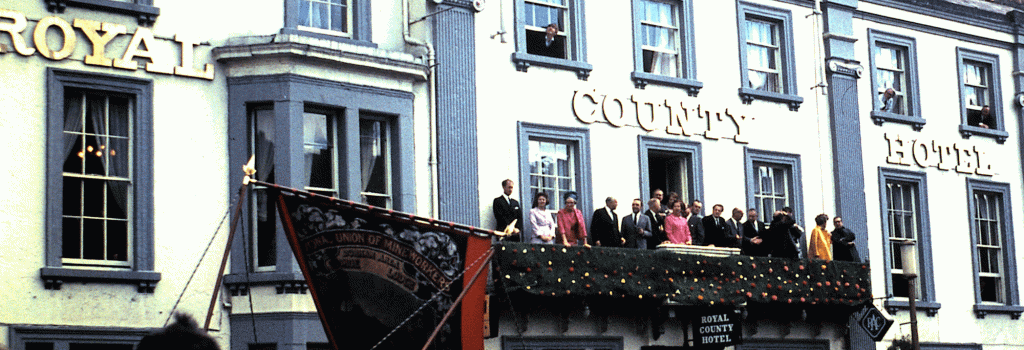
Since its inception, the Miners’ Gala has invited a range of notable labour movement figures to address gathered crowds at the racecourse ground. Before the crowds assemble at the ground, however, these honoured guests of the DMA watch – and occasionally address – the parade from the balcony of the County Hotel. The list of Gala guests to have stood on the County Hotel balcony is as extensive as it is venerable. The first time the balcony is explicitly mentioned is in reference to Annie Besant in 1876, although the Durham Miners’ Association and I are confident that the balcony was the preferred viewing platform from 1872, the same year that the Durham miners first paraded down Old Elvet. Attendees to have watched the parade from on high include: Thomas Burt and Alexander MacDonald, some of Britain’s first working-class MPs; Llewellyn Atherley-Jones, the son of Chartist leader Ernest Jones; Labour Party stalwarts such as Clement Attlee, Ellen Wilkinson and Michael Foot; totemic left-wing figures including Tony Benn and Nye Bevan; and trade union leaders such as Arthur Scargill and A.J Cook. In the spirit of international solidarity, figures from abroad who share in the values of the Durham Miners’ Association have also watched the Gala from the balcony, including Peter Kropotkin from the then-Russian Empire and John O’Connor Power from Ireland. The 2025 Durham Miners’ Gala included Husam Zomlot, Palestinian Ambassador to the UK, among its speakers.
Viewers on the balcony of the County today can see how the Gala has evolved. From its beginnings as a celebration of Durham’s mining communities, the Gala has grown into a broad-church event incorporating progressive and internationalist causes of all kinds. This is reflected in the changing makeup of the parade down Old Elvet – alongside the local lodges are delegations from many branches of the National Union of Mineworkers beyond County Durham. They also see representatives from a broad range of other trade unions and contingents from LGBTQ+ organisations, as well as a range of socialist and internationalist groups distributing pamphlets and journals among the crowds. All this activity inevitably coalesces around the focal point of the County and collectively symbolises the best of Britain’s labouring traditions: democratic, communitarian, forward-thinking, inclusive and fun!
I could have selected any number of sites to represent the Miners’ Gala. The marketplace, the Old Elvet road, the gathering site at the racecourse and the newly-renovated D.M.A headquarters at Redhills (well worth a visit) all represent the radical heritage of my home county in various ways. The County, however, sits at the heart of the Gala both geographically and historically – the most memorable photographs of Gala guests have always been taken on that balcony. I defy anyone to stand outside the County on the second Saturday of July, to hear the colliery bands play and not feel connected to the same crowds that have thronged that space for 150 years in the name of workers’ unity. The view from the ground is inspiring enough, though I wouldn’t mind watching from the balcony myself one day!
Some of the information in this piece was only brought to my attention through communication with the Durham Miners’ Association. My thanks to Andy Dowson, Programme Director at the DMA, for providing some welcome clarity regarding the use of the County’s balcony – and to the DMA itself for continuing to honour the most important of Durham’s working-class traditions each year.
Read more articles in the series ‘A Place in Labour History’.
Discover more from Society for the Study of Labour History
Subscribe to get the latest posts sent to your email.
 Society for the Study of Labour History