My PhD research examines the development of anti-fascist activism within industrial communities in twentieth-century Britain. It explores localised anti-fascist movements and how factors such as class, employment, and education influenced political engagement.
Focusing on two case studies, South Wales and North West England, the project examines the shared characteristics and distinctive experiences of anti-fascist activism across different industrial regions. While anti-fascism in Britain has received scholarly attention, much of the existing literature concentrates on London and the South of England. Consequently, the political cultures of working-class communities in Wales and Northern England remain under-researched. This study seeks to address the gaps by investigating how anti-fascism functioned outside the capital and how industrial and social conditions shaped the nature of activism.
These Society for the Study of Labour History-funded trips have allowed me to consult a wide range of archival material. At the National Library of Wales in Aberystwyth, I was able to consult the Peter Hain papers, which revealed the state of the political landscape during the later twentieth century. These papers also revealed that much of Hain’s work whilst he was a sitting MP for Neath focused on his past associations with the Anti-Nazi League and Anti-Apartheid activism.

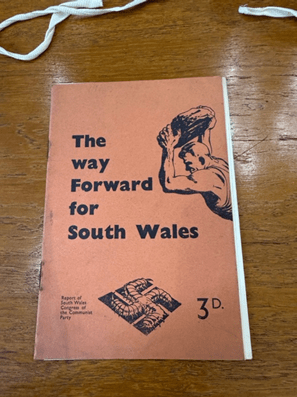
While there, I also examined the Welsh Communist Party files, propaganda materials produced by the Communist Party of Great Britain (CPGB), and Labour Party reports on so-called ‘distressed areas’. One document consulted was ‘the Labour Party’s Commission of enquiry in the distressed areas’. These sources were invaluable in tracing the local connections between communist and anti-fascist activism, particularly in regions the Labour Party described as ‘ideal breeding grounds’ for political extremes. Much of the CPGB works focused on the issue of unemployment in South Wales during the period of study, which has confirmed a working assumption that greater attention must be paid to the links between unemployment and far right politics across the selected case studies.
A second research trip to Swansea enabled me to consult the West Glamorgan Archives and the South Wales Miners’ Library. The latter contains oral histories and interviews with individuals connected to mining communities—sources that have been especially valuable in reconstructing how local people perceived and engaged with anti-fascist activity. Several interviews discuss the influence of international events, including the Spanish Civil War, and how these experiences shaped community attitudes toward fascism and solidarity movements. One interview was particularly interesting due to the interviewee admitting that there was a time when they were members of both the CPGB and the British Union of Fascists, an interesting crossover which was likely thought to be highly irregular.
Together, these materials have both reinforced and refined my original research plans. While my research continues to suggest that industrial communities provided fertile ground for anti-fascist groups, the evidence has also prompted further reflection on the diversity of these movements and the ways local social conditions shaped political engagement. The archival materials consulted have helped clarify the regional variations in anti-fascist sentiment, highlighting how local experience intersected with national and international politics.
As a self-funded, part-time PhD student, the bursary from the Society for the Study of Labour History has been helpful in enabling this research. The trips have not only helped me reach vital archival materials but have also opened new thoughts and ideas that will inform future stages of my PhD. I am deeply grateful to the Society for their support, which has made this essential stage of my research possible.
Harry Griffiths is a PhD student at Bangor University, North Wales, researching a comparative historical study of British anti-fascism in the twentieth century.
Find out more about bursaries on offer from the Society for the Study of Labour History.
Discover more from Society for the Study of Labour History
Subscribe to get the latest posts sent to your email.
 Society for the Study of Labour History