My BA project explores the lived experiences of Gurkha soldiers and their families in Kent, focusing on how they have evolved as a distinctive form of military labour and how they have navigated migration, settlement, and identity in Britain. Gurkhas occupy a unique position as Nepalese nationals who serve under the British Crown. In the British context, they are greatly mythologised as ‘the bravest of the brave’. Yet, the lives of Gurkhas after military service remain underexplored. They are a compelling case study of how a visible minority community has adapted to and shaped British urban life. My research seeks to understand the development of a Gurkha middle class identity in Kent and the wider UK, particularly between 1997 and 2010, a period marked by landmark changes to Gurkha immigration and settlement rights.
Thanks to the Society for the Study of Labour History, I was able to undertake several research visits to the Gurkha Museum in Winchester and the National Army Museum in Chelsea. These visits provided access to materials that have reshaped both the direction and depth of my dissertation.
During my first visit to the Gurkha Museum in August, I reviewed editions from 1997 to 2010 of the Parbate magazine, published for serving and retired Gurkhas. This offered a rare insight into Gurkhas’ own voices. They reveal a growing awareness of rights and economic advancement, contrasting with narratives that often portray Gurkhas as passive or are written by British officers commanding the ranks. Instead, the poems and community reports in Parbate showed Gurkhas forging a place for themselves within British towns through social clubs, religious centres, and welfare associations that blended Nepali traditions with local practices.
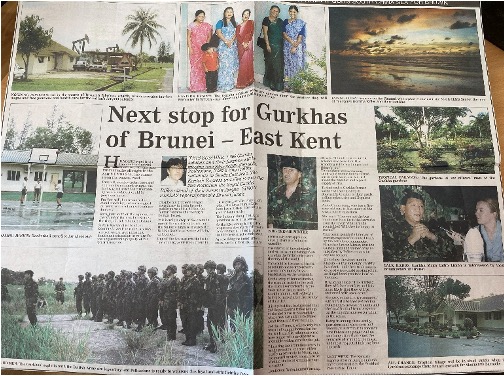
Older Brigade recruitment correspondence also highlighted how the long history of ethnicised Gurkha recruitment has directed the composition of Gurkha communities in Britain today. Many of these groups are ethnic minorities in Nepal. However, they have become disproportionately represented in the UK, creating a distinctive Gurkha identity rooted in caste, shared military service and in new experiences of migration and settlement. A second visit to the museum in September allowed me to examine community newsletters and photographs documenting early settlement initiatives in Kent. The above photo shows a Kentish Express article reporting on the arrival of the 2nd Royal Gurkha Rifles to Shorncliffe. Although this source doesn’t reflect permanent settlement, it identifies education as the primary concern for Gurkha families during migration. This focus on schooling reflects a broader pattern among Gurkhas in Britain, where investment in education has become a key route to upward mobility.
In October, I visited the National Army Museum, where I accessed oral history recordings of Gurkha veterans. I was incredibly moved to find my own father in the archives, as an interviewee for the Crown & Country Project in 2016. In total, I listened to five interviews, including one with a veteran who famously joined the 2007 medal protest outside Parliament. These recordings will aid me in sketching the rise of a Gurkha activist sphere and how this contrasts colonial archetypes of the placid ‘Johnny Gurkha’. The extensive and widely publicised Gurkha Justice Campaign, as well as the ongoing fight for equal pension rights, has redefined what it means to be a Gurkha in contemporary Britain.
The bursary directly funded travel between Kent, London, and Winchester and covered the costs of formal archive appointments. The sources it enabled me to access have become central to my project, allowing me to place Gurkha settlement within a broader history of post-colonial military labour and diasporic activism. More importantly, they have helped me bring Gurkha voices to the forefront – ensuring this is, above all, a Gurkha-centred history.
Drishya Rai is studying for a BA at the University of Cambridge.
Find out more about the BA/Taught Masters Dissertation Bursary Scheme.
Discover more from Society for the Study of Labour History
Subscribe to get the latest posts sent to your email.
 Society for the Study of Labour History