Pritam Singh reports on the roundtable event ‘Freedom and Whatever that Means: A History of the Politics of Overseas Labour Migrations from India c1833-1967’.
Following the abolition of slavery in 1833, colonial India was the largest supplier of labour not just to the British but also to French and Dutch colonies. Whether as convicts, as indentured workers on five-year contracts, or under debt bondage to intermediary contractors, Indian labourers migrated through different channels—both governmental and non-governmental—and in varying forms through the nineteenth and the twentieth centuries. The situation has remained unchanged as India continues to be the most dominant provider of international labour migrants.
Given the centrality of India in the global labour market both in the past and the present, the International History Department of the London School of Economics in conjunction with the Society for the Study of Labour History organised a roundtable event on 23 October 2025, that discussed how ‘freedom’ and ‘free’ labour were defined, contested, and produced both in India and the regions that received Indian labour migrants after the abolition of slavery until the early post-independence period.

The panel consisted of Dr Jonathan Connolly, Dr Kalathmika Natrajan, and Dr Purba Hossain, with Dr Rishika Yadav (fellow in the department) as chair, and Pritam Singh (PhD candidate) as discussant. Dr Connolly (University of Chicago), author of Worthy of Freedom, talked about how Indian indentured labour, which was once a scandal within the British Empire, was legitimised in various ways, such as contracts and government intervention in the post-abolition period. While historians have generally tried to understand the differences and similarities between slavery and indentured labour, Dr Connolly’s talk centred on tracing the changes (rather than straightforward comparisons) as the empire was moving from slavery to this ‘free’ and ‘voluntary’ labour. The presentation brought forward the politics of indentured labour as being shaped in London and in the colonies of Mauritius, Trinidad and British Guiana.
Another shifting perspective in the historiography of indentured labour was provided by Dr Purba Hossain (University of York), author of Voices from Calcutta (Cambridge University Press). Instead of locating India only as a migrant-supplying colony, Dr Purba’s highlighted that India, particularly Calcutta, from where the large number of indentured labourers migrated, was an important ground where the contours of free labour were being constructed and negotiated.
Although there are new perspectives indentured labour, there is still limited historiographical literature on how indentured labour continued to shape the Indian political scene after its abolition in the 1920s. This gap is being filled by Dr Kalathmika Natrajan in her upcoming book Coolie Migrants and Indian Diplomacy (Hurst Publications). Dr Kalathmika showed how, as India moved towards becoming an independent nation state in the twentieth century, lower-caste coolie migrants who had till then formed the backbone of the imperial plantation economy became undesirable labour migrants from India who were seen to threaten the public image of elite Indians in overseas colonies.
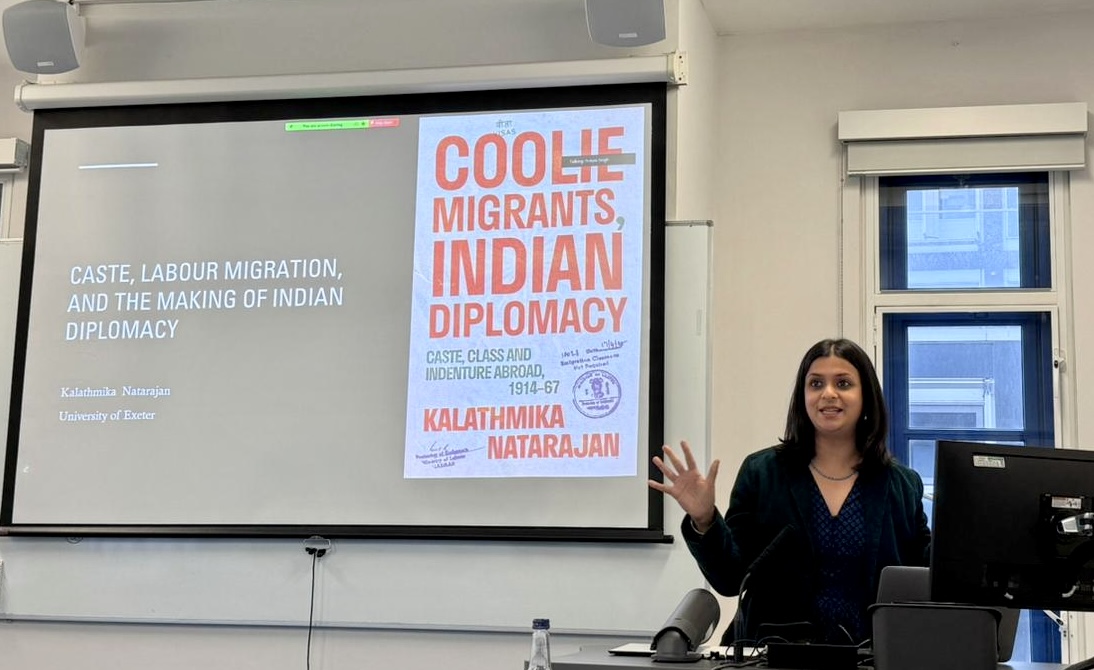
The event was attended by PhD and Masters students and non-academics who have been interested in the history of Indian labour. It concluded with the audience, chair and discussant raising questions around gaps within and futures of the field. There is more to be studied on how overseas labour migrations shaped India and how we should place Indian indentured labour in the broader perspective of ‘free’ labour of the nineteenth century, when there were corresponding systems of labour within the empire being supported through ex-slaves or apprentices.
Maarten Jonker, a PhD candidate in the Department of International History, asked how indentured labour was financed within the Empire. This is another question that Dr Connolly highlighted that needs much more exploration. The event ended with Dr Rishika Yadav thanking the Society for the Study of Labour History and the International History department for their financial support.
Pritam Singh is a PhD candidate in the International History Department of the London School of Economics.
Find out more about the Society for the Study of Labour History grants programme.
Discover more from Society for the Study of Labour History
Subscribe to get the latest posts sent to your email.
 Society for the Study of Labour History