Remembering to Help, Helping to Remember, an exhibition funded by an SSLH grant, has opened at the Heugh Battery Museum in Hartlepool. Michael Reeve reports.
Stories of the struggles, heroism and sacrifice of ordinary people in wartime continue to emerge in social history and war studies. While we have learned much from conventional military history about how wars were fought, social and cultural histories of war shed light on the lived experience of people who lived through armed conflict.
Hartlepool’s First World War story is fascinating, in that it has very real national and even global resonances but is often overlooked as ‘local history’ – even many people who live in Hartlepool are not aware of the town’s wartime history.
The key event that defines much local historical discourse is the 16 December 1914 naval bombardment of the town, a raid that also took in Scarborough and Whitby further down the coast. As an industrial, coaling port, Hartlepool was a ‘legitimate’ military target according to the laws of war – its share of civilian and military sacrifice was significant, and many civilians were killed or injured on that fateful morning. This is the topic that occupies much of the historical interpretation at the Heugh Battery Museum, which is the site of an actual First World War-era gun battery that saw action attempting to repel the 1914 bombardment.
However, until now, there has not been an exhibition in the museum that has looked in detail at the post-bombardment emergency response by local working people, or one that connected these efforts with the quite unique tradition of commemoration in the town, that continues to this day.
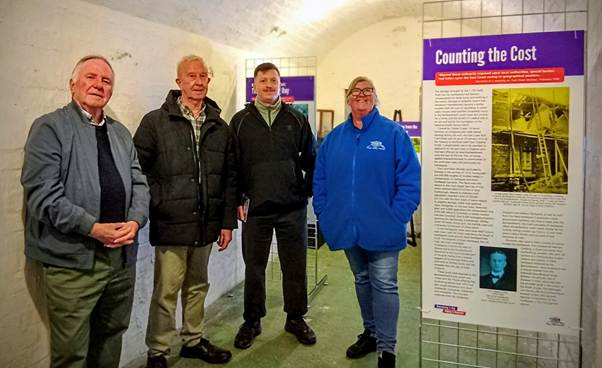
The new exhibition, written and curated by social and cultural historian Michael Reeve – who wrote a 2021 book on the topic – has launched under the title, ‘Remembering to Help, Helping to Remember: Hartlepool’s Practical Response to Adversity during the First World War’. This title reflects two intertwined themes that run though the historical interpretation contained on the exhibition display boards and in the accompanying booklet:
- ‘Remembering to Help’ reflects the efforts of ordinary working people in Hartlepool to come to the aid of those affected by the bombardment, including passers-by who provided first aid and transported people to the hospital.
- ‘Helping to Remember’ focuses on the ways that memorialisation and commemoration of the victims of the attack was connected to mutual aid, in the form of annual fundraising events to raise money for local hospital where victims had been treated.
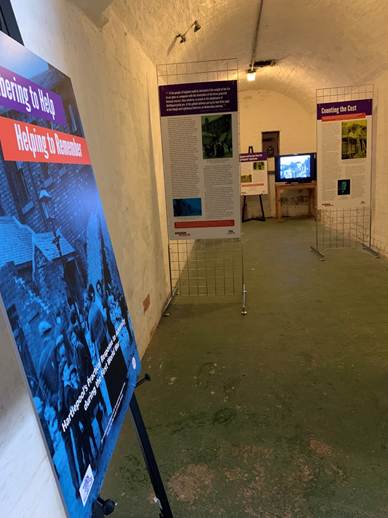
The exhibition – which is accompanied by a booklet that expands on the story featured in the museum – takes visitors from the immediate fallout of the bombardment, focusing on the testimony of ordinary workers and children who witnessed the attack and sought to help others, through to post-bombardment efforts to make sense of the attack and count its human and material costs (including seeking compensation and support from the state). On its way, it takes in elements of First World War political history – not least the exploits of a local anti-German populist politician who capitalised on the attack in his campaigning efforts – and the history of the British empire (the town received charitable donations from as far afield as India). The focus of its final third is on processes of memorialisation and commemoration, particularly local fundraising efforts which intertwined commemoration with mutual aid. Visitors can also get a sense of the scene that faced people after the attack, as a Gaumont newsreel plays in the exhibition, courtesy of the North East Film Archive – this focuses on the bombardment of the coast and gives it first few minutes to the Hartlepool experience.
These commemorative processes continue to this day, with the annual commemorative events at the museum (on the time and date that the first shells hit the town). Though fundraising for local hospitals is no longer necessary, the need to continually reinforce local public memory of an event that affected civilians more than any other group is ever-present at the Heugh and its environs.
It is hoped that visitors will see some parallels between these events more than a century ago with ongoing conflicts around the world, which continue to affect civilians on an enormous scale – time and again we are reminded of the resilience of ordinary people in times of crisis, and their ability to help and support each other. But we are also reminded that such efforts must be situated within broader histories of war, not as add-ons that follow the activities of military personnel – wars may be the business of militaries and governments, but it is within human stories, and lives, that they play out.
‘Remembering to Help, Helping to Remember: Hartlepool’s Practical Response to Adversity during the First World War’ is now open at the Heugh Battery Museum, Moor Terrace, Hartlepool, TS24 0PS. The museum is open Monday, Friday, Saturday and Sunday. More information can be found on the museum’s website. The accompanying booklet (produced with a grant from the British Association for Local History) is available in the museum gift shop.
The exhibition would not have been possible without the Society for the Study of Labour History’s generous grant, the efforts of museum volunteers and museum manager Diane Stephens’ project management prowess. In addition to Michael Reeve’s writing and curation, Philip Eldridge provided his considerable skills as a graphic designer (though he is now retired), while Roger Codner made available a number of historical images from his impressive collection of photographs. A report of the exhibition’s launch on 20 September 2025 can be read on the Hartlepool Mail website.
Further reading
Bombardment, Public Safety and Resilience in English Coastal Communities during the First World War, by Michael Reeve (Palgrave Macmillan, 2021). Here.
Heugh Battery Museum. Here.
‘See the story of what happened after Hartlepool’s 1914 Bombardment as new exhibition opens at UK’s only First World War battlefield site’, by Mark Payne, Hartlepool Mail, 27 September 2025. Here.
Find out more about the Society for the Study of Labour History’s grants programme.
Discover more from Society for the Study of Labour History
Subscribe to get the latest posts sent to your email.
 Society for the Study of Labour History