My dissertation focuses on the individual and political legacy of the Labour Party Young Socialists (LPYS) with particular emphasis on the period 1979 – 1991. This period covers the ideological polarisation of Britain under Thatcher’s premiership. It was also a time when the LPYS grew dramatically to nearly 600 branches by 1985, only to contract and ultimately be closed down by the Labour Party in the early 1990s.
I wish to explore how a relatively small organisation managed to influence political debate and how the skills learnt by young activists during that period shaped later personal and political development.
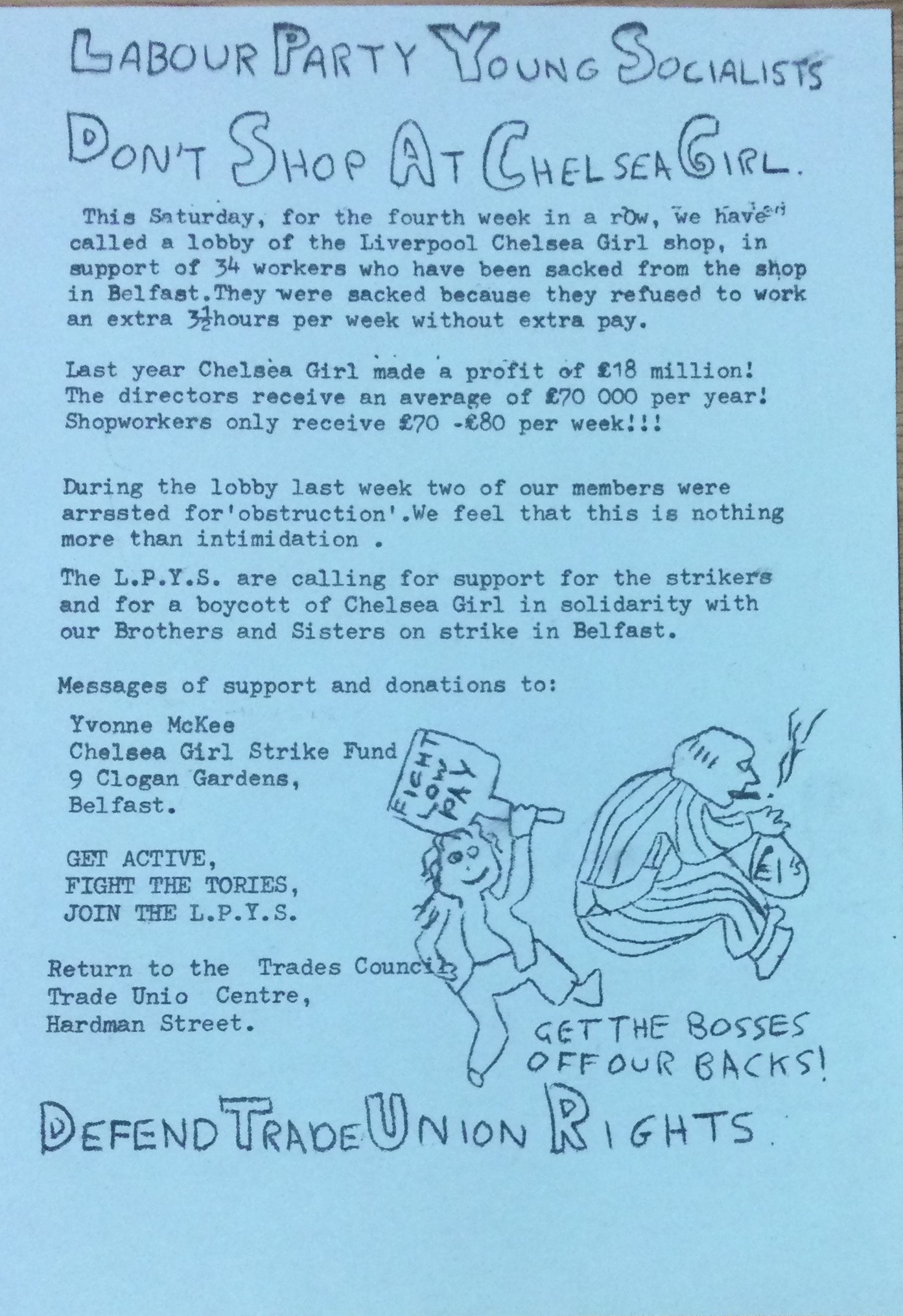
The research consists of two main strands: primary research and oral history interviews with former LPYS members. The primary material I accessed included LPYS conference documents, LPYS National Committee minutes and back copies of publications such as Socialist Youth and Labour Weekly.
The visit to the Modern Records Centre at Warwick University was particularly illuminating. I managed to access LPYS conference documents, LPYS national committee minutes and leaflets and ephemera from LPYS branches. These resources gave depth and context to the oral history interviews. They highlighted that for a small window of time, left-wing youth politics had a countercultural but also profoundly working-class character. The documents revealed that the LPYS although often maligned for their narrow sectarian ideology were still able to mobilise young people around issues such as unemployment and trade union rights.
The newspapers were accessed at the People’s History Museum. Back copies of Socialist Youth demonstrated the reach of the LPYS. Campaign articles mixed with interviews with pop stars and politicians. Socialist Youth also had space for debates. Although never reaching a mass circulation its style was in stark contrast to the parent party’s publication Labour Weekly.


I also visited the Working Class Movement Library in Salford. Its collection of internal Militant Tendency documents demonstrated the pivotal role that young people had in the faction. The library also had background information on how the LPYS contributed to political debates in the Labour Party in Manchester.
This material informed the semi-structured interviews with former LPYS members. By analysing LPYS campaigns, articles and policy positions, I was able to frame the interviews around how participation in the LPYS informed future activities. The interviews revealed skills developed and what participation meant to former activists. The research also highlighted the educative role of the LPYS which is demonstrated by numerous leaflets and branch minutes.
The research shows that despite only having a few thousand members, the LPYS had a social weight and long-term resonance. It is hoped that the research could be the basis for a re-evaluation of the meaning of youth participation in radical and socialist politics. I am profoundly grateful to the SSLH for giving me the opportunity to explore this under researched aspect of labour history.
Steven Cox is studying for an MA in Modern History at Liverpool John Moores University. His dissertation is titled The Legacy of Labour Party Young Socialists 1979 -1991.
Find out more about the BA/Taught Masters Dissertation Bursary Scheme.
Discover more from Society for the Study of Labour History
Subscribe to get the latest posts sent to your email.
 Society for the Study of Labour History