My MA dissertation research focuses on a wave of state repression of Italian militants from the late 1970s to mid-1980s.

On 7 April 1979 several Italian militants and intellectuals of Potere Operaio (workers’ power), Autonomia Operaia (workers’ autonomy), and unaffiliated activists critical of the Italian Communist Party, were arrested for participation in the armed group ‘The Red Brigades’ and the suspected kidnapping and killing of former Prime Minister, Aldo Moro.
The arrests came off the back of a wave of worker and youth militancy in response to the Communist Party’s planned electoral coalition with the Christian Democrats. The aftermath of this wave of struggle would see thousands of militants arrested, with many of them detained until 1984 without substantive evidence of their involvement in terrorist crimes ever discovered. In particular, my research has sought to understand international solidarity movements with Italian political prisoners to uncover hidden lineages of political struggle in the second half of the twentieth century and evolutions in Marxian thought with relation to struggle and the state.
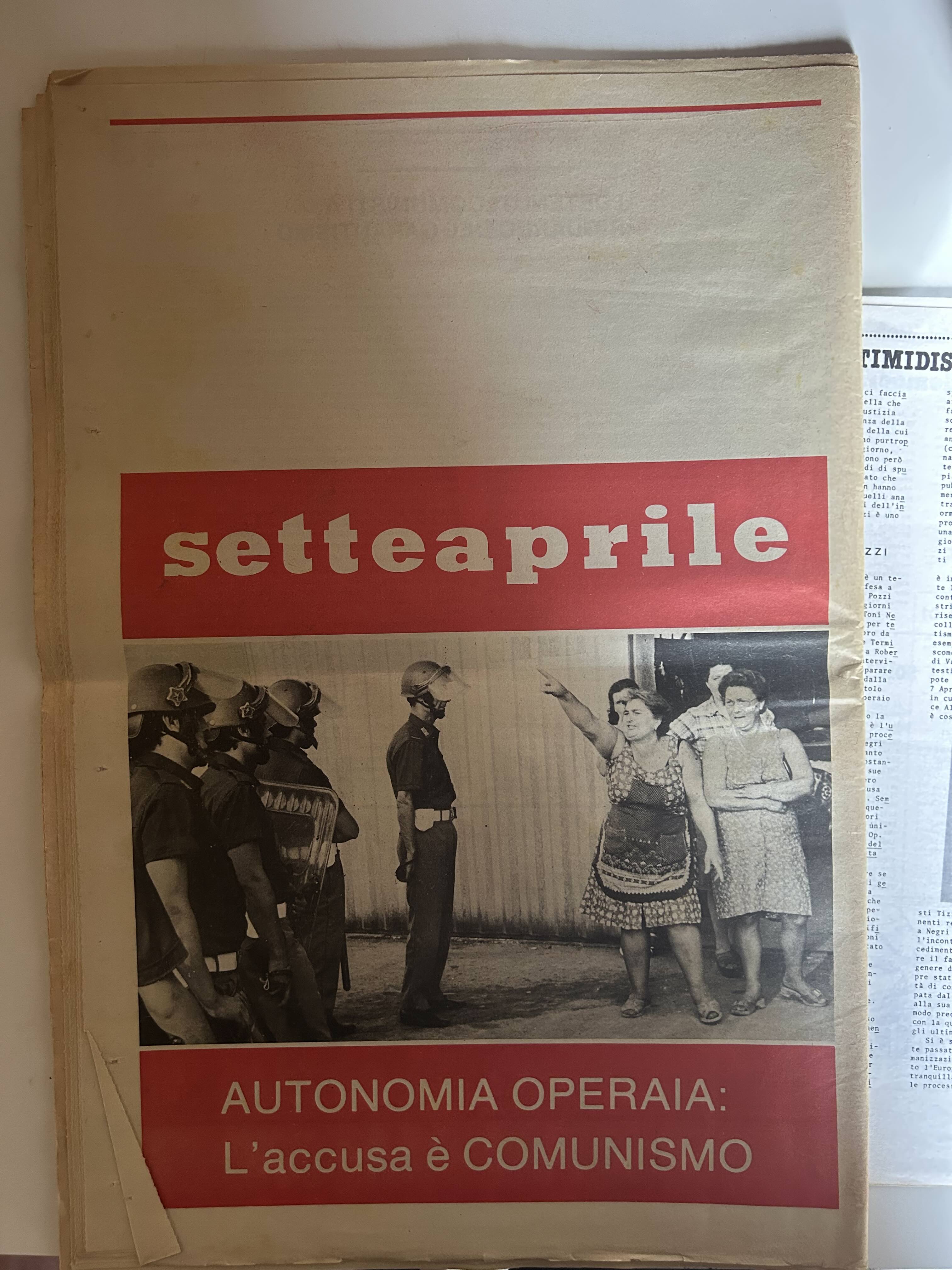
Thanks to the support of the Society for the Study of Labour History, I was able to spend more than two weeks in Italy conducting archival research. I visited the University of Bologna Archives, Fondazione Gramsci Emilia-Romagna, Archivio Marco Pezzi (Bologna), VAG61 (Bologna), Archivio via Avesella (Bologna), Archivio Open Memory (Padova) and Archivio Giuseppe Pinelli (Milan). The bursary enabled me to access a wide range of posters, letters, newspapers, dossiers and flyers that have proved invaluable to my research.
Thanks to the trip, I have been able to situate state repression of the late 1970s within a much broader history of violence and persecution: from the death of anarchist rail worker Giuseppe Pinelli in police custody in 1969 to the police killing of Francesco Lorusso in Bologna in March 1977. Items studied in the archives include documentation for international solidarity conferences in Bologna, Padova and Paris; articles and letters of support by Noam Chomsky, Felix Guattari and Michel Foucault; and details on the state’s use of special prisons and torture, resulting in the involvement of Amnesty International lawyers globally in the cases.

This experience has allowed me to better comprehend the scale of state repression in the Italian context, as well as the ways in which critical theorists comprehended Italy’s autonomous social movements and the state’s response to them within the wider machinations of global capitalism. A particularly surprising and useful find was a Lotta Continua article on the Angry Brigade trials in Britain, which points towards a much larger transnational discussion on armed struggle, state repression and the fabrication or manipulation of evidence during the 1970s.

A highlight of the trip was the opportunity to meet and speak with activists and archivists whose insight into my research topic was invaluable for my dissertation. Through them, I was able to uncover archives I’d not heard of or planned to visit, many of which ended up being some of the most useful and expansive collections I came across. Additionally, I was delighted to attend a conference on Public History at the University of Modena where I heard movement photographer Uliano Lucas discuss the importance of photojournalism in capturing and remembering these social movements and their repression.
This trip has been invaluable in developing the direction of my dissertation, and I am incredibly grateful to the Society for their support in making this research possible.
Jamila Squire is studying for an MA in Cultural and Critical Studies at the University of Westminster. Her dissertation is titled International Solidarity with Italian Political Prisoners: 1979-84.
Find out more about the BA/Taught Masters Dissertation Bursary Scheme.
Discover more from Society for the Study of Labour History
Subscribe to get the latest posts sent to your email.
 Society for the Study of Labour History