The 1945 general election saw the Co-operative Party return a record twenty-three MPs in alliance with the Labour Party. Here, Ellie Townsend introduces research that shows how candidates tailored their electoral message about co-operation to suit local circumstances.
The Co-operative Party, set up in 1917, was an attempt to protect the interests of the consumer co-operative movement in parliament.1
From its outset, the Co-operative Party worked closely with the Labour Party, an arrangement formalised in the 1927 Cheltenham Agreement. Whilst the alliance with the Labour Party was initially forged at national level, co-op political involvement was predicated on the local, voluntary involvement of individual co-op societies. This had a direct impact on this alliance.
This article provides an overview of how the Co-operative Party campaigned politically in its the alliance with Labour at grassroots level through a case study of the 1945 general election. This election was the first to take place following the conclusion of the Second World War and also saw the successful election of a record twenty-three Co-op MPs.2
The Co-operative Party’s bottom-up approach to politics had a distinctive impact on the way in which its candidates ran their election campaigns. Often, they adopted a pragmatic approach, and this has led historians to question the extent to which co-operative priorities were present in candidates’ election campaigns.3
But whilst many Co-operative Party candidates did not prioritise the direct concerns of the co-operative movement, my research shows that many did. Instead of the Co-operative Party being completely absent within these campaigns, its visibility varied as part of a pragmatic approach adopted by its candidates to maximise their chances of election.
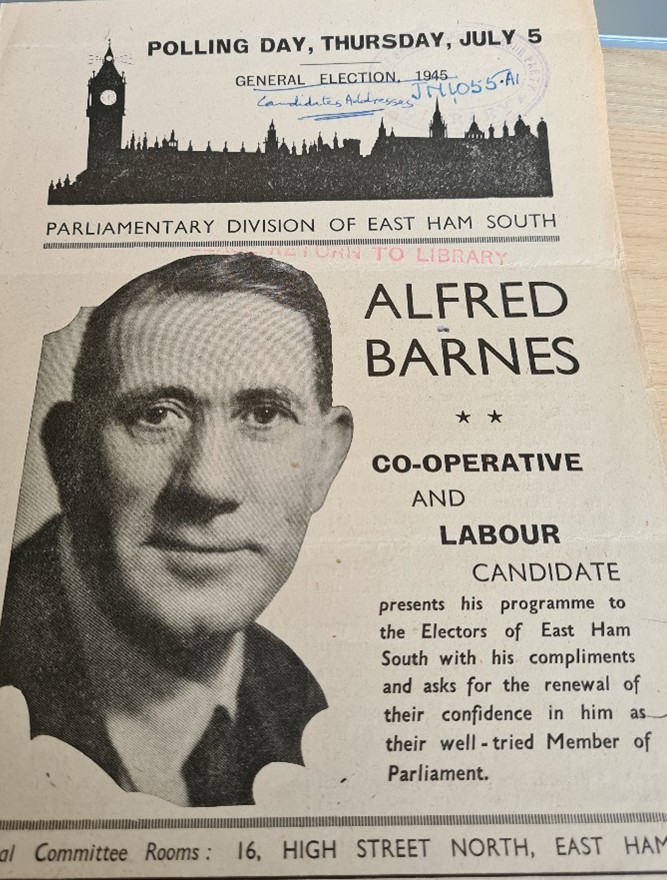
On the one hand, candidates such as Alfred Barnes, who was seeking re-election for East Ham South at each of the elections between 1945-51, were very supportive of the work of the co-operative movement. In 1945, he declared his support for Labour policies which would indirectly support the work of the co-operative movement, such as full employment and housing. However, his election address also promoted consumer issues, questioning the price and quality of certain foods, and as such was an attack on profiteering.4
Barnes was a significant figure in the Co-operative Party serving as its chairman but he had also had a long history of involvement in the co-operative movement since joining the Stratford Co-operative Society in 1908 and becoming its secretary in 1915.5 Whilst his prominence within the co-operative movement undoubtedly contributed to his strong advocacy of these policies, similar support could be seen in election addresses produced by less involved candidates.
In Bradford South, for example, Meredith Titterington pledged himself to pro-consumer policies, such as price control and reduction of consumer taxation including the removal of taxes on Co-operative Societies.6 For candidates such as these, co-operative issues were embedded enough in their constituencies to make them vote-winning issues.
The local press coverage in Bradford also aligned Titterington with co-op and consumer issues. The Bradford Observer dedicated much of its local election coverage to Titterington. Reporting on local candidates’ attitudes towards the continuation of controls, the Observer, despite its historical Liberal affiliation, contrasted with the attitude of the Conservative Party, which wanted to completely remove controls, with Titterington’s view that controls were necessary as a means of facilitating fair shares. The paper highlighted Titterington’s view that the only person impacted negatively by controls was the ‘profiteer’.7
Similar coverage of Co-operative Party candidates was evident in the local press in other constituencies. The Western Daily Press’ coverage of Will Coldrick’s campaigning in Bristol North echoed the Co-operative Party’s national campaign themes underlining his commitment to take under public ownership the same industries as proposed by the Co-operative Party nationally whilst avoiding areas of policy tension with Labour.8

By contrast, many other candidate election addresses made little to no reference to the co-op movement. All candidates would declare themselves as standing under the joint label, but how far this translated into the policies discussed was limited. In the case of Frank Beswick, who stood at Uxbridge, specific co-op issues had less visibility in his campaign materials. He supported many of the policies nationally advocated by the Co-operative Party, such as full employment, housing and education. However, the extent to which he discussed consumer issues was limited.9
This was also the case for Norman Dodds, who had been the publicity manager for the Co-operative Wholesale Society and served on the management committee of the Co-operative Society in Dartford.10 Dodds would be elected for Dartford in 1945 by a significant majority, winning 61.5% of the vote compared with the 38.5% won by the Conservative Party candidate.11 Yet, despite his long involvement in the co-operative movement, he was elected on an address which prioritised Labour issues.
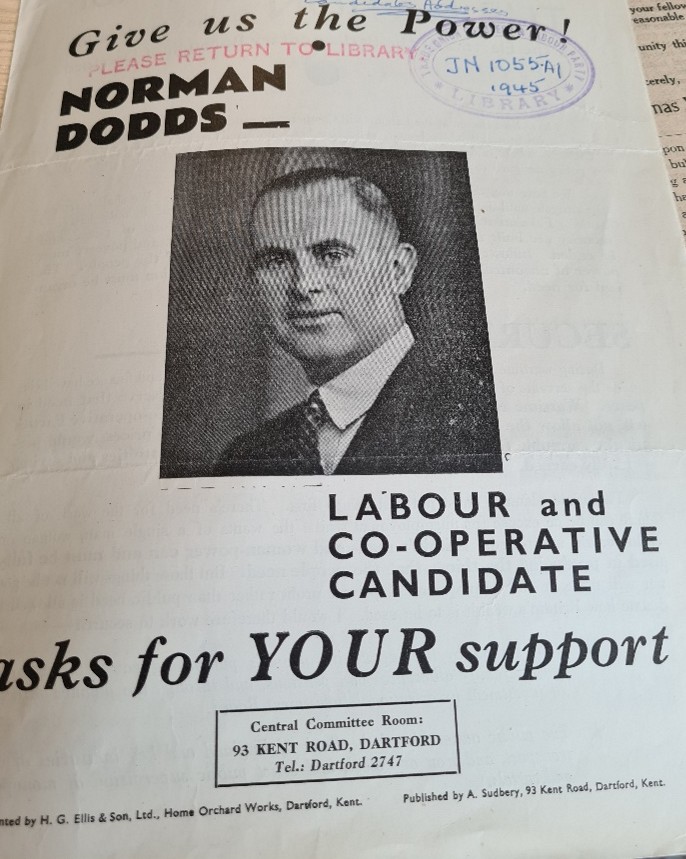
Dodds discussed the need to ensure the continuation of controls to prevent rising prices and made several general references to a ‘Labour and Co-operative government’, but he did not explain how the co-operative movement would contribute to that government and how Labour would promote co-op interests. Beyond this, his election address focused on peace, housing, full employment and the National Health Service.12 This contradicted the very reason the party had been set up in the first place, as this marginalisation of co-operative issues impeded the protection or promotion of co-operative interests.13
In the same vein as it had been pragmatic for Barnes in East Ham South to support policies of key concern to the co-operative movement as they were key consumer issues, Dodds, saw better electoral prospects in supporting wider non-movement specific issues prevalent within the national campaign. This was demonstrated in the emphasis he placed on popular policies such as those related to the Beveridge Report.14
This strategy by which candidates varied the prominence they gave to specific issues in their own campaigns proved to be successful for the Co-operative Party. The 1945 election saw 23 Co-op MPs successfully elected.15 The size of the group meant that its members could work as part of a pressure group within the Parliamentary Labour Party, securing several successful policy compromises in favour of the Co-operative Party ahead of the 1950 election. Prior to this election, in 1949, the Labour Party published the policy document, Labour Believes in Britain. This document raised several concerns for both the Co-operative Party and its parent body, the Co-operative Union as it committed the Labour Party to the nationalisation of several areas of Co-op business.16
Business interests had been critical of Labour Party policy on nationalisation. Not so the Co-operative Party, whose concerns were responded to positively. Here, the Labour Party changed its stance to mutualisation.17 By contrast, although Tate and Lyle raised concerns about the nationalisation of sugar, the Labour Party continued to advocate nationalisation of the industry.18 Whilst co-operative representation was not the sole factor in ensuring this success, having a group of MPs meant the Co-operative Party had a significant enough presence within the PLP to ensure it could not simply be ignored.
References
1 Jack Bailey, The Co-operative Party – An Outline of an Organisation (Manchester: Co-operative Party, 1944), p.1
2 Thomas Carbery, Consumers in Politics: a history and general review of the Co-operative Party (Manchester: Manchester University Press), p.128
3 James Michael Trevor Parker, Trade Unions and the political culture of the British Labour Party, 1931-1940, PhD Thesis, University of Exeter, 2017. Available at: ParkerJ.pdf (exeter.ac.uk). p.174
4 Labour History Archive and Study Centre, Alfred Barnes, Election Address 1945, JN105055.AI
5 Whitecross, Co-operative Commonwealth or New Jerusalem, p.83 and Nicole Robertson, The Co-operative Movement and Communities in Britain, 1914-60: Minding their own business (Farnham: Ashgate, 2010), p.176
6 Labour History Archive and Study Centre, M.F Titterington, Election Address 1945, JN105055.AI
7 Stephen E. Koss, The Rise and fall of the political press in Britain (Chapel Hill University North Carolina Press, 1981),p.447 and ‘West Riding Elections: Four Bradford Candidates Talk Pensions’, Bradford Observer, 30th June 1945, p.3 [accessed: 11 November 2023] at the British Newspaper Archive
8 ‘Bristol North Labour Candidate’, Western Daily Press, 8th June 1945, p.3 [accessed: 10 November 2023], at the British Newspaper Archive
9 Labour History Archive and Study Centre, Frank Beswick, Election Address 1945, JN1055055.AI
10 Labour History Archive and Study Centre, Norman Dodds, Election Address 1945, JN105055.AI
11 Craig, British parliamentary election results, 1918-1949, p.123
12 LHASC, Norman Dodds, Election Address 1945, JN105055.AI
13 Whitecross, Co-operative Commonwealth or New Jerusalem, p.65
14 LHASC, Norman Dodds, Election Address 1945, JN105055.AI
15 Carbery, Consumers in Politics, p.128
16 The Labour Party Archive and Study Centre, The Labour Party, Labour Believes in Britain (Labour Party: London, 1949), pp.16-17 and National Co-operative Archive, Co-operative Party Papers, Report of the 1950 Co-operative Party Conference (Manchester: Co-operative Union, 1950), p.75
17 Labour Party, Let Us Win Through Together: A Declaration of Labour Policy for the Consideration of the Nation. Available at: 1950 Labour Party Manifesto (labour-party.org.uk) [accessed: 5 October 2023]
18 Whitecross, Co-operative Commonwealth or New Jerusalem, p.161 and Labour Party, Let Us Win Through Together: A Declaration of Labour Policy for the Consideration of the Nation. Available at: 1950 Labour Party Manifesto (labour-party.org.uk) [accessed: 5 October 2023]
Ellie Townsend recently completed a Master of Arts by Research degree at the University of Central Lancashire analysing the Co-operative-Labour Party alliance at general elections between 1945 and 1951. The thesis is available here.
Discover more from Society for the Study of Labour History
Subscribe to get the latest posts sent to your email.
 Society for the Study of Labour History