Towards the end of October 1945, Prime Minister Clement Attlee was back in his Limehouse constituency for a victory rally. It had been less than six months since the end of the war in Europe, and just weeks later in the UK a Labour government had been swept to power. A world reshaped by conflict was being remade once again in a new era of peace.
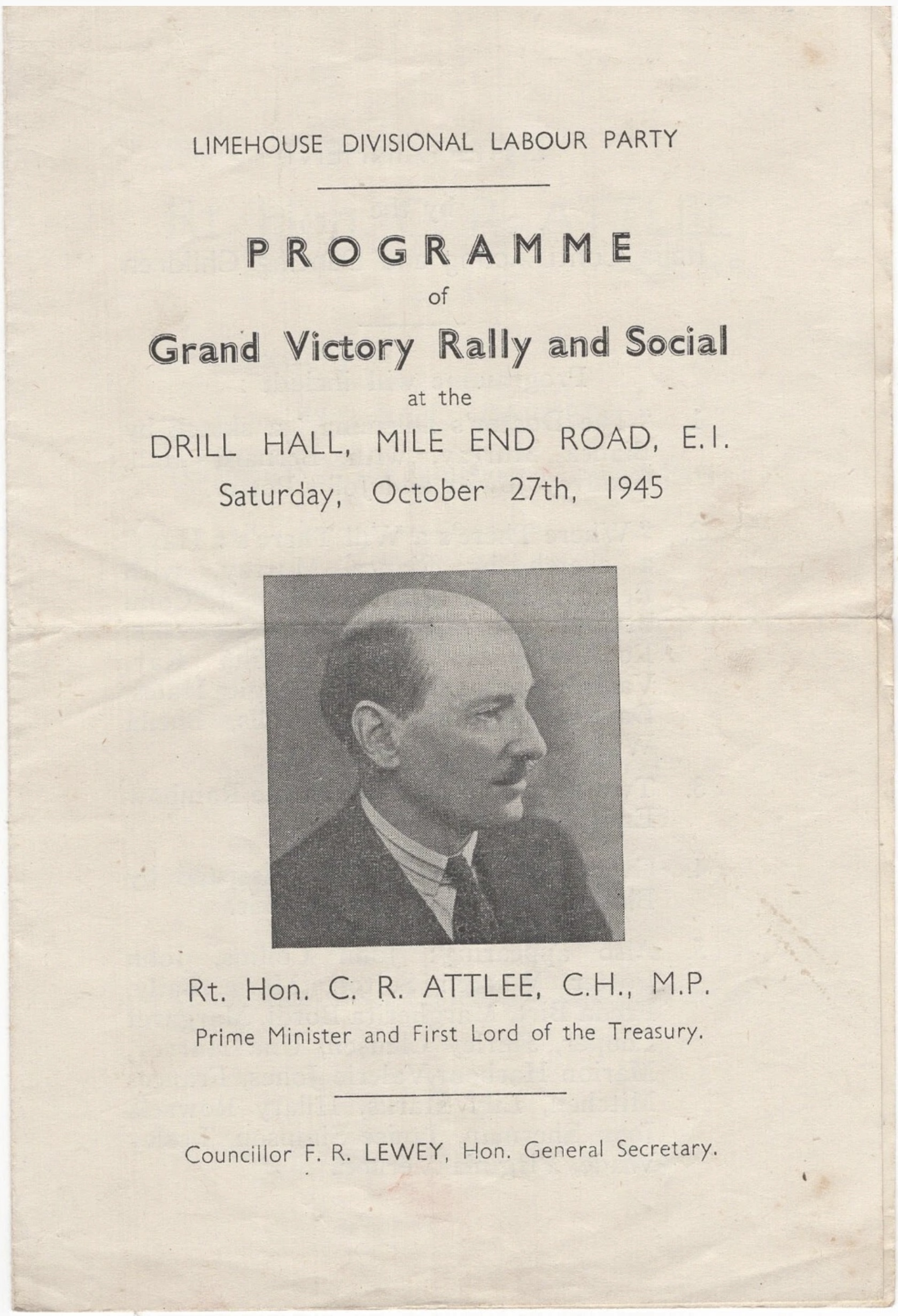
The leaflet shown here gives the programme for Limehouse Divisional Labour Party’s ‘Grand Victory Rally and Social’ at the Drill Hall in Mile End Road. Taking place on Saturday 27 October, it featured only a short address by the Prime Minister, then preparing for a trip to meet the new American President Harry Truman, but also gave time to local party worthies to speak.
The following day’s Sunday Dispatch was among the few newspapers to report Attlee’s words, summing them up with the headline ‘Mr Attlee is confident’. There was little more to say about a speech in which the main message appeared to be: ‘We have many difficulties to overcome, but I am quite sure we are going to overcome them.’
Many of those in the audience, however, were probably there just for a sight of the man who had led the Labour Party to form its first majority government, and for the social events promised in the programme.
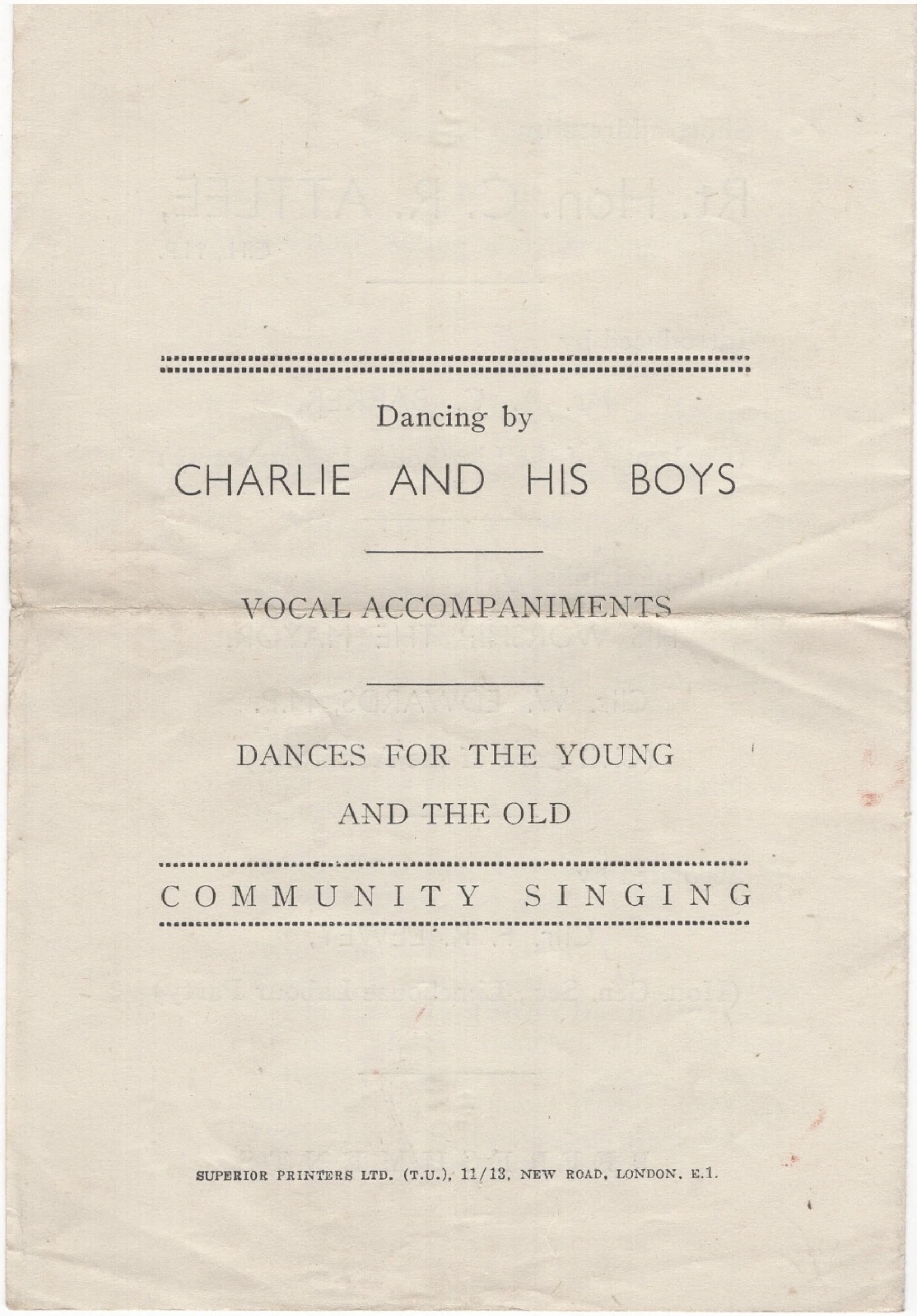
There would be, the programme promised, dancing to Charlie and His Boys, with ‘dances for the young and the old’, and ‘community singing’. The Italia Conti Acting and Dancing Children would also perform sketches, dancing and a musical performance. The cast of one sketch includes a young Nanette Newman, then eleven years old and on the verge of a long film career.
If the Prime Minister’s reassuring words were less than newsworthy, there was plenty going on to fill the papers. In other news that day: concrete blockhouses and pillboxes were being removed from Whitehall; Dr Lisa Meitner, ‘the Austrian woman scientist who made the discovery which gave the clue to the atom bomb’, had been elected to the Swedish Academy of Science; and the Cabinet looked set to take action to deal with a five-week long dockers’ strike.
The big story, however, was a speech by President Truman in which he set out the ‘twelve commandments’ that he said would shape future American foreign policy. These promised that America sought ‘no territorial expansion or selfish advantage’, the right of all peoples to self-government, and the establishment of peaceful democratic governments in the defeated states ‘to attain a world in which Nazism, Fascism, and military aggression cannot exist’.

Discover more from Society for the Study of Labour History
Subscribe to get the latest posts sent to your email.
 Society for the Study of Labour History