This report outlines my research on the spatial practices of Glasgow’s Showpeople, focusing on the domestic yards where they live between periods of travelling fairground work. These yards—often built into the city’s post-industrial landscape—are not simply resting places but complex working environments. They are shaped by Showpeople’s cultural knowledge, and wider urban pressures. My research details how these spaces are designed, maintained, and defended—what they reveal about urbanity, labour, and the role of infrastructure in daily life.
The Society for the Study of Labour History’s bursary made a fundamental difference to this work. It helped cover costs related to travel, enabling me to move between Glasgow and key archive sites including The Mitchell Library, The National Library of Scotland, and university collections in Glasgow and Edinburgh. These journeys allowed for consultation of planning records, trade publications, and historical material linked to Showpeople’s citywide presence. The bursary helped with transport between formal archives and those within Showpeople’s yards—collections of signage, family albums, and oral accounts stored in trailers, garages, and memory. The bursary also supported the time needed to settle in Glasgow. This allowed for sustained, place-based research: travelling the yards, attending community meetings, and building familiar relationships. For research that depends on close listening and observation, this continuity of presence has been essential.
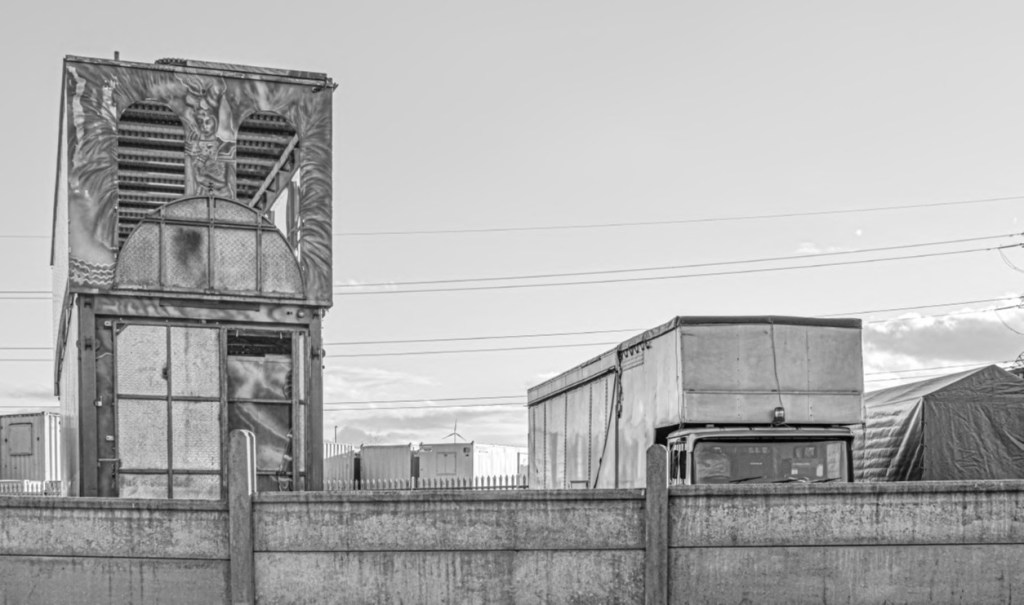
The central focus of my work is how the everyday life and labour of Showpeople is shaped by Glasgow’s shifting conditions. The yards are often built on land left behind by industry— spaces that sit between dereliction and redevelopment. In these marginal zones, Showpeople form working communities that rely on continual adaptations. Homes are moved, extended, angled and connected to electricity and sewage. Yards are not chaotic or transient spaces as they are sometimes assumed to be, but carefully managed and maintained. This reflects a broader pattern in working-class history: people finding ways to live and work within the ruins of previous economic systems. As a mobile community repurposing infrastructures for new use, Showpeople’s yards are part of this history.
My research details how this knowledge is historically developed and sustained. Showpeople cleverly adapt past infrastructures into mixed-use spaces. These yards are built for use, not for show, but their layouts reveal longstanding cultural systems. Their citywide architecture evolves through cycles of maintenance and seasonal travel. In doing so, it reflects the labour that sustains it, not only in building but in remembering and repairing the work that goes into the nationwide fairgrounds.
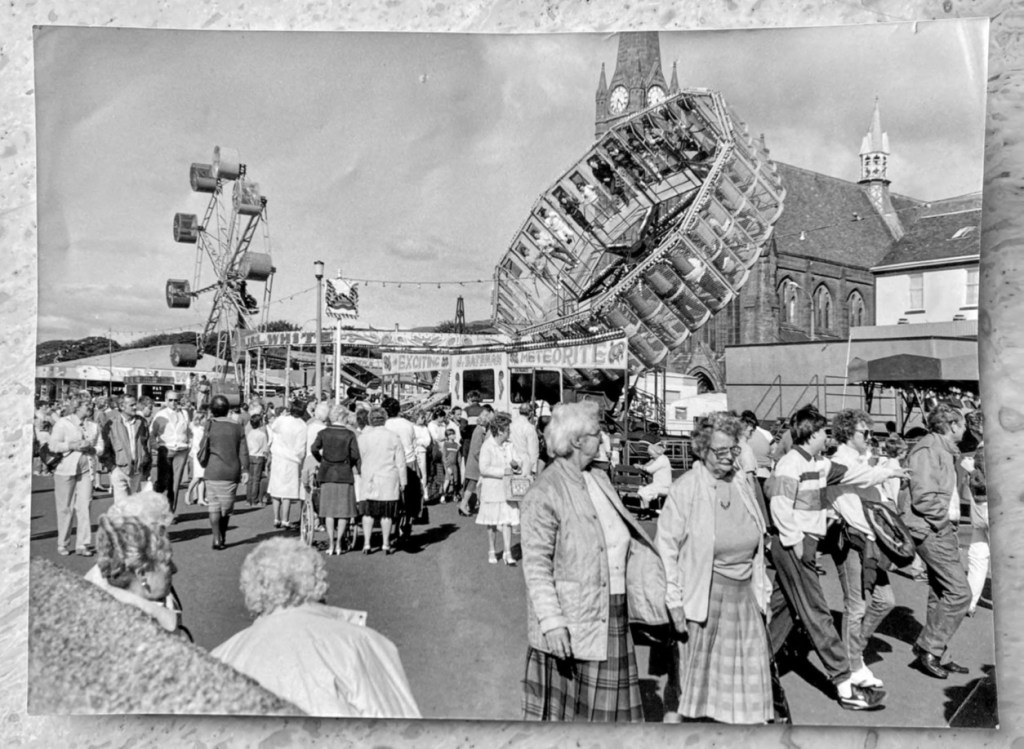
To an outsider, a yard may appear cluttered or informal. But within these spaces, there is a clear logic. Materials are grouped, boundaries observed, access points negotiated. The result is a living architecture—flexible, generational, and rich with knowledge. June Jordan once described this kind of design as making living room in the face of systemic neglect— designing for life in all its complexity (1981). Here, labour and home life blur: yards are workshops, repairs can be collective, and the space itself is a form of resistance to exclusion.
This type of placemaking can run against zoning laws. David Harvey’s framing of urban history offers a helpful lens: the shift from the city of use value (where land serves life), to exchange value (where it serves markets), and eventually to speculative gain, in which land becomes a financial instrument (Rebel Cities, 2012). The yards sit uneasily within this arc. In places like Govan, Dalmarnock, and Shettleston, where many yards are located, these tensions are clear. Land once seen as marginal is now being redeveloped. But Showpeople’s yards, which have occupied these areas for generations, are excluded from planning discussions. They are rarely mapped, and when they are, it is as problems rather than as homes. These are the situations I have tracked through fieldwork. By living on a yard myself, I am following the details of how life continues under constraint, how people keep hold of place even when policy does not.

This research situates Showpeople’s yards within Glasgow’s industrial wake, contributing to the broader effort within labour history to chart evolving relationships between people, work, and place in post-industrial cities. It examines how infrastructures once built for circulation— railways, shipbuilding, foundries, canals—have become catalysts and collaborators for mobile people. Drawing on Jussi Parikka’s writing on second and third nature and McKenzie Wark’s probing of undead labour, I argue that these infrastructures of past industry are not inert but still shape how people live and move. I will expand on this through a public-facing project at Architecture Fringe 2025, titled Shifting Order: Loose–Maps and Data Visuals, which will illustrate how self-built Showpeople’s spaces persist alongside large-scale development.
Ultimately, Showpeople’s yards call for a rethinking of how we understand history, how urban planning relates to labour, and how architectural value is defined. This group’s ongoing cultural labour is an infrastructure in itself, something that continues to take shape and hold space in overlooked parts of the city. Their heritage is not based on fixed artefacts or singular monuments, but on ongoing, adaptable practices and shared knowledge. The bursary made it possible for me to take in these practices. It allowed me to spend time in the yards—not just observing, but building relationships, learning routines, and listening closely to how place is made and remade. I am grateful for that opportunity, and for the openness of Showpeople for selflessly sharing their generational knowhow and hard-won domestic spaces.
Graham Skeate is a second-year PhD candidate of Una Europa’s Una-Her-Doc Programme, jointly hosted by the University of Edinburgh and KU Leuven. His project, Unfixed Design, centres on the socio-material arrangements of Glasgow’s Showpeople.
References
Harvey, D. (2012). Rebel Cities: From the Right to the City to the Urban Revolution. Verso.
Jordan, J. (1981). Civil Wars: Observations from the Front Lines. Beacon Press.
Parikka, J. (2015). A Geology of Media. University of Minnesota Press.
Sendra, P., & Sennett, R. (2020). Designing Disorder: Experiments and Disruptions in the City. Verso.
Wark, M. (2020). Sensoria: Thinkers for the Twenty-First Century. Verso.
Find out more about bursaries on offer from the Society for the Study of Labour History.
Discover more from Society for the Study of Labour History
Subscribe to get the latest posts sent to your email.
 Society for the Study of Labour History