Keith Gildart reports on a conference/symposium on the History and Legacy of the 1984/5 Miners’ Strike, held at the National Coal Mining Museum for England
This year marked the fortieth anniversary of the end of the miners’ strike of 1984/5. This seismic event is now widely regarded as one of the key-turning points in post-war British history.
In recent years a number of books, articles, exhibitions and documentaries have been produced documenting the twelve-month dispute and the devastating impact the defeat had on mining communities. A conference/symposium held at the National Mining Museum for England in Wakefield on 22 February brought together historians, sociologists, former miners and members of the public to explore the latest research on the history of the strike and its legacy that still leaves a scar on post-coal regions. The event was supported by the Society for the Study of Labour History with the accompanying exhibition material funded by the Arts and Humanities Research Council.

The first session explored the strike in historical perspective. Professor Keith Gildart (Wolverhampton) and Professor Andrew Perchard (Otago University) opened proceedings by presenting findings from their four-year project; ‘On Behalf of the People: Work, Community and Class in the British Coal Industry 1947-1994’. The discussion then focussed on the recent literature on the strike assessing its strengths and limitations. Andrew Perchard presented a more nuanced reading of National Coal Board managers and their attitude to mine closures and industrial relations. Professor David Howell (University of York) then gave a detailed paper on Nottinghamshire, Spencerism, and the mythologies that have become associated with the coalfield and its reluctance to substantially support the strike in 1984. The ensuing discussion highlighted the need for further research on coalfields of the Midlands and their political cultures.
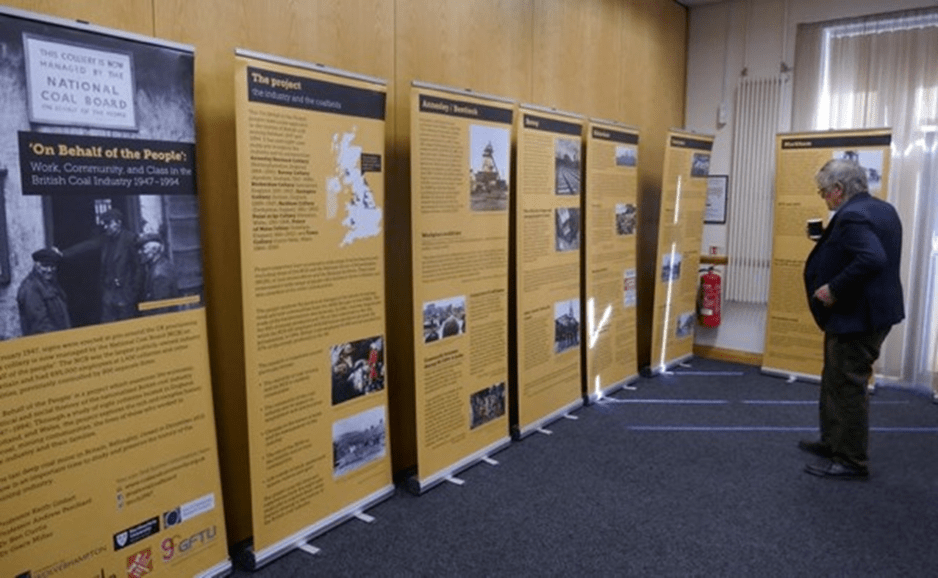
The day was divided by the chance to peruse the ‘On Behalf of the People’ exhibition which consisted of a focus on eight collieries in England, Scotland and Wales: Annesley-Bentinck (Nottingham), Barony (Scotland), Bickershaw (Lancashire), Easington (North East), Markham (Derbyshire), Point of Ayr (North Wales), Prince of Wales (Yorkshire) and Tower (South Wales).
This exhibition included oral testimony, photographs and documents to access the post-war history of each colliery and the stance taken in the strike of 1984/5 and eventual closure. This was accompanied by the screening of a new documentary film In the Veins (2024) made by Teesside University consisting of archive footage depicting work, culture, and politics in the coalfields of the North East and Yorkshire. The film was a reminder of the size and influence of the coal industry and how quickly it declined from the end of the 1960s. Attendees also had the opportunity to purchase used books on the history of the coal industry from a pop-up shop provided by Northern Herald Books. The exhibition and the film allowed speakers, ex-miners, curators and members of the public to discuss the first half of the day in an informal setting over lunch.
The afternoon session of the conference/symposium focussed on the post-strike legacy and the contemporary problems facing towns and villages that had been at the forefront of the dispute in 1984/5. Dr Natalie Thomlinson (University of Reading) presented her latest research on women in the strike. Here again was an attempt to unpick some of the mythologies of the dispute. Thomlinson’s research showed that it was only ever a small minority of women who were involved in picket lines and activism. The recorded interviews conducted for this project can now also be accessed by researchers using the museum.
Dr Kat Simpson (University of Huddersfield) then led a discussion on young people’s experiences of growing up in former coalfields long after the pits had closed. This session was crucial in bring together the past and present and how the strike is remembered, mis-remembered, and for many young people in Barnsley now means very little at all. This generated much discussion on the legacy of the strike with critical interventions by ex-miners and their families.
The politics of the present day, and in particular, the impact of Brexit and the Reform Party in Nottinghamshire was noted by Dr Lisa Mckenzie (University of Bedfordshire). This was a crucial reminder of the ways in which deindustrialised regions have led to alienation, fragmentation and a sense of loss. This was a thought-provoking and challenging presentation and discussion attempting to make sense of the ways in which the post-coal working class in the East Midlands and across the country more generally have been marginalised, vilified and forgotten with regards to national and local political representation.
The conference/symposium was evidence of the many research projects from across a range of disciplines (History, Politics, Sociology, Education) that continue to focus on the background, impact and legacy of the miners’ strike of 1984/5. With around 50 people in attendance, it showed that amongst academic researchers, museums, community groups, and perhaps most importantly former miners and their families, the strike still looms large in the individual and collective memory. The research presented will inform books, articles and future exhibitions that will follow in the coming months and years.
Report by Professor Keith Gildart, University of Wolverhampton.
Discover more from Society for the Study of Labour History
Subscribe to get the latest posts sent to your email.
 Society for the Study of Labour History