In the final part of our series on meetings with figures from labour history, Quentin Outram tells the story of miners’ leader Thomas Hepburn’s encounter with mine owner Lord Londonderry, and the two men’s very different lives.
Thomas Hepburn (1796-1864) and Charles William Vane, formerly Stewart, 3rd Marquess of Londonderry, KG, GCB, GCH, PC (1778-1854)
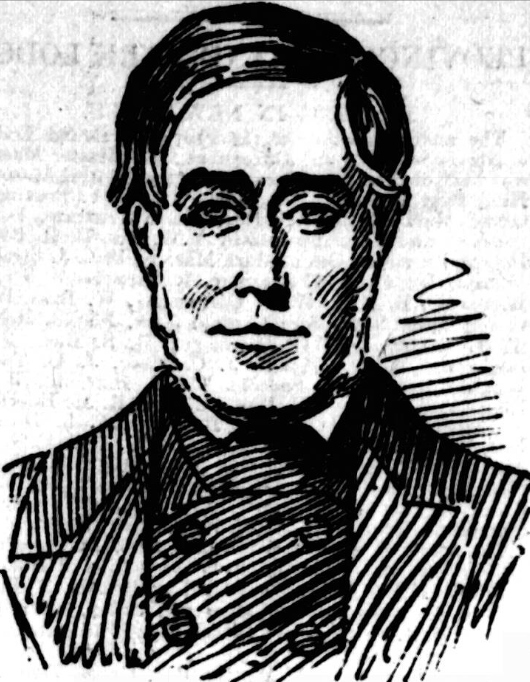
‘Where is this great man of yours, your leader Hepburn?’ The speaker was the third Marquess of Londonderry, one of the richest coalowners in the North East. The man he was after, Thomas Hepburn, was the leader of a trade union of the pitmen extending across the collieries of the Tyne and Wear. The date was 5 May 1831 and the place was the Black Fell, in northern Co. Durham. The pitmen had been locked out and Hepburn had called a monster meeting on the Fell to demonstrate their power, their unity and to encourage more to join the fray. Londonderry, according to his own account, saw the meeting as ‘a hostile assemblage’ and ‘determined go with the troops and disperse such meeting, conceiving that, with banners and with martial array, such an assemblage was entirely illegal.’ It is no surprise therefore that the colliers who saw him approach, leading a military escort, immediately concluded that he had come to take Hepburn prisoner. The pitman who led Londonderry’s horse towards Hepburn is said to have held a pistol concealed among his clothing, ready to fire if Londonderry gave orders to his troops. The stage was set for carnage. But Hepburn maintained his presence of mind, and ‘betrayed neither fear nor resentment’. He ‘coolly held his handkerchief up, the signal for order; and it was obeyed as implicitly as if he had been the general of a perfectly disciplined force. The Marquis, who had seen a deal of active service, is said to have exclaimed when he saw this, “I never saw one man have so much influence over a body of men as this fellow has!”’. As the crowd dispersed Hepburn ‘fell in with the marquess and told him that if the owners agreed to guarantee the men thirty shillings a fortnight the strike would be called off immediately’ (James A. Jaffe, The Struggle for Market Power, p. 172). But negotiations held the next day failed and the lockout continued, at some pits at least, until the middle of June.
Despite the drama of this occasion, nobody knows exactly what Hepburn and Londonderry said to each other. The meeting is fascinating because of the extraordinary contrasts between the two men. Pitmen and aristocrats did not normally meet in the 1830s, even if the aristocrats were coal owners. Much later, in 1875, Thomas Burt, Secretary of the Northumberland Miners’ Association, reflecting on the lives of Thomas Hepburn and another early mining trade unionist, Martin Jude, noted that he and his fellow officials were then, in the 1870s, allowed ‘to stand face to face with the employers of labour and fight out those disputes, by an appeal to reason and common sense, on the broad platform of equality between man and man.’ This he thought was one of the great changes since Hepburn’s time. In Hepburn’s time communications were usually conducted through intermediaries, in Londonderry’s case usually through his head viewer (ie his chief mining engineer and colliery manager), John Buddle, or, as here, Buddle’s assistant, George Hunter, the resident viewer at the Penshaw Colliery. Not least of the reasons for this was the difference in speech between them; Londonderry’s pitmen would have spoken in a broad Geordie dialect, possibly an early form of ‘pitmatic’; Buddle was fluent in both this and in standard English and could translate from one to the other. Londonderry appears to have acquired some understanding of it as well, if the accounts of his meetings with Hepburn are to be believed.
But the contrasts do not stop there. Hepburn’s father died in a colliery accident when he was eight years old. Londonderry’s father lived till he was eighty-one. Hepburn was sent down the pit when he was eight; Londonderry was sent to join the army as an ensign when he was twelve, was commissioned as a lieutenant when he was fourteen, and first saw active service in 1794 when he was sixteen. After various promotions he was appointed aide-de-camp to the King, George III, in 1803. Hepburn’s work never brought him into royal circles, though doubtless the King and all his court burned Tyneside coal. Londonderry was awarded one medal and one honour after another; Hepburn was honoured only in his reputation among the pitmen. Londonderry moved around the country from one estate to another, back and forth between London, County Durham and his Irish estate in County Down, by ship and by horse and carriage; Hepburn travelled around County Durham on foot and by cart. In 1831 Hepburn did not have a vote and nor would he gain one under the Great Reform Act. Londonderry not only had a vote, he got himself elected to the Irish House of Commons in 1800 and by 1831 was a member of the UK House of Lords. Hepburn campaigned for parliamentary reform; Londonderry was one of the staunchest antagonists of the reform movement before 1832, his name being mentioned in the same breath as that of his commander in the Peninsular War, then known as Arthur Wellesley, between 1828 and 1830 the Prime Minister, the Duke of Wellington. Londonderry later achieved greater notoriety by his opposition to Lord Shaftesbury’s Bill to ban women and girls from underground work in the mines and reduce the hours of labour for boys. It was rated as one of Hepburn’s greatest achievements that he had won a reduction in the hours of labour for pit boys in the North East. Hepburn was described as ‘humble’; Londonderry was proud.
Both men married twice. Hepburn’s first wife, Alice Wears, died in Bensham Lunatic Asylum in 1856. In 1859 he married Mary Pattison of Sunderland, a widow twenty years younger than himself, the mother of five teenage children, who was working as a laundress. Neither Alice Wears nor Mary Pattison could claim any celebrity. In contrast, Londonderry’s second marriage was out of the story books. In 1804, he had married Lady Catherine Bligh, the sister of the Earl of Darnley, an event which caused little excitement. But in 1812 she caught a cold which, according to the newspapers of the time, progressed to a brain fever, and died. Seven years later, Londonderry wooed and married Lady Frances Anne Vane in a romance that excited much interest, amplified by the fact that she was not of ‘full age’, was a ward of court, and the marriage had been opposed by one of her guardians, her aunt Mrs. Frances Taylor, who made scandalous accusations of Londonderry’s behaviour. Frances Anne was not only very young, but beautiful, and very, very rich. She had inherited the coalfields of her father, Sir Henry Vane-Tempest, on his death in 1813 and his death made her the most sought after heiress in the whole kingdom. If Londonderry was not notably tall, was fair rather than dark, and neither strikingly handsome nor obviously ugly, there was no doubt about his patriotism, his loyalty to the crown, and his courage on the battlefield. As in all the fairy tales, he fought his battles bravely, vanquished his enemies, won his bride, and secured his fortune. When Hepburn died Mary Pattison had to keep working as a laundress and sought refuge in the household of her son-in-law, the husband of her eldest daughter Christiana, who worked as a labourer in a Tyneside chemical works. Mary died in 1904, aged 87. At least she had a long life. When Londonderry died in 1854 Frances Anne gained unfettered control of her property for the first time and became one of the most powerful coal-owners in the whole of the North East. But she died in 1865, aged only 66.
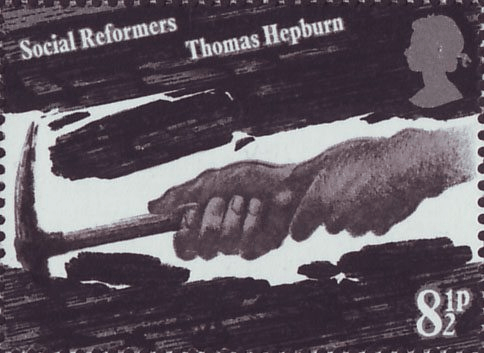
Even Death, the ‘Great Leveller’, failed to level Hepburn and Londonderry. The shades of both were offered memorials: a subscription was eventually raised that paid for tombstones of polished granite to be raised over Hepburn’s grave and that of his younger co-adjutor, Martin Jude, and for a marble bust of each to be placed in the headquarters of the Durham Miners’ Association. (It seems likely that Hepburn had been first placed in an unmarked grave as were many poorer working-class people at this time.) Their memorial committee raised a little short of £200. Londonderry’s memorial committee raised £2,000 and decided on a double life-sized equestrian statue. Hepburn’s tombstone is in the churchyard of St Mary’s Church, Heworth, a few miles east of Gateshead, an area already despoiled by coal and chemical industries by the time Hepburn was buried and rarely visited by tourists then or now. An annual remembrance ceremony is carried out, nevertheless, and when this writer visited the churchyard in November 2024 the grave was festooned with wreaths laid by local miners’ organizations, Gateshead’s Labour councillors, and, fittingly, by the Gateshead branch of the NASUWT, the teachers’ union. The Londonderry statue dominated and still dominates Durham market square and is unmissable by any who visit the City or whose lives are lived there. The conversation between two such contrasting men, or their ghosts, would be spellbinding.
Dr Quentin Outram is Secretary of the Society for the Study of Labour History
Notes, sources, and acknowledgements
The main source for these events is an anonymous but clearly well-informed article written long afterwards as part of a series called ‘Northern Worthies’ and published in The Newcastle Weekly Chronicle, 27 February 1875, p. 2c. The French spelling ‘Marquis’ was usual in the C19th. ‘Black Fell’ is the same place as ‘Gateshead Fell’, being three or four miles south of Gateshead. Its highest point is called ‘Shadron’s Hill’, ‘Shadons Hill’, or Shadon Hill in the various accounts of Hepburn’s meeting; this is marked as ‘Shaddon’s Hill’ and then ‘Sheddon’s Hill’ on C19th Ordnance Survey maps. The nearest modern landmark is The Angel of the North about a mile to the west.
Londonderry’s own account of his meeting with Hepburn was published as a letter in the Durham County Advertiser for 3 June 1831 and subsequently widely re-published, in, eg, The Morning Chronicle, 4 June 1831. Burt’s remarks are quoted from the Newcastle Daily Journal, 8 November, 1875, p. 4. Buddle’s linguistic competence is documented in Christine E. Hiskey, John Buddle (1773-1843): Agent and Entrepreneur in the North-East Coal Trade, University of Durham, M.Litt. thesis, 1978, p. 288, citing G. C. Greenwell, ‘Mining Reminiscences –No. 1: John Buddle’, The Colliery Guardian, 1900. For ‘pitmatic’, see Bill Griffiths, Pitmatic: The Talk of the North East Coalfield, Northumbria University Press, 2007.
For Londonderry’s life see the entry in the Oxford Dictionary of National Biography and the well-written but partial account by Edith Londonderry, Frances Anne: The Life and Times of Frances Anne, Marchioness of Londonderry, and her Husband Charles, Third Marquess of Londonderry, Macmillan, London, 1958. Londonderry’s courtship of Frances Anne has been accurately related by Lauren Gilbert who is, suitably enough, an author of historical romances.
For Hepburn’s life, see Richard Fynes, The Miners of Northumberland and Durham, Blyth, 1873, reprinted by Thomas Summerbell, Sunderland, 1923; Fynes’s letters to the editors of the Newcastle Weekly Chronicle, 20 March and 2 August 1873, the Newcastle Daily Journal, 18 February 1875, and the Newcastle Journal, 25 February 1875; and the entry by Joyce Bellamy and John Saville, in the Dictionary of Labour Biography, volume III. The Oxford Dictionary of National Biography perpetuates the inequalities between Londonderry and Hepburn in the contrast between its four-paragraph entry for Hepburn (which also fails to mention even the names of his wives) and the seventeen paragraphs devoted to Londonderry together with the seven devoted to Frances Anne.
For Victorian working-class burials, the best source is Sylvia M. Barnard, To Prove I’m Not Forgot: Living and Dying in a Victorian City, Manchester University Press, 1990, which comments on the failure of much burial insurance to provide for the cost of a headstone. I am grateful to the Revd Lucy Moss, the priest in charge at Heworth St Mary, who kindly directed me to Thomas Hepburn’s grave on my visit to the churchyard in November 2024. The topography of Heworth is from Francis Whellan’s History, Topography and Directory of Durham, London, 2nd edition, 1894.
The best modern account of Hepburn and Londonderry’s meeting is in Jim Jaffe’s book The Struggle for Market Power: Industrial Relations in the British Coal Industry, 1800-1840, Cambridge University Press, 1991, at p. 172).
You can read all the Class Encounters in this series here.
Discover more from Society for the Study of Labour History
Subscribe to get the latest posts sent to your email.
 Society for the Study of Labour History