In the sixth of our series on meetings with figures from labour history, Vic Clarke encounters the Chartist leader, MP and newspaper proprietor Feargus O’Connor.
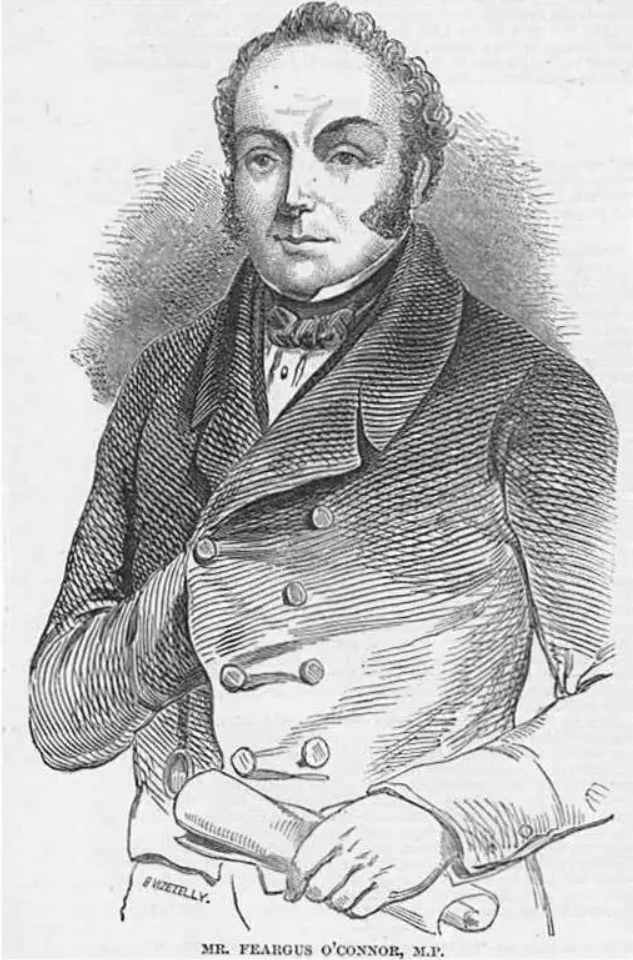
Any collective effort is bound to include a clash of personalities, and self-proclaimed ‘people’s friend’ Feargus O’Connor certainly came to clashes in the Chartist movement. A surprisingly understudied figure, O’Connor’s charismatic and bombastic editorials, or ‘letters’ to his readers in the Northern Star are famous within the record of the movement, acknowledged by the acrimonious and first historian of movement, R. G. Gammage writing in 1854. [1]
O’Connor entered radical agitating in England following the end of his tenure as MP for his native County Cork in 1835, and was able to establish the leading newspaper of the Chartist movement, the Northern Star, through his radical credentials and connections. James Epstein, in his study of the founding of the Star, notes that publisher Joshua Hobson trusted his reputation as a ‘gentleman’ of means and his persistent criticisms of the workhouse system of the New Poor Law of 1834. [2]
Reading his letters – both private and public – almost 200 years on raises many questions about celebrity culture in early Victorian Britain. I would be fascinated to meet O’Connor at his zenith during his prolific lecture tours of 1839-40 following the rejection of the first Chartist petition in parliament. This was just before his factious rift with William Lovett’s ‘New Move’, publicly denounced in the pages of the Northern Star in 1841; but coincided with the seeds of his idea of the Chartist land plan, an imaginative but mismanaged utopian vision for rehabilitating industrial workers from unsanitary and overcrowded living and working conditions. [3] However, the fandom around Feargus O’Connor speaks to the conviviality of the Chartist movement – to be a fly on the wall of one of the many soirees and tea parties of the cause, would be to witness not just great speeches, but their reception and subsequent gossip. Of course, I’d hope he not ask explanation for my extremely 21st century sense of style including short, purple hair.
Dr Vic Clarke is a historian of 19th century British radical politics and print culture. She is currently working towards her first monograph on the Northern Star (1837-1852). Find her here or on Instagram and Bluesky @vjc_torianist.
References
[1] R. G. Gammage, History of the Chartist Movement 1837-1851 (London: Merlin, 1969 [1854]), p. 17. For more recent scholarship on O’Connor, without personal bones to pick, see Paul Pickering, Feargus O’Connor: A Political Life (Monmouth: Merlin Press, 2008) and Catherine Howe, ‘Feargus O’Connor and Louisa Nisbitt’ (2016).
[2] James Epstein, ‘Feargus O’Connor and the Northern Star’, International Review of Social History 21.1 (1976), pp. 51-97.
[3] For a thorough explanation of the ‘New Move’ and denouncement in the Northern Star, see Malcolm Chase Chartism: New History (Manchester: Manchester University Press, 2007) pp. 168-178.
You can read all the Class Encounters in this series here.
Discover more from Society for the Study of Labour History
Subscribe to get the latest posts sent to your email.
 Society for the Study of Labour History