In the third of our series on meetings with figures from labour history, Mark Crail encounters George Julian Harney, editor of the Northern Star and Red Republican.
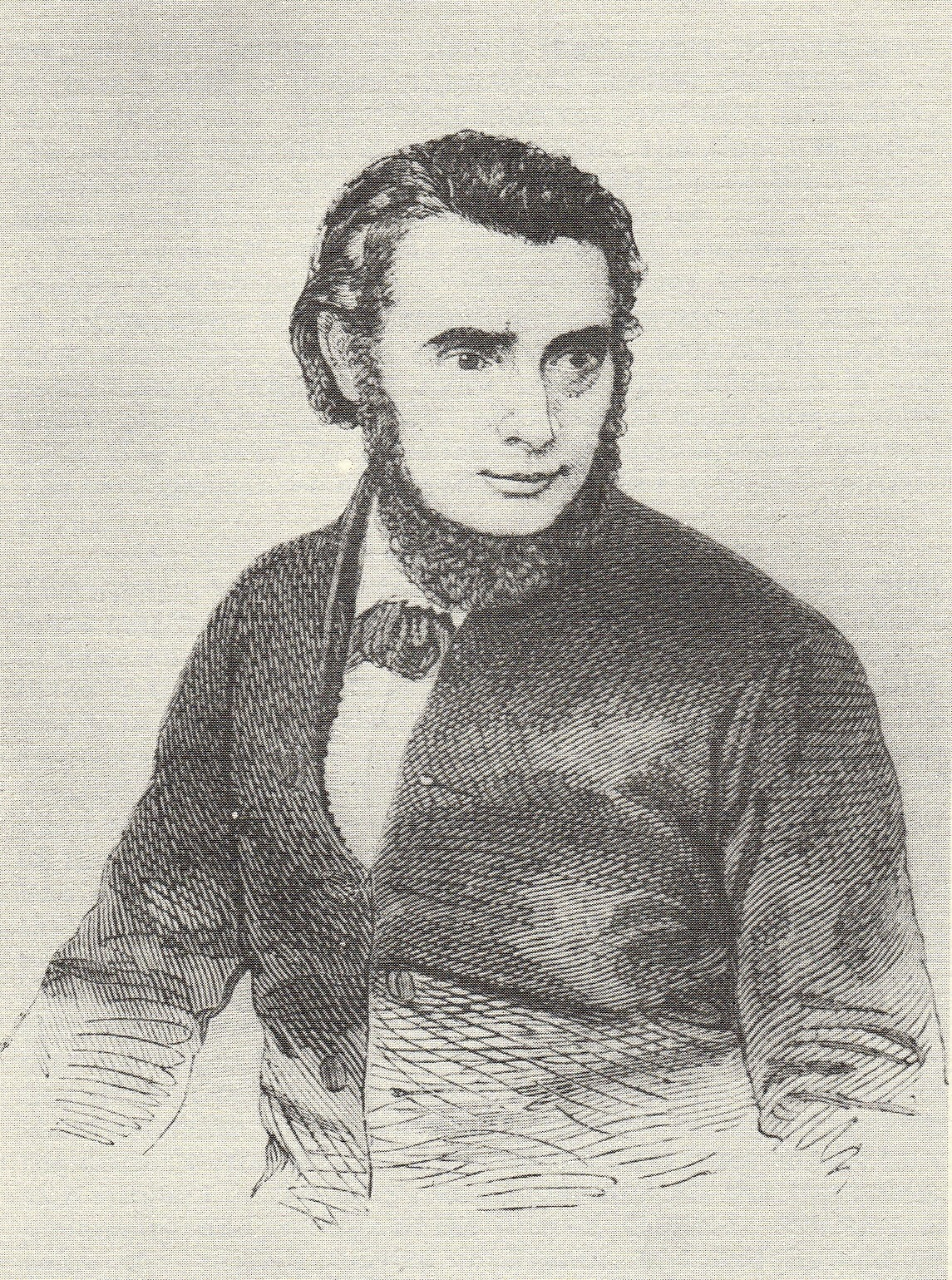
On a bitterly cold Christmas Day 1840, George Julian Harney walked eighteen miles across North-East Scotland from Elgin to Keith in the hope of reviving the town’s Chartist Association. But when he got there, no lecture room could be had, and local radicals told him that ‘an outdoor meeting was not to be thought of, the cold being intensely severe’1. Some people, it seems, will do anything to get out of a family Christmas. But Harney was not lacking in conviviality and good cheer. The letters he sent to ‘My dear Engels’ over the fifty years of their friendship have plentiful references to a ‘good Rhenish wine’ or ‘a glass of fair whisky’ for which they shared a liking; and in December 1850, Harney would write telling Engels: ‘If you come to London at Christmas be sure to see us. The pipe of peace shall be forthcoming, and fire-water shall not be wanting.’2
As someone who has researched and written about Chartism for many years, I have lots of unanswered questions , and can think of no-one who lived through those years who would have been better placed to answer them than Harney, his story-telling lubricated, perhaps, by a glass or two of something alcoholic.
Born at Deptford in 1817 and finding work at a young age with the radical London publisher Henry Hetherington, Harney had already served three prison sentences for distributing the Poor Man’s Guardian and other unstamped papers by the time he was nineteen. In his early twenties, he was a notable voice on the left of Chartism, and would be a leading figure in the movement through to the 1850s, as an organiser and editor, first of the Northern Star and then of his own Red Republican and other papers. Always an internationalist, Harney was also the leading advocate for ‘the Charter and something more’. But after his wife’s death in 1853, Harney retired from active politics, and moved to Jersey and then America, where he lived for thirty years before returning to England.
So what could Harney tell us? It is true that he was probably not a party to the plan for a nationwide uprising that ended so badly on the steps of the Westgate Hotel in Newport (he had his own legal problems to contend with at the time), but he must have known the real story of the conspiracy and how it went so badly wrong. It would be interesting, too, to have him talk about some of those he struggled alongside (and sometimes against). The letters he and Feargus O’Connor exchanged during his time at the Northern Star are often a masterpiece of polite passive aggression. In later life Harney wrote about the Chartist years in his regular column for the Newcastle Weekly Chronicle3. But that was half a century after the event, and often he was, in effect, writing the obituaries of those who had recently died. Harney in old age bore few grudges, or if he did, he chose not to write about them.
It would be fascinating to know what was said at New Year 1851 between his star columnist on the Red Republican, Helen MacFarlane, and Mary Cameron, the radical weaver’s daughter from Mauchline who married Harney after they met at the end of his two-thousand-mile trek through Scotland. So much for the Proclaimers. Whatever it was, MacFarlane left the paper for good, and Marx and Engels broke completely with Harney for some years. Out of personal curiosity, I would also love to question Harney about my three-times-great-grandfather James Grassby, who sat alongside him on the National Charter Association executive committee and sided with him on many issues during Chartism’s final days.
Finally, it is worth noting that in 1897, the year in which Harney died, the socialist journalist Edward Aveling travelled to leafy Richmond to interview the now bed-bound old Chartist for the first issue of The Social Democrat4. The article he published is notable for its evocative description of the pictures and books that surrounded Harney in his old age, but less so for anything that he might have had to say. Harney would appear to have been a talkative, but rather uninformative interviewee. I hope I might have done better had I had the chance to question him when the memories were still fresh and had not yet had time to calcify into anecdotes.
Mark Crail runs the Chartist Ancestors website and edits the Society for the Study of Labour History website.
References
1. ‘Julian Harney in the North’, Northern Star, 16 January 1841, p2.
2. The Harney Papers, edited by Frank Gees Black and Renee Métivier Black (International Institute of Social History, 1969).
3. George Julian Harney: The Chartists Were Right, edited by David Goodway (Merlin Press, 2014).
4. ‘George Julian Harney: A Straggler of 1848’, by Edward Aveling, The Social-Democrat, Vol. 1, No. 1, January 1897. On the Marxists Internet Archive.
You can read all the Class Encounters in this series here.
Discover more from Society for the Study of Labour History
Subscribe to get the latest posts sent to your email.
 Society for the Study of Labour History