In the second of our series on meetings with figures from labour history, Janette Martin encounters her namesake, the Owenite lecturer Emma Martin
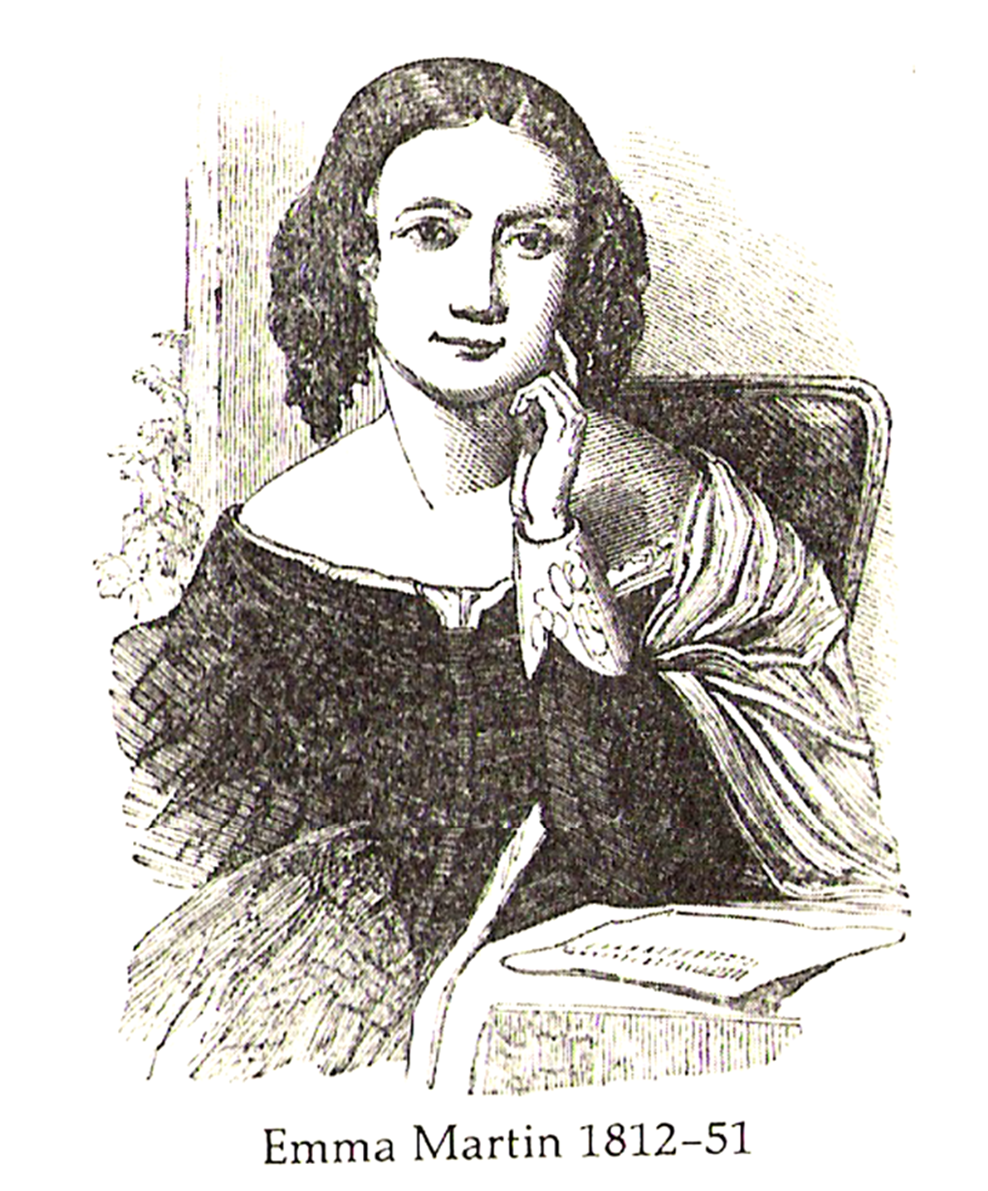
I would most like to meet Emma Martin (1812-1851), the feisty woman who escaped an unhappy marriage to earn a living as an itinerant Owenite lecturer while bringing up her three young daughters.
Emma was born in Bristol to a lower middle-class respectable family, and as a young woman was a devout Baptist who spent many years distributing tracts and raising funds for the Bible Society. She first attended lectures hosted by the Owenite socialists to refute their arguments point-by-point. Yet the more she listened, the more attractive the philosophy espoused by the followers of Robert Owen became. Their progressive attitudes on the position of women, in particular, resonated and ultimately persuaded her, in 1839, to walk away from her abusive husband and to throw her lot in with the Owenites. By all accounts, she was a talented and articulate speaker and within a year became an Owenite movement lecturer. She had a deep intelligence and ready wit and the novelty of seeing and hearing a woman speaker attracted audiences. Reporting on a set-piece debate between a female infidel lecturer (aka Emma Martin) and a Baptist minister, the Hull Reporter (11 October 1844) reluctantly conceded that Emma Martin was more than a match for her opponent. Having spent years listening and thinking through the arguments I am sure Emma Martin would have had plenty of cutting rebuttals up her sleeve and would not have shied away from expressing her views. As a former devout Baptist she would have known the bible inside out and was unlikely to be beaten on scriptural accuracy. While grudgingly conceding that Emma was the best at debate the reporter could not resist making snide remarks about her appearance.
Mrs Martin [was] a very short woman, with remarkably round shoulders, and is between thirty and forty years old. Her face is spoilt with a low forehead; her small and piercing but deeply embedded eyes, gives the whole countenance a restless and sinister appearance.
Just like today, women are judged and rated on their looks and Emma was frequently measured and found wanting, too short, too stout, not to mention those sinister and menacing eyes. This is an all too familiar way in which misogynists have sought to control and degrade uppity women who step outside their proscribed sphere.
If I met Emma, what would I ask her? How she found the strength to leave a secure middle-class life and risk everything for a difficult and precarious life on the road. How old were her girls when she ran away, and had she built up a running away fund? I would also want to ask which was her favourite response to a heckle? How did she silence those that sort to speak over her? And where did she find the strength to carry on? I’d want to know whether she found love and an equal partnership with her common law husband Joshua Hopkins and what made her take up the profession of midwife? Was it vocation and the desire to help or financial need?
I know we are supposed to invite host only one person from history but I would also invite George Jacob Holyoake (1817-1906) to join us for coffee and mints. But only once Emma and I had covered all the key discussion points above. Holyoake acquired fame and a historical legacy as a co-operator, but he also started out his career as an Owenite itinerant lecturer and was very good friends with Emma Martin. So much so that it was Holyoake who delivered her grave side oration and left us with a beautiful vignette of her character and appearance. Holyoake described Emma Martin as having ‘the wit and the courage of several men’ and an ‘attractive expression with dark luminous eye’ and said that she was a ‘womanly woman’. It is interesting that Holyoake felt the need to defend her femininity, as if the platform itself had eroded such characteristics and opened her up to slur and derision. Holyoake was well aware that for a woman to speak in public, to openly argue with ministers and to present an infidel argument was deeply unrespectable, and to be paid for her work was even more beyond the pale. Holyoake’s words are backed up by an engraving of Emma Martin which appeared in The Reasoner (6 May 1855) and which shows her as an attractive woman with expressive eyes.
Emma died young and the last years must have been difficult and full of struggle. But what a woman! I am proud to share her name. Emma Martin is buried in Highgate Cemetery, London.
Janette Martin is Vice Chair, Society for the Study of Labour History
You can read all the Class Encounters in this series here.
Discover more from Society for the Study of Labour History
Subscribe to get the latest posts sent to your email.
 Society for the Study of Labour History