My thesis examines the policy and activism of the Irish Labour Party and Trade Union Congress (ILP&TUC) during the late revolutionary period (c.1918 to 1923). I seek to understand how the party responded to, and navigated, the various socioeconomic crises (unemployment, poverty, wage inequality, and cost of living) which plagued the island of Ireland post-First World War. My thesis also considers the issues of British, Irish Free State, and IRA-perpetrated violence and the extent to which these exacerbated social and economic degradation.
The post-war period marked a watershed moment for Irish labour, as the movement grew unprecedentedly in strength, reach, and confidence. During this epoch, working-class radicalism broke uniformly beyond Ireland’s factories. British demand for food during the First World War caused the agricultural sector on the island of Ireland to boom. With this prosperity, organisation in trade unions became more attractive than ever. Between August 1918 and January 1919, the first ten Irish Transport and General Workers’ Union (ITGWU) branches were established in County Roscommon. In the local elections of the following year, the ILP&TUC became the largest party on the County Council. My thesis uses Co. Roscommon as a case study to demonstrate the considerably successful expansion of the labour franchise into the agrarian west after 1918.
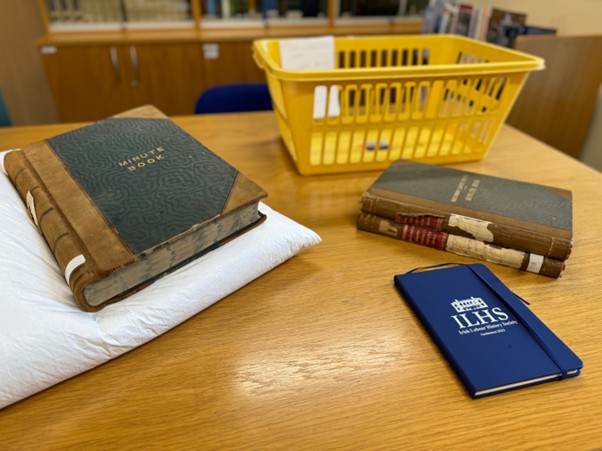
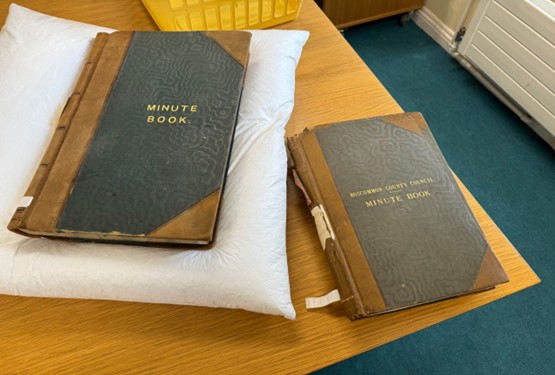
Practically all the archival material concerning this history is available solely in the Roscommon County Library. Hence, the research bursary offered by the SSLH to study here, was both crucial and very welcome. The local studies approach has transformed our understanding of the Irish revolution; it was incredibly exciting to be able to apply this methodology to my own work. At the library, I was granted access to the meeting minute books of the Roscommon County Council from 1916 through 1923. It took three visits to look through all the c.700 pages of this material. The insight these records offered, however, was invaluable. In perusing the pages of these books, I was able to witness how attitudes towards workers and organised labour changed across time, as well as how the rights and requests of different classes of workers were prioritised by county councillors. Examining the collection as a whole, it was made clear how the changing political make-up of the council impacted decisions made on the most pressing political and economic matters of the day. Of particular interest to my research, was the notes from the 1920 sessions of this body. Here, a Labour-dominated council interacted frequently with representatives of local ITGWU branches, and passed many important motions advancing the rights of all types of workers in the county. Considering I was unable to find any records of these interactions elsewhere, access to these books proved vital. Senior Library Assistant Mary Costello was also very helpful in providing digital copies of local newspaper articles, taken from The Roscommon Herald and The Roscommon Messenger, depicting instances of strike action or ITGWU activity. These articles offered important insight into the wider appeal and popularity of the burgeoning organised labour movement in Roscommon, as well as it was how it was perceived by local media.
Thanks to the SSLH’s research bursary, I was able to uncover a key part of the revolutionary labour narrative in County Roscommon, which embellished both the quality and content of my thesis. As the son of a Rossie, it was a privilege to study this history.
The bursary also enabled a three-month subscription to the Irish Newspaper Archives (INA). Thanks to this repository, I was able to analyse the reportage of labour events in broadsheets such as The Irish Times and The Irish Independent. I also browsed articles from The Roscommon Herald to supplement my research on this county. Access to these local and national publications allowed me to understand the relative position of labour (and the party) on the national stage, as well as how the movement operated and developed in the quotidian. Subscription to the INA’s sister catalogue, the Radical Newspaper Archive, granted access to the ITGWU periodical, The Voice of Labour. With this material, I consolidated my understanding of the party’s positions on the major political issues of the day, while also gaining further insight into the ILP&TUC’s proposals to tackle the dire socioeconomic situation on the island of Ireland, and later, the Irish Free State.
Again, I must reiterate my sincere gratitude to the SSLH, for enabling me to research a topic of history that is so dear to me.
Ciarán Kelly was awarded a SSLH BA/MA Dissertation Bursary for his research entitled ‘The Country in Danger!’ Fighting the ‘Other’ Civil War: The Irish Labour Party and Trade Union Congress, 1918-1923. He is studying for an MPhil in Modern Irish History at Trinity College Dublin.
Find out more about the BA/Taught Masters Dissertation Bursary Scheme.
Discover more from Society for the Study of Labour History
Subscribe to get the latest posts sent to your email.
 Society for the Study of Labour History