I am currently working on a book titled A History of the Labour Party in Scotland (to be published by Edinburgh University Press) which will examine the party’s origins in late nineteenth-century working-class politics and trade unionism, through to the formation of a distinct and ‘national’ Scottish Advisory Committee during the First World War. It will then chart the breakthrough of the Red Clydesiders’ at the 1922 general election and the party’s subsequent growth to become, at first, the main opposition in Scotland, and then, from the late 1950s, the largest party as Scottish Conservatism/Unionism declined. Finally, it will look at the challenge presented to Labour by the Scottish National Party (SNP) after 2007. The goal is to fill a gap in the literature by producing (as with similar volumes on the Scottish Liberals and Conservatives) a scholarly yet accessible work on the Labour Party in Scotland, exploring its organisation, ideology, personnel and electoral performance over the past century.
A Society for the Study of Labour History bursary allowed me to undertake two research trips to archives in Scotland where, naturally, most of the relevant primary material is held. My focus was the National Library of Scotland (NLS) and National Records of Scotland (NRS) in Edinburgh, as well as the Scottish Political Archive in Stirling and the Aberdeen University Library. I was particularly interested in reviewing correspondence and pamphlets which form part of several Scottish Labour politicians’ personal archives. Most of this material related to the post-war era, when the party attempted to balance its socialist ideology with growing pressure (from voters and other political actors) for some degree of administrative and legislative autonomy over ‘Scottish affairs’.
The first research trip took place in June 2024, mainly to the NLS in Edinburgh. Of particular interest to me were the personal papers of James Craigen (a Labour and Co-op MP), Keir Hardie (one of the founders of the original ‘Scottish Labour Party’ in the late nineteenth century), Emrys Hughes (the Labour MP and journalist), Thomas Johnston (the wartime Secretary of State for Scotland), Arthur Woodburn (a post-war Scottish Secretary), George Lawson (another Labour MP) and J. P. Mackintosh (a political scientist as well as a Labour MP). This material, mainly correspondence between each individual and other members of the Labour movement as well as policy pamphlets and material from election campaigns, helped me better understand this twin discourse (ideology vis-à-vis the constitution) which took place within the movement during the post-war era.
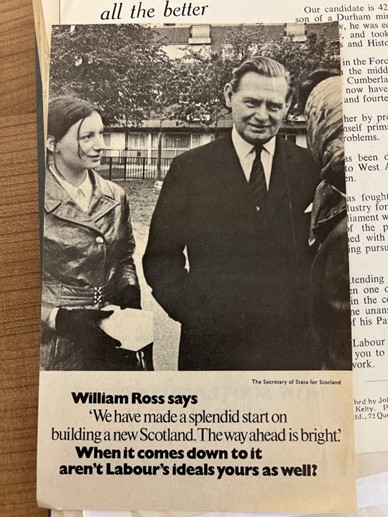
In particular, I wanted to identify the point at which Labour’s message became more tailored towards specifically Scottish policy and concepts of Scottish nationhood, something illustrated by this election leaflet featuring Willie Ross (Secretary of State for Scotland between 1964-66 and 1974-76) from the 1970 general election.
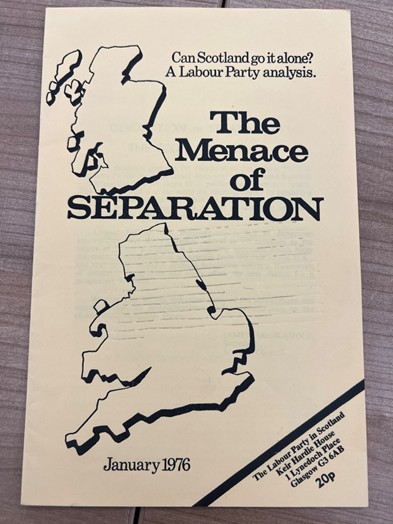
The J. P. Mackintosh collection at NLS was particularly rich in political pamphlets, again regarding the devolution issue and the electoral challenge posed by the SNP. Examining these helped me understand how conflicted the party (if not Mackintosh) was over constitutional policy in the 1970s, with many in the party equating any concession of legislative autonomy with the potential break-up of the United Kingdom. See, for example, the title of this Scottish Council publication from 1976, when such debates were at their height.
At NRS (formerly the National Archives of Scotland) I was able to consult a modest collection of material relating to the life, family and career of Donald Dewar, another Secretary of State for Scotland who became Scotland’s first First Minister in 1999. Although richer on his family than his political career, I was able to get a sense of his political development on the right and ‘nationalist’ (or pro-devolutionist) wing of the party through correspondence and campaign material, including exchanges with Hugh Gaitskell when Dewar was a student and with Willie Ross when he was first an MP (in Aberdeen South) in the late 1960s.
My second research trip took place in August 2024, beginning in Aberdeen and continuing to Glasgow and Stirling. At the Aberdeen University Library I examined local trade union material which helped me understand how organisations in the north-east of Scotland interacted with the local Labour Party and Scottish Trades Union Congress, particularly during the General Strike of 1926. At the Mitchell Library in Glasgow, meanwhile, I was able to examine material from the district and city Labour Parties, mainly council manifestos and campaign literature, which will allow me to ensure that my book does not neglect the local government dimension, particularly as Labour dominated that level of government until the early twenty-first century.
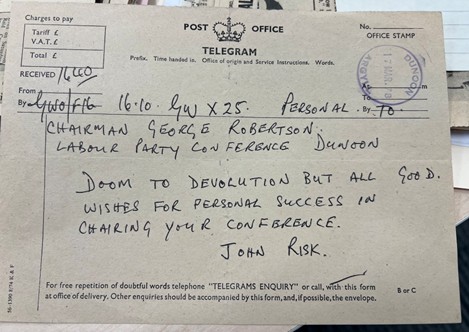
A day at the Scottish Political Archive at Stirling University allowed me to look at more contemporary material from the personal and political papers of George Robertson (a long-serving Shadow Scottish Secretary), George Foulkes and John McAllion (both veteran Labour MPs and MSPs). Unfortunately, it did not prove possible to consult Jack McConnell’s papers as permission was required and this was not forthcoming. The George Robertson collection, however, was particularly useful as it spanned several decades of involvement with the Labour Party in Scotland, with several files devoted to the devolution issue. For example, this telegram highlighted (in a humorous way) tensions with the Scottish Council of the Labour Party during the 1970s.
Another interesting discovery was a long strategy paper composed by Robertson as Shadow Scottish Secretary following the election of Tony Blair as UK Labour leader in 1994. This helped me understand how the generally more left-wing Scottish Labour Party (as it was renamed that year) reconciled itself with the more centre-right and modernising agenda of Blair.
These two research trips proved invaluable in that primary research has always formed a central part of my published work on political history. Although the Scottish Labour Party is well covered by secondary sources, this archival material will add depth and nuance to my final book. I am very grateful to the Society for the Study of Labour History for its financial support in this respect.
Dr David Torrance is a constitutional specialist at the House of Commons Library and an historian whose previous books include A History of the Scottish Liberals and Liberal Democrats (Edinburgh University Press, 2022) and A History of the Scottish Conservative and Unionist Parties (Edinburgh University Press, 2024).
Find out more about bursaries on offer from the Society for the Study of Labour History.
Discover more from Society for the Study of Labour History
Subscribe to get the latest posts sent to your email.
 Society for the Study of Labour History