‘Are you a socialist?’ enquired the Independent Labour Party in a recruitment leaflet published in March 1909. It went on to list six questions about the reader’s beliefs, to which, if the answer were to be ‘yes’, the appropriate course of action would be to join the ILP and help carry its principles into effect.
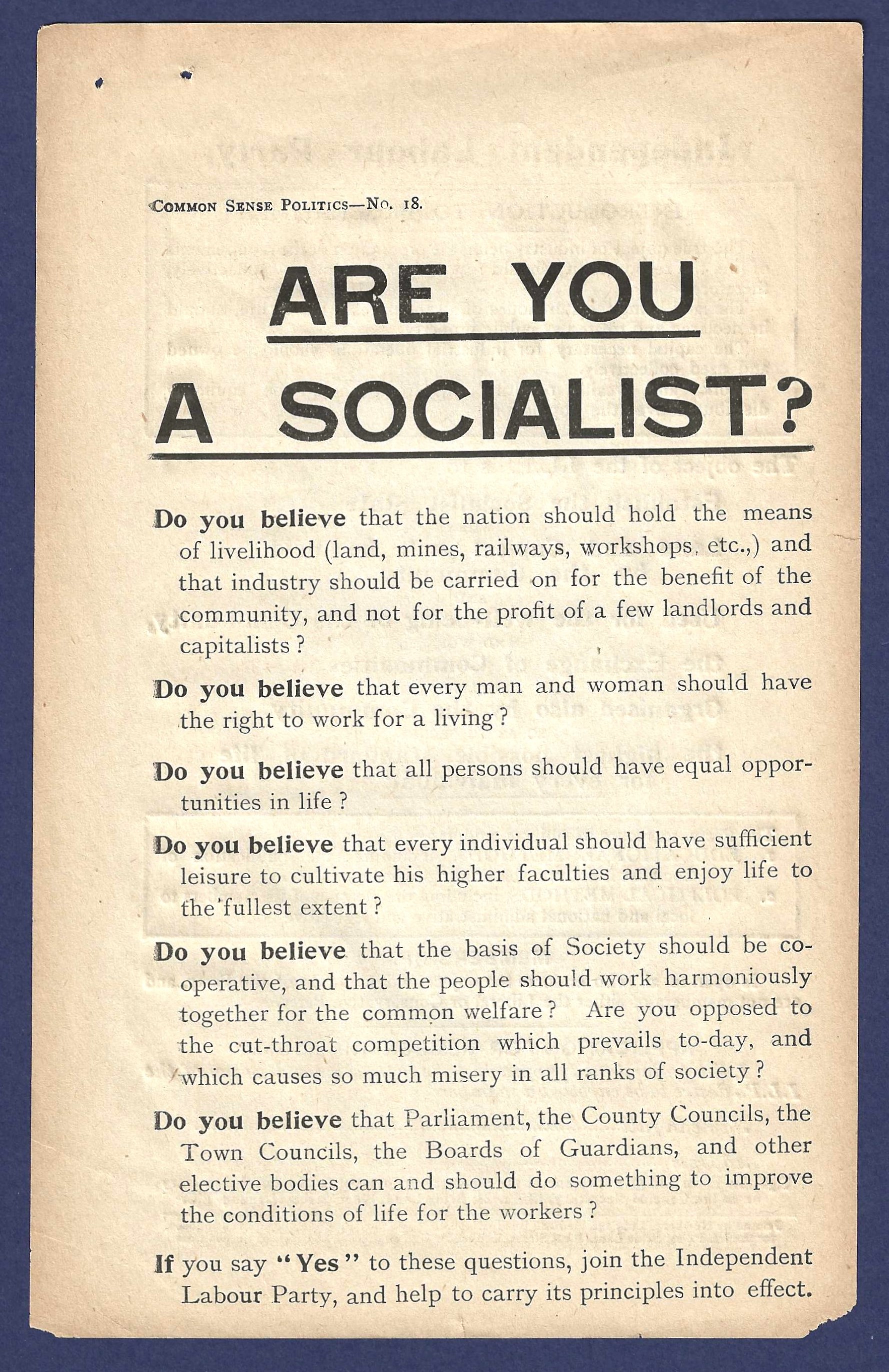
The leaflet itself is of little significance. It includes an introduction to the party’s programme, sets out the object of the ILP, adopts education and electoral office as the route to attaining its objectives, and makes clear that membership is open to all who endorse the object and methods of the party and are not members of either the Liberal or Conservative Party. Leaflets of this sort, would have been printed in huge numbers and issued from the ILP office at 23 Bride Lane, just off London’s Fleet Street.
But the timing of its appearance is of interest. In 1909, the ILP established the National Labour Press, an initiative which laid the groundwork for the large-scale publication of agitational material that moved the ILP on from what the labour historian Keith Laybourn has described as an ethical and moral brand of socialism based on an older Liberal Radicalism, and put it on the path to a more intellectually coherent socialism within a few short years. This leaflet sits right on the cusp of that change in the party.

Looking back on the ILP of the early 1900s, the future Labour MP Fenner Brockway would capture the earlier, almost religious tone of the times: ‘On Sunday nights a meeting was conducted rather on the lines of the Labour Church Movement—we had a small voluntary orchestra, sang Labour songs and the speeches were mostly Socialist evangelism, emotion in denunciation of injustice, visionary in their anticipation of a new society.’
At this stage, it was still not possible for individuals to join the Labour Party directly. From the party’s launch in 1906 until its adoption of a new constitution in 1918, individuals could become members only by joining an affiliated organisation – in practice, the ILP, Fabian Society or a trade union. This was greatly to the benefit of the ILP, whose more radical programme appealed to growing socialist audience in the country.
This all changed in 1918 as the ILP ‘lost its primacy as a socialist parliamentary party when it had its birth right “filched” by the Labour Party, which adopted the famous Clause Four (3d) in its constitution’. But when the leaflet shown here was printed, this was all some way in the future. For now, and with forces further left yet to coalesce into what would become the Communist Party of Great Britain, the ILP was largely unchallenged as the party of socialism.
Further reading
Who needs the ILP? How Labour’s 1918 constitution set it an existential challenge. The ILP’s response to Labour’s new constitution (on this website).
A Century of Labour: A History of the Labour Party 1900-2000, by Keith Laybourn, Sutton Publishing, 2000.
The Independent Labour Party, 1914-1939: The Political and Cultural History of a Socialist Party, by Keith Laybourn, Routledge, 2020 (paperback 2022).
Socialism In Britain Since 1884, by John Callaghan, Wiley-Blackwell, 1990.
Discover more from Society for the Study of Labour History
Subscribe to get the latest posts sent to your email.
 Society for the Study of Labour History