Hugh Clegg was a founding figure of post-war British industrial relations. He defined ‘industrial democracy’ as collective bargaining with trade unions, laid the foundations for the pluralist approach to industrial relations, was a key figure in the post-war social sciences, and a major public policy player.
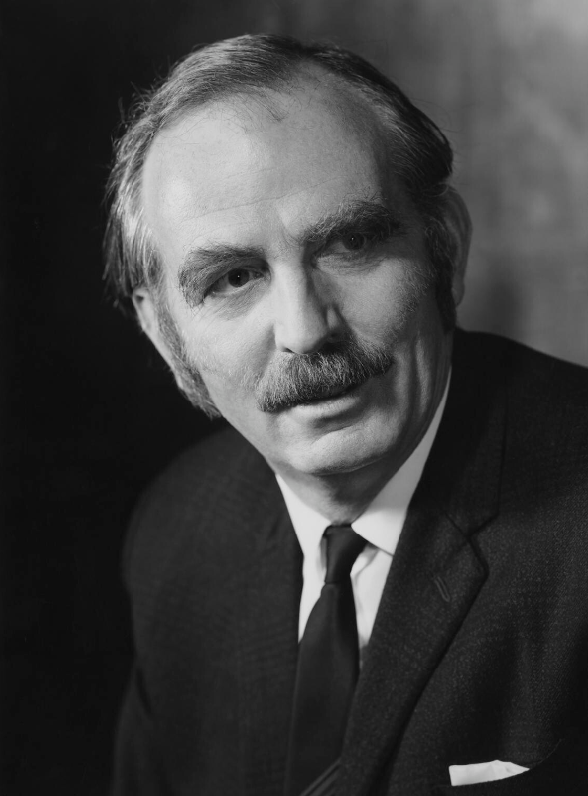
© National Portrait Gallery, London
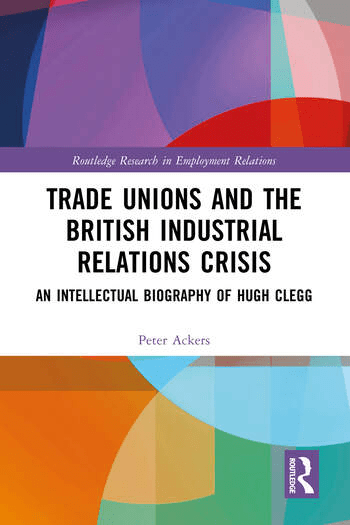
In a new book, Trade Unions and the British Industrial Relations Crisis, Peter Ackers, Emeritus Professor in the History of Industrial Relations at Loughborough University, offers an intellectual biography of Clegg, who he points out was also well known in his lifetime as a labour historian, and an active member of the Society for the Study of Labour History.
As an historian, Clegg produced the three-volume A History of British Trade Unions since 1889 for Oxford University Press, the first volume of which (written jointly with Alan Fox and A.F. Thompson) was published in 1964, followed by volumes two and three (single-handed) in 1985 and 1994, and two histories of the General and Municipal Workers’ Union.
More widely, Clegg was an important figure in the Cold War social democratic academic left, who broke with his earlier Communism to champion free trade unions in a liberal democratic society. An obituary in Labour History Review noted that he was ‘one of the foremost labour historians of his generation’, but went on: ‘His views were not always to the taste of some of our more left-inclined historians, but all recognise the magnitude and scholarly nature of his achievement’ (LHR 60:3, 1995).
Born in Truro in May 1920, after wartime service Hugh Clegg gained a first-class degree in PPE at Oxford, but was persuaded by G.D.H. Cole to focus on industrial relations. He would later serve on the Royal Commission on Trade Unions and Employers Associations (the Donovan Commission) and as a member of the National Board for Prices and Incomes, both of which were established during Harold Wilson’s first term in office.
In 1967 Clegg became the first Professor of Industrial Relations at Warwick University, where he founded the Industrial Relations Research Unit. He retired from the university in 1979 to focus on the second and third volumes of his History, and in the same year was asked by James Callaghan to chair a Standing Commission on Pay Comparability; this was subsequently wound up by the incoming Conservative government of Margaret Thatcher. Clegg died in December 1995.
In Trade Unions and the British Industrial Relations Crisis, Professor Ackers aims to understand the politics and industrial relations of the post-war period in Britain (in which trade unions were central) through the life of a key public intellectual.
The book aims to help readers understand the political and social science roots of contemporary employment relations and human resource management through a deep historical study of Clegg’s life and times, in the context of his post-war social democratic generation. It illustrates how the failures of post-war industrial relations led to Thatcherism.
For Professor Ackers, the book marks the capstone of twenty years of work on Hugh Clegg and the ‘Oxford School’.
Further information about the book can be found on the website of publishers Routledge.
Table of contents
1 Introduction: Why does Hugh Clegg still matter?
Part One: Intellectual and Political Formation
2 A Methodist Family (1920-32)
3 A Communist in a Methodist School (1932-39)
4 Mass Observation then Oxford (1939-41)
5 War and Marriage (1941-45)
Part Two: An Academic and Public Life
6 Losing Faith: Magdalen College (1945-47)
7 Industrial Democracy: Nuffield College (1947-54)
8 The ‘Oxford School’ of Industrial Relations (1954-64)
9 Reforming British Industrial Relations: The Donovan Commission (1964-68)
10 The ‘Warwick School’ of Industrial Relations (1968-79)
11 The Thatcher Turning Point? From Industrial Democracy to Trade Union History (1979-95)
12 Personal Epilogue: The legacy of Hugh Clegg
Discover more from Society for the Study of Labour History
Subscribe to get the latest posts sent to your email.
 Society for the Study of Labour History