Opening a website series on songs associated with labour history, John McIlroy looks at ‘The Working Class in Twentieth-Century Song: A Fan’s Notes[1]’ arguing that researching the genealogy of songs, finding new ones, rediscovering old ones, exploring the cultural ambience in which they were created and performed is part of the folklorist’s mission and the historian’s brief.
Find out more about this series.
Introduction
The Great American Song Book and the World of the Working Class
Rock ‘n’ Roll, Country, Love and Labour
The Swinging Sixties and Militant Seventies, Protest, Working-Class Heroes and Revolution
Punk Rock, Thatcher, Reagan, Anti-Racism and the Great Miners’ Strike
Folk Music, the Music of Labour?
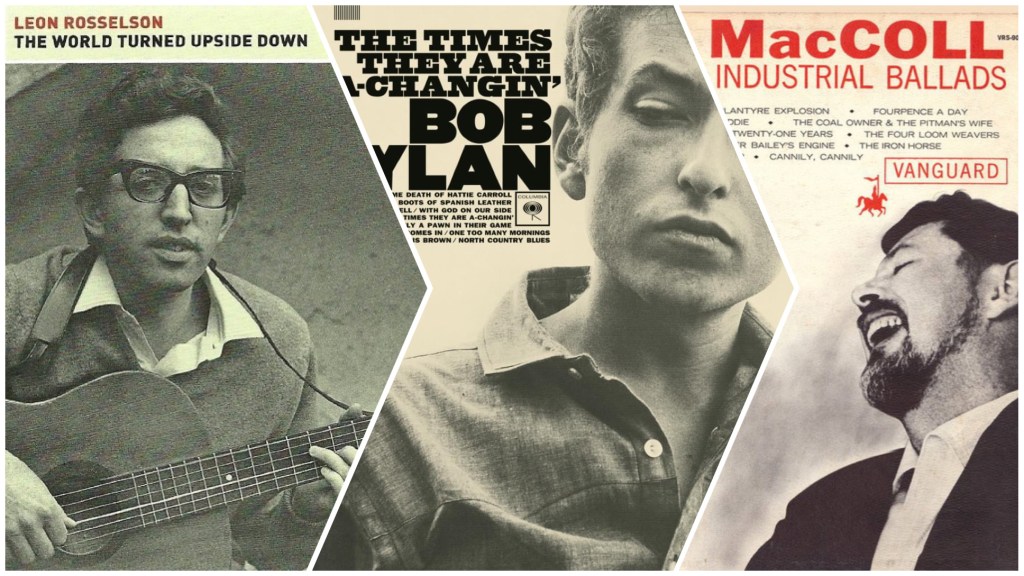
♫ Leon Rosselson, The World Turned Upside Down
♫ Ewan MacColl, Four Pence A Day
♫ Luke Kelly and The Dubliners, Dirty Old Town
♫ Brendan Behan, The Captains And The Kings
♫ Leon Rosselson, Palaces Of Gold
♫ Paul Brady, Arthur McBride And The Sergeant
♫ Ewan MacColl, The Shoals Of Herring
♫ Leon Rosselson, Tim McGuire
♫ The Clancy Brothers and Tommy Makem, Four Green Fields
♫ Bob Dylan, Only A Pawn In Their Game
Reflections
Introduction
Casual acquaintance with twentieth-century popular music will suggest that like Bessie Smith and Sophie Tucker’s Good Man, songs which reflect the concerns of labour history in any meaningful fashion are hard to find. Impressionistically at least, the past and present problems of workers, still less their endeavours to ameliorate and transform their position, seem to have been peripheral in the music of the twentieth century which reached a mass audience.[2] Context adds plausibility. In a capitalist society, whose powerholders are intent on prosecuting and preserving their interest in exploitation and the ideas necessary for its maintenance, music is a commodity created for profit. Production is controlled by the music publishing and record companies, radio, television, Hollywood, the British film studios, ‘the entertainment industry’. Privileging simplified lyrical and musical forms, catering for listening and dancing, the industry operates within the dominant ideology and appeals to mass audiences conditioned by it. That is not to say that songs subversive in one way or another of a mainstream which is never monolithic and rarely all encompassing in its reach, may not from time to time achieve a measure of popularity; or that producers are unaware of niche markets and the need to cater for minority tastes.
Fortunately, we can go beyond impressions: we have some evidence which enables us to gauge the popularity of songs, albeit by the crude index of sales, initially of sheet music and subsequently of single records. Established in the USA by 1940 and the UK from 1952, the record charts provide an imperfect but rough guide to what was popular over the years.[3] In the first part of this essay, I look at them in an attempt to provide a more evidenced, although far from comprehensive, overview of the extent to which songs about workers, their history and contemporary predicament and struggles – taken broadly – achieved a measure of popularity.[4] In the process, I say a word or two about the themes, subjects and musical trends that dominated the best sellers from the 1920s to the 1980s. The second part of the paper turns to look at a minority but possibly more fruitful field, folk music, and briefly explores whether it has redeemed the promise of its pioneers to recuperate and extend past traditions of workers’ song and help create a counterculture linked to social change in and beyond the labour movement.[5]
The Great American Song Book and the World of the Working Class
Twentieth-century popular song reflected the labour/leisure divide. It centred on the life-affirming, consolatory power of romantic love, typically represented as a prelude to happiness, monogamy and the nuclear family, or the unhappiness and loneliness occasioned by infidelity or bad luck. Songs like Walter Donaldson and George Whiting’s My Blue Heaven – ‘Just Molly and me/And baby makes three’ –Kalmar, Ruby and Snyder’s Who’s Sorry Now? – ‘whose heart is aching for breaking each vow’ – or Buck Ram’s Twilight Time – ‘Each day I pray for evening just to be with you/Together once more at Twilight Time’ – endured into the age of rock ‘n’ roll, when they were hits for Fats Domino, Connie Francis, the Platters, and beyond. In the wonderful world of wax, life moved unproblematically from the wedding ceremony in Von Tilzer and Fleeson’s Apple Blossom Time – for as Cahn and Van Heusen were telling us a little anachronistically in 1956, Love And Marriage went together like a horse and carriage – to the domestic, gendered idyll of Rodgers and Hart’s Mountain Greenery –
And if you’re good
I’ll search for wood
So you can cook
While I stand looking
Occasionally, usually humorously, the world outside intruded. Donaldson and Gus Kahn’s Makin’ Whoopee rehearsed the difficulties of marriage and the journey from church to divorce court, highlighting the institution’s economic basis. When the dream disintegrated, as in Larry Conley and Willard Robison’s Cottage For Sale – lines like ‘the lawn we were proud of is turning to hay’ were emoted down the years by a long line of minstrels from Billy Eckstine to Willie Nelson – resilience was required. Casualties were urged by Dorothy Fields and Jerome Kern to ‘pick yourself up, dust yourself down and start all over again’. This demanded, as Johnny Mercer insisted, an ability to ‘accentuate the positive’ in the knowledge that, as Al Jolson declaimed, ‘You can’t have everything’. Nor should you want to. As the millionaire Cole Porter evinced in Who Wants To Be A Millionaire, ‘…I don’t. Cause all I want is you.’ But you could always have a good time. Happiness was not contingent on cash, as Kahn pointed out in his saga of ‘the Roaring Twenties’.
Every morning, every evening
Ain’t we got fun
Not much money
Oh but honey
Ain’t we got fun
There’s nothing surer
The rich get rich and the poor get poorer
In the meantime
In between time
Ain’t we got fun.[6]
If the message did not always get through, on the whole it reinforced most workers’ intuition that there was little alternative: you had to accept things as they were, get on with it, make the best of the hand fate had dealt you and enjoy what you have while you can. Russ Morgan’s hardy perennial, You’re Nobody Till Somebody Loves You put matters plainly: ‘The world is the same, you’ll never change it – so find somebody to love’. You could sometimes take refuge in a cosmeticized, brief, rarely white, Christmas. Or, as the century wore on, escape to Faraway Places with strange sounding names or accept Mercer’s invitation: Dream ‘when you’re feeling blue/Dream that’s the thing to do’. Or turn to drink, as he did in One For My Baby ‘… and one more for the road’. If you were rich, pampered and bored you might console yourself with thoughts of downward social mobility among Ruritanian labourers as in Cole Porter’s final offering:
Wouldn’t it be pleasant
To be a simple peasant
And spend a happy day digging a ditch[7]
Escape was temporary. All too often, as Jolson and Billie Holliday pointed out:
You’ll come weary at heart
Back where you started from
The bird with feathers of blue is waiting for you
Back in your own backyard.[8]
Labour, class conflict, inequality, politics, barely impinged. Love, its joys, trials and tribulations were at the heart of ‘The Great American Songbook’. Usually identified with the Gershwins; Jerome Kern; Cole Porter; Rodgers and Hart; Donaldson and Kahn; Schwarz and Dietz; Johnny Mercer; Hoagy Carmichael; Harry Warren and Al Dubin, among others, it dominated the first half of the musical century in both America and Britain, surrounded by a mass of songs in similar mould, if frequently more transient. It constituted a significant cultural achievement of the European diaspora and the American melting pot. These lyricists and composers often came from impoverished immigrant backgrounds. They were blessed with talented interpreters who drew on the jazz tradition of black music: Holliday; Frank Sinatra; Bing Crosby; Ella Fitzgerald; Nat Cole; Sarah Vaughan; Peggy Lee.
As would become the norm in much popular culture, British songwriters such as Noel Coward, Ray Noble, Eric Maschwitz, Jimmy Kennedy and Michael Carr, and their imitators, followed the American prescription. Some such as Coward and Ronald Frankau pursued the path of light satire in songs like Mad Dogs And Englishmen, Good Times Are Just Around The Corner and Let’s Not Be Beastly To The Germans. And on both sides of the Atlantic, there was no problem with contributing propaganda when the country was threatened by war. Al Bowlly and Tommy Handley offered songs lampooning Hitler, Kennedy and Carr’s We’re Going To Hang Out The Washing On The Siegfried Line briefly threatened to become the Tipperary of World War II, and Irving Berlin contributed This Is The Army Mr Jones and My British Buddy. There was bellicosity as in Praise The Lord And Pass The Ammunition and paeans to productivity like The Five O’Clock Whistle. But love endured with A Pair Of Silver Wings, I Walk Alone, We’ll Meet Again, Somewhere in France With You, Room 409 and That Lovely Weekend.
Other traditions – Vaudeville in the USA and Music Hall in Britain – were alive and kicking, if declining, in the first fifty years of the century. Music hall songs dealt directly, albeit usually in a light-hearted and stoic way, with the vicissitudes of working-class experience. Marie Lloyd’s Follow The Van extracted humour from a moonlight flit. Leslie Sarony’s Ain’t It Grand To Be Bloomin’ Well Dead! – later adapted as a protest song by the Clancy Brothers and Joan Baez – insisted nobody really cared about you once you were no longer around. Where for Rodgers and Hart the First of May, rather than being Labour Day, was an occasion for escape – ‘Spring is here, so blow your job/Throw your job away’ – lack of work could be a calamity for wage slaves. In Wait Until The Work Comes Round – still being sung in folk clubs by Bob Davenport in the 1960s – Gus Elen recommended accepting the cyclical ‘ups and downs’ of capitalist economics, looking on the bright side of life, making the best of a bad job and enjoying the opportunities of enforced leisure unemployment provided:
What’s the use of kicking up a row
If there ain’t no work about?
If you can’t get a job, you can rest in bed
Till the school kids all comes out
If you can’t get work you can’t get the sack
That’s an argument that’s sensible and sound
Lay your head back on yer piller and read yer Daily Mirrer
And wait till the work comes round
In Herbert Rule and Fred Holt’s brilliantly understated Only A Working Man, Lily Morris reminded her audiences that women also worked and laboured under a double burden. In a sarcastic evocation of the ideal marriage, she reflected:
I wake him every mornin’ when the clock strikes eight
I’m always punctual and never late
With a nice cup o’ tea and a little round of toast
The Sporting Life and The Winning Post
I make him nice and cosy, then I toddle off to work
I do the best I can
For I’m only doing what a woman should do,
Cause he’s only a working man!
If, in the Tin Pan Alley ‘moon and June’ canon, fulfilment lay in the private sphere of ‘boy meets girl, boy marries girl’ and social issues rarely intruded, there were always exceptions. They were limited in scope and subject matter. Like Cole Porter’s Love For Sale, such songs usually related to popular music’s overriding concern. And things had to be kept within respectable bounds. After a storm of scandal over ‘appetising young love for sale’, Porter engineered a compromise and switched the ethnicity of the prostitute from white to black. Gloomy Sunday, immortalised by Billie Holliday, seems at first listening to centre on a suicide; listened to more attentively it was, as so often, all a dream. Yip Harburg and Jay Gorney’s Brother Can You Spare A Dime? – ‘Once I built a railroad, I made it run/Made it race against time/Once I built a railroad now it’s done’ – entered the popular imagination in America and Britain via Crosby, Rudy Vallee and Al Bowlly as a remonstrance against productive workers thrown on the scrap heap in the 1930s depression. In similar vein, Joan Blondell sang Remember My Forgotten Man in Gold Diggers of 1933. Harburg was a gifted lyricist, a member of the American Socialist Party blacklisted, despite his anti-Communism, in the 1950s. Despite excision of the introductory verse, ‘When the world is in a hopeless jumble …’ from the film of The Wizard of Oz (1938), Over The Rainbow is a song of hope and yearning for a better world. It is stretching things a little to give it the socialist – still less Zionist – subtext some have attributed to it.
Others have celebrated Sinatra as a leftist in the 1940s.[9] The musical evidence seems to be his recording of The House I Live In composed by the Black Communist activist Earl Robinson, who wrote the tune to I Dreamed I Saw Joe Hill Last Night. Sinatra’s representation of a rose-coloured, idealised ‘land of the free’ came at the tail end of the radical Popular Frontist strand in the narrative of the New Deal-wartime national unity. It was isolated and untypical of his output of the period. But, sandwiched between his far bigger hits Nancy With The Laughing Eyes and the No. 1 Oh What It Seemed To Be, the song reached No. 22 on the infant US charts.
Frankie Laine’s 1949 success, That Lucky Old Sun –
Up in the morning
Out on the job
Work like the devil for my pay
But that lucky old sun got nothin’ to do
But roll around heaven all day
– has been interpreted as metaphorising the oppression of the worker and privilege of the rich. It is more persuasively read as a plea to the Lord for release from worldly suffering and heavenly salvation. With Burton Lane, Harburg contributed songs like When The Idle Poor Become The Idle Rich to the 1947 musical Finian’s Rainbow which took up exploitation and racism in America and was filmed two decades later starring Fred Astaire and Petula Clark. The 1954 musical The Pajama Game, with a score by Richard Adler and Jeremy Ross, filmed in 1957 with Doris Day as the heroine, was described by Jean-Luc Goddard as ‘the first left-wing operetta’. A tale of attempts to deny workers a wage increase and break the union, ends happily as Day, an unusual workers’ representative, falls head over heels in love with the boss. Love conquers all, even class conflict. Even the hit songs, Hernando’s Hideaway and Hey There were in conventional mould.
In January 1956 every delivery boy was singing as he parked his bike:
You load 16 tons, what do you get?
Another day older and deeper in debt
St. Peter, don’t you call me ‘cause I can’t go
I owe my soul to the company store
Sixteen Tons had been written in 1946 by a young Kentucky country and western singer, Merle Travis, who also wrote Dark As A Dungeon Down In The Mine and Tex Williams’s Smoke! Smoke! Smoke! (That Cigarette). Hardly a critique of industrial capitalism, Sixteen Tons lamented the plight of the overworked, underpaid miner but celebrated him as one tough hombre. Sung by Tennessee Ernie Ford, it reached No.1 in Britain with a version by Frankie Laine at No.11. Singles also appeared by Michael Holliday, Ted Hockridge, Edmundo Ros and Ewan MacColl. Max Bygraves typically unimaginatively parodied it as Seventeen Tons. Few who bought the record seemed unduly concerned at the conditions of the miners or the operation of the Truck Acts. But the song was swiftly incorporated, mostly with a touch of humour, into the braggadocio of the young UK male:
If you see me comin’, better step aside
A lotta men didn’t, a lotta men died
Its appeal was enduring. Among those who subsequently recorded it were Eric Burdon, Johnny Cash and Tom Jones and, more incongruously, Bo Diddley and The Platters.[10]
Rock ‘n’ Roll, Country, Love and Labour
‘Rock ‘n’ Roll’ was, as Nik Cohn wrote, ‘very simple music. All that mattered was the noise it made, its drive its aggression, its newness’.[11] But there were elements of continuity. Single records often had one side for dancing and one side for dreaming or smooching. Of the wild men of 1956 and 1957, from the start of his career Elvis Presley recorded older ballads like That’s When Your Heartaches Begin and I Love You Because; Little Richard revived By The Light Of The Silvery Moon and Babyface; Fats Domino sang Louis Armstrong’s Blueberry Hill and Bing Crosby’s Did You Ever See A Dream Walking? But like its predecessors, the new genre had little to say about the world of work – even Buddy Holly’s Midnight Shift turned out to be about a goodtime gal or perhaps what today would be termed, less felicitously, ‘a sex worker’.[12] Frankie Lymon, Eddie Cochran and Jerry Leiber and Mike Stoller – in a series of songs for The Coasters – explored the world of adolescence. From 1958, rock lost its rawness, and Frankie Avalon, Sam Cooke, Dion and the Belmonts and even Chuck Berry, apart from a slight brush with employment and work in a filling station in Too Much Monkey Business, concerned themselves with the angst of youth and problems with parents, with schools, cars, loneliness and love. Elvis’s rough edges – ‘If you’re looking for trouble/ You came to the right place’ – and raw sexuality were refined – his cover of Smiley Lewis’s One Night Of Sin became One Night With You. High school and the age of ‘the Bobbies’ – Darin, Rydell and Vee, and in Britain Cliff Richard, Adam Faith and Billy Fury, dawned. As Tin Pan Alley morphed into the Brill Building, the tunesmiths of the early 1960s – Pomus and Shuman; Bacharach and David; Goffin and King; Sedaka and Greenfield; and Mann and Weil – adapted its time-honoured formulas to the new teenage market for 45 rpm. records.
The ‘do-it-yourself’ music of the skiffle boom should not be overlooked. But it was a brief affair. It was largely confined to 1956 and 1957, which saw hits by Johnny Duncan, notably Last Train To San Fernando (No.2 UK, 1957) and Nancy Whiskey with the Charles McDevitt Skiffle Group’s Freight Train (No.5 UK, 1957) and Greenback Dollar ((No.28 UK, 1957). It brought American folk music to a wider audience, particularly through the pyrotechnics of ‘the King of Skiffle’, Lonnie Donegan, whose chart success lasted until 1962. He sang about work (Rock Island Line, No.8 UK, No.8 US, 1956) and work songs (Pick A Bale of Cotton, No.11 UK, 1962), about The Grand Coulee Dam (No.6 UK, 1958), Fort Worth Jail (No.14 UK, 1959) and the Battle of New Orleans (No.2 UK,1959), even murder and hanging (Tom Dooley, No.3 UK, 1958). Donegan’s hits appropriated, popularised and made money from the work of pioneers like Huddie Leadbetter and Woody Guthrie. Other hits like My Old Man’s A Dustman (No.1 UK, 1960) had more to do with music hall comedy than work. Skiffle at best touched on real people and influenced future rock stars and folk singers.
Such partial exceptions to the amatory narratives were few and far between and usually unenlightening In 1960, few listeners took Sam Cooke’s Chain Gang (No.2 US, No.9 UK), with its rattling chains and mesmeric ‘Ooh …Aah’ backdrop, as an indictment of the prison system in the American South rather than an excellent pop song.[13] Sam had to wait until 1965 to succeed with his memorable protest A Change Is Gonna Come, and then as the B-side of his posthumous US top ten dance hit, Shake. In 1961, country singer Jimmy Dean (no relation) reached No.1 in the US, No.2 in the UK, with a song – and a voice – reminiscent of Tennessee Ernie Ford. Big Bad John again celebrated the masculinity but also the nobility and solidarity of the miner.
Every mornin’ at the mine you could see him arrive
He stood six foot six and weighed two forty five
Kinda broad at the shoulder and narrow at the hip
And everybody knew, ya didn’t give no lip to Big John
On a fatal day, the timbers gave way: ‘everybody thought they had breathed their last – ’cept John’. The doomed giant heroically holds up the roof while his fellow miners escape. It was the end of that ‘worthless pit’ but a marble stone remains, commemorating ‘one hell of a man’.[14] As Big Bad John slipped down the charts, to be succeeded in the USA by a number of parodies and a new No.1, The Marvelletes’ Please Mr Postman – a love-lorn plea for faster delivery by Detroit mail carriers, life for the miners and the rest of us went on as before. And in the way of the world, a sanitised version of Big Bad John turned up years later in adverts for Sainsbury’s and Domestos.
Despite its roots in folk music and relative closeness to the communities it catered for, country and western’s staple diet remained the ‘somebody did somebody wrong song’. Gene Autry’s Back In The Saddle Again, D. J. O’Malley’s When The Work Is Done Next Fall and other cowboy songs referred to work incidentally as a backdrop to people and places. Country’s poet laureate, ‘the hillbilly Shakespeare’, Hank Williams, like the pioneering Jimmie Rodgers, wrote about trucks and trains but generally about the pain of love and loneliness. In the early 1950s, proto-feminism, which remained very much a minority trend, was aired in Kitty Wells’ It Wasn’t God Who Made Honky Tonk Angels, a reply to the Hank Thompson hit, The Wild Side Of Life. In the 1960s, Mel Tillis wrote Ruby, Don’t Take Your Love To Town, about the impact of war and maimed bodies on sexual relations. After leaving Sun Records, Johnny Cash recorded a series of albums, Songs Of Our Soil, Blood, Sweat And Tears and Bitter Tears – Songs Of The American Indian, about blue-collar America and the dispossessed, which included songs like With These Working Man’s Hands and The Ballad Of Ira Hayes. Through the 1960s and into the 1970s, Loretta Lynn’s Coalminer’s Daughter and Bobby Bare’s Detroit City portrayed industrial life with pride and disillusion, and David Allan Coe’s Take This Job And Shove It – made famous by the ironically named Johnny Paycheck – with defiance. While Cash purveyed an individualistic brand of rebelliousness, Merle Haggard expressed the social conservatism of redneck culture in Okie From Muskogee and The Fighting Side Of Me.
The Swinging Sixties and Militant Seventies, Protest, Working-Class Heroes and Revolution
In 1965, ‘Protest’ arrived in the British charts, powered by changing political and social trends and the influence of the burgeoning American folksong scene. More specific was the impact of the songs of Bob Dylan, hitherto confined to albums but popularised by Peter, Paul and Mary – on British bands searching for an alternative to covering US rhythm and blues hits. An early example was The Searchers’ recording of the former US Communist Malvina Reynolds’ anti-nuclear What Have They Done To The Rain (No.29 US, No.14 UK, 1965), while Peter, Paul and Mary had already had singles success with Blowin’ In The Wind (No. 2 US, 1963, No.14 UK, 1963) and a small British hit with The Times They Are A-Changin’ (No.44 UK, 1963). Released as a single, Dylan’s own version of the latter entered the British Top Ten in Spring 1965 (No.9 UK, 1965). Far from his best song in the genre, it saluted an irresistible tide of impending social transformation in which in Biblical terms the first would soon be the last. Dylan exhorted parents, Senators and Congressmen to heed the call, join the crusade or get out of the way ‘for the times, they are a-changin’.
It was followed by Dylan’s Chuck Berry influenced manual for the hip out on the street, Subterranean Homesick Blues (No.39 US, No.6 UK, 1965); Manfred Mann featuring Dylan’s With God On Our Side on the One In The Middle EP (No.6 UK, 1965), which satirised the official US version of its warlike history; Joan Baez’s version of Phil Ochs’s There But For Fortune (No.7 UK, 1965); and Donovan’s cover of Buffy St Marie’s The Universal Soldier (No.20 UK, 1965). The Animals weighed in with a plea for social mobility, We Gotta Get Out Of This Place, written by Barry Mann and Cynthia Weil, who had graduated from efforts like Who Put the Bomp and You’ve Lost that Lovin Feeling to more social and currently lucrative themes.[15] Protest climaxed in Britain that Autumn with Barry McGuire’s Eve Of Destruction (No.4 UK, 1965) – ‘Think of all the hate there is in Red China/Take a look around at Selma Alabama’; and Sonny Bono’s ode to privileged self-pity, Laugh At Me (No.10 UK, 1965). The band-wagoning Hollies’ Too Many People, which combined criticism of the H-bomb and over-population, proved a step too far. Decline was sealed with the failure of the chameleon-like Bobby Darin, who had moved with effortless success from rock ‘n’ roll to Sinatra-style swing to rhythm ‘n’ blues and country, to dent the charts with perhaps the ultimate complaint, We Didn’t Ask To Be Brought Here Anyway.
The protest boom dealt effectively with, or trivialised, important political issues. The working class, still less the labour movement, scarcely got a look in. The Rolling Stones’s Salt Of The Earth contrived to laud its virtues a trifle inauthentically. Street Fighting Man (1967, No.17 UK, 1971) inspired by the anti-Vietnam demonstrations, had the whiff of radical chic about it. In contrast, Ray Davies’ songs for The Kinks frequently portrayed a forgotten section of the working class, trapped in poverty, for whom ‘the swinging sixties’ had never happened (Dead End Street, No.8 UK, 1966). Autumn Almanac (No.5 UK, 1967) celebrated a conservative, backward-looking, still-cherished but now ageing – ‘Oh, my poor rheumatic back’ – culture.
I like my football on a Saturday
Roast beef on Sundays, all right
I go to Blackpool for my holidays
Sit in the open sunlight
…
This is my street and I’m never gonna leave it
Davies’ songs were infused with nostalgia and romanticised memories of the corporate working class of the 1930s:
She’s bought a hat like Princess Marina’s
To wear at all her social affairs
She wears it when she’s cleaning the windows
She wears it when she’s cleaning the stairs
…
He’s bought a hat like Anthony Eden
Because it makes him feel like a lord
Despite the innovations of the 1960s, the old world remained resilient and personal predicaments remained at the heart of popular song. But wider change influenced the music. ‘Flower Power’ had its roots among the proponents of peaceful protest and passive resistance against the war in Vietnam – ‘the flower is more powerful than the gun’. It radiated out and became identified with the Hippies and belief the best way to change society was to change oneself through ‘a revolution of the mind’, sometimes facilitated by drugs. Flower Power’s best known base was the Haight Ashbury communes in San Francisco – also frequented by rock stars – and the philosophy was celebrated in Scott McKenzie’s major hit, San Francisco (Be Sure To Wear Flowers In Your Hair) (No.4 US, No.1 UK, 1967). Britain produced its own kitsch variant in the shape of The Flower Pot Men’s Let’s Go To San Francisco (No.4 UK, 1967) and the more serious but derivative San Franciscan Nights (No.9 US, No.11 UK, 1967) by Eric Burdon and the Animals. Love was now universalised as a social rather than individual relation, a cure for all society’s ills in The Beatles All You Need Is Love (No.1 US, No.1 UK, 1967). Yet the year ended with conventional fodder, Engelbert Humperdinck’s The Last Waltz and The Foundations, Baby, Now That I’ve Found You, firmly at the top of the pops. Vestiges of the Flower Power revolution lingered, but Thunderclap Newman’s Something In The Air (No.39 US, No.1 UK, 1969) summed up its sentiments and signalled its swansong:
Call out the instigators
Because there’s something in the air
We’ve got to get together sooner or later
Because the revolution’s here
The ferment in America’s black ghettoes at the end of the decade spilled over into the recording studios, produced songs like The Temptations’ Ball Of Confusion (No.7 UK, No.1 US, 1970) and linked up with the Anti-Vietnam War Movement in Edwin Starr’s War (No.1 US, No.2 UK, 1970): ‘War – What is it good for/ Absolutely nothin’!’.
The engagement of The Beatles, who in many ways embodied the decade, with wider social issues was belated and mediated by excursions into LSD and mysticism. Tracks like Nowhere Man and Taxman were trite, She’s Leaving Home and Eleanor Rigby superior, but while John Lennon’s You’ve Got To Hide Your Love Away and Norwegian Wood reflected the influence of Dylan, they were still within the ‘private’ problematic. In 1968, the then doyen of cultural radicalism, Jean-Luc Goddard, described The Beatles as ‘apolitical’ and, as if in confirmation, Lennon’s Revolution, the B-side of Hey Jude, explicitly rejected the possibilities of the Euro-Maoism espoused by the French film director. Its sentiments provoked outcry on the left as ‘a petit-bourgeois cry of fear’, and an answer song by Nina Simone.
A year later, Lennon changed his mind and released two contagious anthems, Give Peace A Chance (No.2 UK, No.14 US, 1969) and Power to the People (No.6 UK, No.11 US, 1971). The former was adopted by protesters and sung by almost half a million people at an anti-Vietnam demonstration in Washington. Inspired by the marches against Edward Heath’s Industrial Relations Act, the latter was a hymn to the ‘instant revolution’ espoused, often unthinkingly, by the cultural avant-garde:
Say you want a revolution
We better get it on right away
Well you get on your feet
Head out to the street
…
Singing power to the people
… Power to the people, right on!
Lennon continued to write in similar vein with Gimme Some Truth, Imagine (No.3 US, 1971; No.5 UK, 1975; No.1 UK, 1980), Happy Christmas (War Is Over), (No.4 UK, 1972) and Working Class Hero. Imagine’s utopian sentiments were quickly assimilated by the mainstream, and it was soon being warbled by Diana Ross and a host of practitioners of ‘easy listening’. Working Class Hero remains relevant as a bleak, bitter denunciation of the repressive conditioning of mid-century capitalism:
They hurt you at home and they hurt you at school
They hate you if you’re clever and they despise a fool
Till you’re so fucking crazy you can’t follow their rules
A working class hero is something to be
Lennon described it as ‘a revolutionary song’; but while its sentiments transcended individual angst, there was no note of resistance or real-world revolution. Unlike most rock stars, he was active in radical causes, briefly in Britain and particularly in America in the early 1970s, attracting the attention of Nixon and the FBI, and his concerns were reflected in songs such as The Luck Of The Irish and Woman Is The Nigger Of The World (No.55 US, 1972) from the Somewhere In New York City album. Somewhat incongruously, Paul McCartney, who had been alarmed at Lennon’s overt political stance, followed suit. Despite being banned by the BBC, Give Ireland Back To The Irish reached No.13 in the British charts in 1972.
The increasing prominence of trade unionism in the 1960s and 1970s went largely unremarked by rock artistes, although The Kinks contributed an anti-union protest, Get Back In Line on a 1970 album. The song, like the Boulting Brothers film, I’m All Right Jack, was motivated by the job controls of the workers in the entertainment industry, in this case in America. In a song which fed into the right-wing narrative of ‘restrictive practices’, Ray Davies petulantly explained, ‘All I want to do is make some money’, and worried about whether he would be able to go to work that day:
Cause when I see the union man walking down the street
He’s the man who decides if I live or I die, if I starve or I eat
The industrial militancy of the period was reflected in record sales when The Strawbs’ Part Of The Union became a No.1 hit the following year. Despite claims it offered an anti-union discourse, the band stated it was intended to be supportive of what was happening on shopfloors across the country. However, the ability of capitalism to turn any challenge to its own advantage was illustrated in later years when the catchy chorus was adapted to headline adverts for the Norwich Union Insurance Company, airbrushing sentiments such as ‘I always get my way, If I strike for better pay’ from the messaging. Like so much British popular culture, the only song about trade unionism to make the charts possessed an American pedigree. The chorus, ‘You don’t get me I’m part of the union/Until the day I die’, bore a striking resemblance to Woody Guthrie’s Union Maid: ‘You don’t scare me, I’m sticking to the union, till the day I die’. In contrast to Guthrie’s song, at a time when it was still conventional, although the gender balance in unions was changing, the Strawbs were resolutely masculine: ‘Now I’m a union man/Amazed at what I am…’.[16]
Labour history put in a rare appearance in the Top Ten in the shape of Alan Price’s Jarrow Song (No.4 UK, 1974). Price, who had made a fortune copywriting the arrangement of the million-selling The House of the Rising Sun to the chagrin of his fellow Animals, who claimed equal authorship, commemorated the Jarrow Marchers of the 1930s. His song had a rousing tune, complete with brass band and infectious chorus, and its generally unimpressive lyrics added a radical twist as the wife counsels her departing husband:
And if they don’t give us half a chance
Don’t even give a second glance
Then Geordie with my blessing burn them down
Punk Rock, Thatcher, Reagan, Anti-Racism and the Great Miners’ Strike
Commentators have explained the advent of punk rock in 1976 in a variety of ways from a new generation’s alienation from the excesses of bloated supergroups performing ‘concept’ albums inaudibly in giant stadiums and increasingly part of the establishment, to the mood of social crisis and disillusion with things as they were as the postwar economic and political settlement came under strain. The music returned to basics. Often primitive lyrics, delivered in stridently working-class accents, conveyed a mood of confusion and chaos:
Oh I am an Anti-Christ
And I am an anarchist
Don’t know what I want
But I know how to get it
(The Sex Pistols, Anarchy In The UK, No.38 UK, 1976)
The Sex Pistols erupted into Elizabeth II’s Silver Jubilee celebrations in the summer of 1977 with an antidote to the orchestrated frenzy of adulation of Britain’s profoundly anti-democratic constitution:
God Save the Queen
She ain’t no human being
There is no failure
In England’s dreaming
It was a considerable distance away from the carefully crafted work of the Gershwins, Rodgers and Hart, Bob Dylan – or The Beatles. In its pristine energy, it emulated and exceeded the rebellious drive of rock ‘n’ roll and Merseybeat and the amateur élan of skiffle. Crucially, it resonated with sections of the youth: predictably banned by the BBC, God Save The Queen still reached No.2 in the charts. The Pistols laced media interviews with obscenity: their television confrontation with Bill Grundy in December 1976 scandalised ‘public opinion’ yet was admired by many young workers. Their music was driven by blasting guitars and thudding drums but perhaps their best realised parody was the Sid Vicious deconstruction of My Way, the self-congratulatory anthem taken from the French by Paul Anka and popularised by Sinatra, Presley as well as a multitude of working-class men with too many Saturday night drinks under their belts. They were courted without success by the left and right. Possibly the nearest they came to the world of work in this period was observing and sometimes defying the efforts of their manager, Malcolm McLaren, a contemporary variant on Larry Parnes and Andrew Loog Oldham, to garner publicity. So far as can be discerned, their only brush with the labour movement occurred when female workers at the EMI plant in Hayes, West London, refused to pack copies of Anarchy In The UK.[17]
Inspired by the Pistols, The Clash, whose success continued into the 1980s, evoked violence, riot and struggle against the police in a series of singles including White Riot (No.38 UK, 1977); (White Man) In Hammersmith Palais (No.20 UK, 1978); Tommy Gun (No.19 UK, 1978); the old Crickets/Bobby Fuller song, I Fought The Law (No.17 UK, 1979); and The English Civil War (No.25 UK, 1979). The latter was taken as a warning about the rise of the National Front, Tommy Gun a disquisition on contemporary terrorism. Exactly what was being said in lyrics which were at times opaque and susceptible to different interpretations, was not always apparent. More substantial than The Pistols, The Clash identified with the left and participated in ‘Rock Against Racism’, the organisation launched by the Socialist Workers Party (SWP) in 1976, as well as later initiatives.
Eton Rifles (No.2 UK, 1979) was the best of the early hits by The Jam and their gifted singer/songwriter Paul Weller. It was sparked by a news story that ‘Right To Work’ marchers passing Eton College had been jeered by its pupils. The song narrated an ensuing fracas between the public schoolboys and local working-class youth in which the forces of the proletariat were bested by the muscular resources – and ‘razor sharp wit’ – of the rugby playing, proto-officer corps. It constituted a prescient parable of what was to come and foreshadowed ruling class ability to successfully mobilise in the struggles of the ensuing decade. In Town Called Malice (No.1 UK, 1982) – a counterpart to The Specials Ghost Town (No.1 UK, 1981) which evoked the desolation that recession and unemployment was breeding in Britain’s cities – and particularly in Going Underground (No.1 UK, 1980), Weller was more forthright:
You choose your leaders and place your trust
As their lies wash you down and their promises rust
You’ll see kidney machines replaced by rockets and guns
And the public wants what the public gets
But I don’t get what this society wants
The early resistance to Thatcher’s project to dismantle the social democratic order, seed a 24/7 entrepreneurial culture and redraw the boundaries between life and work was marginally reflected in popular music. The Beat’s straight from the shoulder Stand Down Margaret (No.20 UK, 1980) and The Specials’ Rat Race (No.6 UK, 1980) rubbed shoulders with vacuous ditties like Dolly Parton’s 9 To 5 (No.1 US, 1980) and Sheena Easton’s different song of the same name (No.3 UK, 1980) in the Top Twenty listings. Most contemporary hits embraced traditional concerns. An impressive exception was Robert Wyatt’s Shipbuilding (No.35 UK, 1982), with world weary lyrics by Elvis Costello – ‘Within weeks they’ll be re-opening the shipyards/And notifying the next of kin once more’ – and music by Clive Langer. The song ruminated on a grim reality: the state’s devastation that government policies had wrought on traditional industries in Belfast, Merseyside and the North-East could only be remedied by re-arming for further destruction and the war over the Malvinas. Labour historians received a small credit when the LP, Life In The European Theatre, appeared in 1981 with tracks by, among others, The Clash, The Jam and The Undertones, royalties going to European Nuclear Disarmament and sleeve notes by Roger Deakin of Friends of the Earth and E. P. Thompson.
In the 1980s, the career of Bruce Springsteen took a new direction. His work fused rock and folk traditions in compelling stories which evoked the dilemmas of working-class life in the aftermath of Vietnam and the human consequences of America’s crumbling economy and de-industrialization. Springsteen attributed the new turn and concern with politics to the influence of Woody Guthrie and a growing preoccupation with how the past moulded the present, encouraged by reading books like Howard Zinn’s A People’s History of the United States. The River (No.27 UK, 1980) and Hometown (No.5 UK, 1985; No.6 US, 1985) are good examples of the songs he wrote at this time. The former, one of Springsteen’s finest songs, sees love, happiness and hope culminate and collapse in pregnancy, early marriage and the protagonist’s abrupt and painful entry into the world of work:
… And for my nineteenth birthday
I got a union card and a wedding coat
…
I got a job, working construction
For the Johnstown Company
But lately there ain’t been much work
On account of the economy
The river once symbolised joy and optimism, washing away quotidian difficulties. It now mirrors pessimism as their lives darken:
Now all the things that seemed so important
Well, mister they vanished right into the air
Now I just act like I don’t remember
And Mary acts like she don’t care
They still go down to the river, but the river has run dry. The narrator muses:
Now those memories come back to haunt me
They haunt me like a curse
Is a dream a lie if it don’t come true
Or is it something worse
My Hometown describes the decline and fall of the area Springsteen grew up in, Freehold, New Jersey. A good place has turned bad, the factories and the mills have closed, racism has divided the workers. But the sense of belonging lingers. The exhilaration and Kerouac-like release in the excitement of moving on expressed in Springsteen’s 1975 Born To Run has evaporated. But as he leaves with his family in sober, considered flight, the protagonist repeats to his son what his father had told him long ago:
Son, take a good look around
This is your hometown
Springsteen’s Born In The USA (No.9 US, 1984; No.3 UK, 1985) illustrated listeners’ ability to hear what they wanted to hear, particularly when lyrics are embedded in loud, dramatic instrumentation. Ronald Reagan read the record as a patriotic hymn when it was anything but. An oil worker, ‘Send me off to a foreign land/To go and kill the yellow man’ returns home to find no work, no prospects, no future:
Down in the shadow of the penitentiary
Out by the gas fires of the refinery
I’m ten years burning down the road
Nowhere to run, ain’t got nowhere to go
The chorus, which it seems is all that Reagan registered, after repeated ‘Born in the USA’s’, ends ironically with: ‘I’m a real cool Daddy in the USA’, a characterisation which might also be seen as suggestive of the distance between multi-millionaire entertainers and the people they wrote about.
The 1980s saw a spate of songs composed in solidarity with the struggle against the apartheid regime in South Africa, notably Biko by Peter Gabriel (No.21 UK, 1980, No.33 UK, 1988), Free Nelson Mandela (No.9 UK, 1984) by The Specials AKA; and Eddy Grant’s Gimme Hope Jo’Anna (No.6 UK, 1988). Opposing apartheid was a popular cause compared with other liberation struggles but what attracted entertainers in droves was the far from left-wing Live Aid and its off shoots, and We Are The World. The emergence of British reggae threw up some radical work, the best of which came from Linton Kwesi Johnson on albums like Makin’ History. Steel Pulse’s Ku Klux Klan (No.41 UK, 1978) employed that organisation as a symbol of the rise of racism and the National Front in Britain. Prodigal Son (No.24 UK, 1978) saw Rastafarianism as the answer. Aswad identified with the fight against racism and UB40 – the group’s name was taken from the Unemployment Benefit Form – were in the forefront of the opposition to the impact of Thatcherism. One In Ten (No.8 UK, 1981) lamented the state’s dehumanisation of people by considering them as simply statistics.
Nobody knows me, but I’m always there
A statistic a reminder of a world that doesn’t care
If It Happens Again (No.9 UK, 1984) warned of the consequences of a third Conservative term in office after the 1983 general election. But there was nothing comparable to Bob Marley, particularly his tour de force, Redemption Song.
The Great Miners’ strike of 1984–1985 energised the small minority of radical singer-songwriters. Weller’s new band The Style Council, which had already enjoyed success with Money-Go-Round (No.11 UK, 1983) released Walls Come Tumbling Down (No.5 UK, 1985):
You don’t have to take this crap
You don’t have to sit back and relax
You can actually try changing it
I know we were always taught to rely
Upon those in authority
But you never know until you try
How things just might be
If we came together so strongly …
Are you gonna realise
The class war’s real and not mythologised
And like Jericho – You see walls can come tumbling down!
In songs like Soul Deep (No.20 UK, 1985) by The Council Collective, an extension of The Style Council, Weller and his lyrics were explicit and hard hitting in their support for the embattled miners:
There’s people fighting for their communities
Don’t say this struggle – does not involve you|
If you’re from the working class this is your struggle too
And clear-eyed and candid about the short-sightedness of other trade unionists:
Where is the backing from the TUC?
If we aren’t united, there can only be defeat
Billy Bragg was equally vocal in his solidarity and like Weller put his money where his mouth was. His most successful song, Between The Wars (No. 13 UK, 1985) drew parallels between the 1930s and the 1980s. It was basically an appeal for decency from those in power:
I paid the union and as times got harder
I looked to the government to help the working man
…
Call up the craftsmen
Bring me the draughtsmen
Build me a path from cradle to the grave
And I’ll give my consent
To any government
That doesn’t deny a man a living wage
A Labour Party supporter influenced by punk and folk music, Bragg’s song yearned for a return to a benevolent Britain and what he saw as ‘Sweet moderation, heart of this nation, Desert us not, we are between the wars’. He took a leading part in Red Wedge, a group of musicians established to mobilise the youth vote for Neil Kinnock in the 1987 general election. The Redskins were very different. Members and supporters of the SWP, in a mixture of punk and soul they urged workers to rely on their own power and criticised Kinnock for his role in the miners’ strike. They had a couple of small hits: Kick Over The Statues (No.38 UK, 1985) and The Power Is Yours (No.33 UK, 1986).[18]
The post-punk band, The Men They Couldn’t Hang, explicitly referenced labour history in a series of singles in the later 1980s, such as the Rebecca riots of 1839–1845 in West Wales in Ironmasters, the 1930s anti-fascist struggles in Ghosts of Cable Street (No.94 UK, 1987) and the 1797 naval mutinies at Spithead and the Nore – ‘events of worldwide significance’ in the judgement of Edward Thompson[19] – in the rousing republican anthem Colours:
I was woken from my misery by the words of Thomas Paine
On my barren soil they fell like the sweetest drops of rain
Red is the colour of the new republic
Blue is the colour of the sea
White is the colour of my innocence
The latter was a minor hit (No.61 UK, 1988), despite being banned by the BBC on the grounds that the narrator, ‘a citizen mutineer’, was about to face the scaffold.
Folk Music, the Music of Labour?
Our abbreviated survey of popular song from the 1920s to the 1980s suggests that despite making a greater impression from the mid-1960s, ‘songs of social significance’ rarely figured in the charts. Songs dealing with labour and its problems were rarer still. From the publication of the first Top Ten in the NME on 15 November 1952 when Here In My Heart by Al Martino – who later starred as Johnny Fontaine in The Godfather – was top of the pops, the thousands of songs which made the hit parade have been overwhelmingly concerned with affairs of the heart. The same applies to America. The dislocation between music and labour in the workplace documented by Marek Korczynski and his colleagues has been carried over outside work, at least as reflected by the public’s taste in popular songs.[20] Examining the corpus of music which made the charts may add to our knowledge of some aspects of social history. Those invested in labour and its predicament will encounter comparatively little that is relevant and less that is evocative, insightful, inspiring and aesthetically satisfying.
We are more likely to find songs which reflect these qualities in the field of folksong. It was marked in the post-war years by ‘the second folksong revival’ which gathered momentum and became an established part of the music scene of the 1960s and 1970s.[21] Many, although not all, of its early protagonists were influenced by Communist politics. They aimed at re-animating older traditions, often neglected, of songs produced by workers themselves which expressed their common experience as well as creating new work in a similar style. Approaches varied and developed and many of the initial emphases, American cultural colonisation, rock ‘n’ roll, Tin Pan Alley and commercialisation were the enemy, and songs were best sung without accompaniment, gradually softened and faded away.[22] To provide a sense of the scope and concerns of the British folksong scene in its heyday, I will discuss a small number of songs from England, Ireland and the USA which were popular in the 1960s and 1970s, the highpoint of the revival. They are, it should be stressed, far from representative of the hundreds of songs sung and recorded during these years but express only personal predilections and represent songs I enjoyed and appreciated at the time. They relate not only to the world of work but to the political issues which affected the working class in the past and in the sixties and seventies.
Leon Rosselson, The World Turned Upside Down
Written by Leon Rosselson
Approaching the age of 90 years, Leon Rosselson, singer/songwriter, author of children’s books and political campaigner, is still fighting injustice and oppression and writing songs about it as he has for the last 70 years. From a Communist family – he sang about his background in My Father’s Jewish World – he never seems to have joined the party but supported leftwing causes from the protests against Britain’s invasion of Suez in 1956 and CND from the Aldermaston March of 1958 to opposing the war in Iraq and the policies of the Blair and Brown governments and their Conservative successors. He is a staunch supporter of justice for the Palestinian people who believes folk music may reinforce consciousness but rarely change it. Rosselson first attracted attention when writing songs for the path-breaking, early 1960s television show ‘That Was The Week That Was’ before becoming a fixture of the folk song scene. His songs have typically been topical and satirical, sometime gentle, sometimes fierce, invariably perceptive. Drawing on the traditions of English folk music, European political song and French chanson, they are unusual in the way they sometimes empathise with their targets. On Her Silver Jubilee is a good example: it takes issue with the institution of monarchy rather than Elizabeth II, a woman who, he notes with sad sarcasm, had little choice given her birth and conditioning but to forego a fully human if imperfect life for an existence of privileged dehumanisation:
She doesn’t ride the rush hour, queue for buses in the Strand
She’ll never play maracas in the Ivy Benson Band
Labour historians are greatly indebted for our knowledge of John Lilburne and Gerrard Winstanley, the Levellers and the smaller, more extreme group, the Diggers who espoused a form of primitive communism and their role in the events of the 1640s, to Christopher Hill and a body of work which began with The English Revolution in 1940.[23] My own interest stemmed from reading Comrade Jacob (1961) by David Caute, a novel whose provenance the author traced to Hill’s teaching at Oxford. It was dramatized for television in the early 1960s and the publication of Hill’s classic history, The World Turned Upside Down in 1972 and Kevin Brownlow’s 1975 film Winstanley based on Caute’s book, helped popularise the subject. It was taken up in the 1980s by Tony Benn who termed the Diggers ‘the first true socialists’ and chose Rosselson’s song as one of his choices on ‘Desert Island Discs’. There have been regular commemorative events, Digger festivals, plays by Caryl Churchill (1976) and Jonathan Kemp (2010) and recovery of ballads dated to the period, including The Diggers Song, which Rosselson also recorded. The Diggers have inspired hippies, squatters and Green groups.
The World Turned Upside Down is about the dissolution of the Diggers’ community at St George’s Hall, Surrey, in 1649 and has been recorded by a variety of artists including Dick Gaughan and Billy Bragg. In this rendition, Rosselson’s lyrics – the body of the song is based on a pamphlet attributed to Winstanley – are highlighted by deliberate and unadorned piano accompaniment whose simulated drumbeats evoke a growing atmosphere of muted menace as events move to their conclusion. The words speak movingly for themselves:
By theft and murder
They took the land
And everywhere the walls spring up at their command
They make the laws
To chain us well
The clergy dazzle us with heaven
Or they damn us into hell
We will not worship the God they serve
The God of greed who feeds the rich
While poor men starve.
The reaction of the rich and powerful, as voiced by Rosselson, was swift and decisive:
From the men of property
The orders came
They sent the hired men and troopers
To wipe out the Diggers’ claim
Tear down their cottages
Destroy their corn
They were dispersed
Only the vision lives on
Introducing a new edition of The English Revolution in 1955, Hill reflected on the hopes of the visionaries of the 1640s with their insistence ‘The earth was made a common treasury for all to share/ All things in common, all people one …’ and remarked: ‘… today we can at last see our way to realise the dreams of the Levellers and the Diggers in 1649’.[24] If history makes fools of most of us, we can still dream.
Ewan MacColl, Four Pence A Day
Written Traditional/Thomas Raine
Ewan MacColl (Jimmy Miller) was probably the major influence on the folk scene from the 1950s into the 1970s as collector, scholar, philosopher, organiser, above all and most enduringly, as a singer and songwriter. Raised in Salford by Scottish parents, he was a Communist who followed Stalin then Mao Tse Tung and pursued a lifelong passion for forging a revolutionary culture. An animator of the Theatre Workshop in the immediate post-war years, he increasingly devoted himself to the resurrection and recreation of folk song as the authentic voice of the working class and an important means in reconstituting it as a radical force capable of playing its part in transforming society. Engaged with the Workers’ Music Association, Topic Records, the ‘Ballads and Blues’ and the Singers Club as well as grasping any openings the BBC then offered, MacColl was prescriptive and proselytising. He created the Critics Group to educate a new generation of singers in his own philosophy, was intolerant of commercialism and scathing about those who sacrificed their native traditions for the seductions of popular, particularly American, music. Like many, he mellowed with age.[25]
Joan Littlewood recalled that she and MacColl collected Four Pence A Day in 1948 from John Gowland, a lead miner in Teesdale. She remembered that visiting the area, ‘I amused myself collecting fragments of an old song and got Jimmie [MacColl] a job completing it’.[26] The relationship between the fragments and the final version, recuperation and reconstruction remains vague, and Thomas Raine, ‘The Bard of Teesdale’ to whom the song is sometimes attributed, obscure. MacColl dated it to the early 1800s, a time when the Teesdale iron ore mines were owned by the London Lead Company. Its subject is the boys who together with disabled workers were employed to separate and wash the lead-bearing rocks from the clay and detritus so that they could be dressed and crushed to extract the valuable lead. The work regime was harsh and trade unionism weak and localised, although by 1900 the strongest organisation, the Cleveland Union, enrolled 7,500 out of 9,000 miners.[27] The singer – perhaps ironically, perhaps not – muses on the possibility of morality triumphing over economy and the boss undergoing a conversion to justice and even generosity: ‘His conscience it may fail, aye his heart it may give way/Then he’ll raise our wages to nine pence a day’.
We know too little about the lives of these miners and how they viewed justice and exploitation but the song, as it stands, folksong or ‘fakesong’, reflects the ability of workers to depict and protest their conditions in a way that is still instructive and enjoyable today.
It’s early in the morning, we start at five o’clock
And the little slaves come to the door to knock, knock, knock
Come my little washer lads, come let’s away
It’s very hard to work for four pence a day
… My daddy was a miner and lived down in the town
T’was hard work and poverty that always kept him down
He aimed for me to go to school but brass he couldn’t pay
So I had to go to the washing rakes for four pence a day
Four Pence A Day was recorded by MacColl on a Topic EP in the 1950s but enjoyed increased popularity when reissued on his LP, Steam Whistle Ballads, in 1964.In the best tradition of folksong, it was soon parodied in Stan Kelly and Eric Winter’s Four Pounds A Day, recorded by the Ian Campbell Folk Group:
Four pounds a day, my lads, and nothing much to do
No trouble from the foreman, he’s in the union too
Some want the rain to go to Spain, we want the rain to stay
We’re rained off and contented on four pounds a day
If the sentiments may not have been out of place in the Mail or the Telegraph of the time, Kelly, a computer programmer from Liverpool and Winter, editor of Sing magazine, were staunch if irreverent socialists. I don’t know how MacColl felt about it. But we took the song as a celebration of workers taking back a fraction of the surplus value the bosses had appropriated from super-exploitation in the construction industry.
Luke Kelly and The Dubliners, Dirty Old Town
Written by Ewan MacColl
This is probably the best known of MacColl’s songs, with the exception of The First Time Ever I saw Your Face, a song surely overdue for the Spike Jones treatment. Dirty Old Town was written in 1951 for the play, Landscapes with Chimneys, a drama about homelessness, the slums and the 1946 Squatters’ Movement. MacColl recorded it for Topic and in 1959 it became, so far as I know, the first of his songs to be aimed – unsuccessfully – at the pop charts, in the shape of a Decca single by Mike Preston, who achieved a measure of fame with his cover of The Fleetwoods’ Mr Blue. Dirty Old Town was subsequently recorded by The Clancy Brothers, The Dubliners, Donovan, The Spinners and Rod Stewart among numerous others. It became a folksong. It was 1985 before The Pogues took it into the Top 40 where it reached No.34. The song is based on MacColl’s early experience. His Salford, which he shared with Walter Greenwood and Love on the Dole, like Harold Brighouse’s Edwardian Salford of Hobson’s Choice or Shelagh Delaney’s later Salford of A Taste of Honey, no longer exists. For better or worse, the city has undergone sweeping physical change, particularly in recent decades. And if some of its citizens felt the popularity of the song brought little credit to the area, others proved willing to apply its sentiments to their own ‘dirty old towns’. In 2003, Simple Minds released a charity single on the ‘Bhoys from Paradise’ label, featuring Jimmy Johnstone, Celtic’s most beloved ball playing genius since Charlie Tully. In 2008, The Spinners’ version appeared on the soundtrack of Terence Davies’ elegy to post-war Liverpool, Of Time and the City.
The melody permits a contagious, loping, ride-along arrangement, emphasised in the version by the country singer, George Hamilton IV. The lyrics evoke the urban grime of the post-war years, the soot-stained buildings, the docks, railways, gasworks, factories, canals and Victorian housing of Britain’s gloomy monuments to the first industrial capitalism, battered and scarred by Hitler’s bombers. They configure and confine but can never extinguish the vibrancy of life. Workers still find love and beauty in the dirt and dreariness: ‘I met my love by the gasworks croft/ Dreamed a dream by the old canal … Smelled the spring on the smoky wind …’.[28] Nonetheless, the song demands more than slum clearance, affordable housing, fewer chimneys and more smoke control. It concludes with support for revolutionary transformation facilitated by disciplined organisation and action:
I’m going to make a good sharp axe
Shining steel tempered in the fire
We’ll chop you down like an old dead tree
Dirty Old Town, Dirty Old Town[29]
Brendan Behan, The Captains And The Kings
Written by Brendan Behan
Brendan Behan’s song, to the tune of the old air, Roses In Bloom, was written for his play The Hostage. First performed by Joan Littlewood’s Theatre Workshop at the Theatre Royal, Stratford East in 1958, its success saw Behan approach the height of his brief celebrity. He came from a passionate Republican and musical Dublin family. His uncle, Peadar Kearney, wrote the words to Amhran na bhFiann, The Soldier’s Song, the national anthem of the 26 counties. He joined the IRA at 16. Still a teenager, he served several spells in prison and Borstal in England, having participated in the abortive 1939 bombing campaign and was subsequently interned by the De Valera government at the Curragh Camp. The Hostage presented a complex and contradictory take on Anglo-Irish relations. The play lampooned both imperialism and nationalism and suggested the distance between romance and myth and the prosaic, sometimes squalid, reality of politics. The story centred on the kidnap of an English soldier in retaliation for the impending execution of an IRA volunteer. The Captain And The Kings is sung in the play by Monsewer, an unhinged Anglo-Irish convert to republicanism and a veteran of 1916.
Removed from its conflicted context, the song functions as a caustic caricature of English imperialism and its entitled protagonists. Decca released a single by Dominic Behan in 1959 and Brendan included it on his LP, Brendan Behan Sings Songs From The Hostage and Irish Ballads the following year. Over the next decade, it found its way into the repertory of Irish balladeers and many considered Ronnie Drew’s version with The Dubliners as definitive. Elvis Costello produced a single by the Dublin singer Philip Chevron and performed the song himself in the 1980s. Delivered in the portentous drawl and affected BBC accent commonly adopted by their Irish – and English – critics to mimic and mock those who consider themselves out of the top drawer, the song satirises the bourgeoisie’s enduring colonial mentality in the twilight of empire:
I remember in September when the final stumps were drawn
And the shouts of crowds now silent and the boys to tea have gone
… We have many goods for export, Christian ethics and old port
But our greatest boast is that the Anglo-Saxon is a sport
The lyrical offensive continues intoned with faux solemnity:
In our dreams we see Old Harrow and we hear the crow’s loud caw
At the flower show our big marrow takes the prize from Evelyn Waugh
If the sun is setting, imperialism lingers on abroad and nearer home:
Faraway in dear old Cyprus or in Kenya’s dusty land
Where we who bear the white man’s burden in many a strange land
As we look across our shoulder in West Belfast the school bell rings
And we sigh for dear old England and the Captains and the Kings
The references to ‘the white man’s burden’, ‘Christian ethics’ and so forth indicate the Kiplingesque subtext generally and relate more specifically to the poem, Recessional – the title of the song is taken from Kipling’s lines:
The tumult and the shooting dies
The Captains and the Kings depart
Written for Queen Victoria’s Silver Jubilee in 1897, it is a cautionary tale in which Kipling observes the transience of world domination. England’s imperial mission had only been possible with divine approval and its continuance was contingent on God’s blessing and the maintenance of Christian morality. Behan was a life-long critic of the hypocrisy he saw as inherent in utilising religion to justify racism and pillage. He was scathing about ‘the Christian ethics’ of the Establishment, particularly the Church of England and its adherents, and frequently quoted sentiments he attributed to a 16th century Gaelic preacher:
Don’t speak of the alien minister
Nor his church without meaning nor faith
For the foundation stone of his temple
Is the bollocks of Henry the Eighth[30]
The Captains And The Kings concludes:
By the moon that shines above us in the misty morn and night
Let us cease to run ourselves down and praise God that we are white
And better still are English, tea and toast and muffin rings
Old ladies with stern faces and the Captains and the Kings
Old ladies with stern faces and the Captains and the Kings
Imperialism has changed its form – witness the British state’s recent enthusiasm for anti-racism and multi-culturalism. It is still with us, shaped by the UK’s subordination to the US hegemon, not least in the labour movement, a judgement aptly affirmed by the career of Tony Blair and the fate of Jeremy Corbyn.
Leon Rosselson, Palaces Of Gold
Written by Leon Rosselson
In autumn 1966 a slag heap collapsed at Aberfan, South Wales. The rubble enveloped the pit village, buried a school and killed 116 children and 28 adults. For Rosselson, the incident confirmed his conviction that ordinary people can never trust those in authority and set him thinking about Britain’s under-resourced, unequal and segregated education system which operated to determine life chances and destinations, and, for the most part, allocated children to their parents’ class. The offspring of the elite were educated in the misnamed ‘public schools’, private institutions subsidised from the public purse; children whose parents could not afford the fees were consigned to the state system, which in 1966 attracted 46 per cent of Gross Domestic Product (GDP) at a time when 56 per cent of GDP went on arms and defence expenditure.[31] By and large, public schools received superior resources, enjoyed better facilities, higher spending per pupil, lower staff-pupil ratios and better examination results.
Rosselson’s song is an imaginative exercise in ‘What if?’ It ponders that transformation of state education if a Labour government ever had the audacity and courage to abolish the public schools, presenting the richer elements of society with their money, social skills and political pull with little alternative but to use the state sector:
If the sons of company directors
And judges’ private daughters
Had to go to school in a slum school
Had to herd into classrooms cramped with worry
With a view onto slagheaps
Had to file through corridors grey with age
And play in a crackpot concrete cage
Unlike Labour, the privileged would act decisively. The few would not accept what they had insisted was more than sufficient for the many. They would pursue their own interests as they always did. Power would be mobilised:
Buttons would be pushed
Strings would be pulled
And magic words spoken
Invisible fingers would mould
Palaces of Gold
Over half a century later, the ‘human rights’ and ‘civil liberties’ of company directors and judges, their freedom to spend their hard-earned cash to purchase and perpetuate privilege, ensure their offspring become company directors and judges and insulate them in their formative years from engagement with working-class children in classrooms ‘cramped with worry’ and ‘corridors grey with age’, still flourish. In the context of the historic underinvestment in British education which accelerated from 2010, Labour leader, Keir Starmer, declines to promise any radical reversal and retreats on earlier commitments to strip public schools of their charitable status or the means by which the many continue to subsidise the few. In 2023, the National Audit Office reported, ‘Following years of underinvestment, the estate’s overall condition is declining and around 700,000 pupils are learning in schools that the responsible body of DfE believes need major rebuilding’.[32] In the wake of the RAAC concrete crisis, the Minister of Education claims pupils prefer being taught in Portakabins rather than crumbling classrooms. Palaces of Gold.
Paul Brady, Arthur McBride And The Sergeant
Written by: Traditional
Ireland is notable for fine and enduring songs depicting the human costs of war such as the ubiquitous and macabrely humorous Johnny I Hardly Knew Ye – known in America as When Johhny Comes Marching Home – Mrs McGrath and The Kerry Recruit. Mrs McGrath was most recently popularised by Bruce Springsteen on his 2006 album, We Shall Overcome. It enacts tragedy with comedic con brio:
Oh! Mrs McGrath the Sergeant said
Would you like [to make] a soldier of your son Ted?
With a scarlet coat and a big cocked hat
Oh! Mrs McGrath wouldn’t you like that?
Seven years or more pass. And then:
Up comes Ted without any legs
And in their place two wooden pegs
Its dating to the War of the Spanish Succession in the early 1700s seems unlikely, given the restrictions on recruiting Catholics which lasted for most of the century and the version we have comes more plausibly from the Peninsular War of 1807–1814. The Kerry Recruit is a song of the Crimean War period. Unlike Mrs McGrath – ‘For I’d rather my Ted as he used to be/ Than the King of France and his whole Navee’ – the Kerry labourer, once ‘a fine, dashing lad tossin’ turf round Tralee’, who has lost an eye and a leg seems, reconciled to his lot and the price he has paid for economic security: ‘Contented with Sheelagh, I live on half pay’.
For a century from the early 1800s, Ireland, given the increasing poverty of its inhabitants, was a fertile source of recruitment for the British forces. A family of songs highlighting the distance between the opportunities for glory and a better life broadcast by the authorities and the grim reality, clustered around the Recruiting Sergeant – like the Press Gang and the Crimping House in sailors’ songs, he was a familiar feature of working-class life across the British isles. ‘The treacle tongued, bloody-minded humbug and bamboozler that men of his agency had to be if they were to induce recruits into the ranks,’[33] was often an object of ridicule and resistance as he exploited naivety, gullibility and the host of economic and personal troubles that afflicted his potential victims. With military service seen as an alternative to migration or poverty. the Sergeants encountered a fair measure of success. However, judging at least by the songs that have come down to us, antagonism, always present, sharpened in the twentieth century as the forces that would coalesce around 1916 crystallised to stem the 1914 tide of volunteering and oppose the introduction of conscription. Acclamation greeted the decline of William Bailey and his ilk:
Some Irish lads with placards have called his army blackguards
And told the Irish boyhood what to do
He’s lost his occupation, let’s sing in jubilation
For Sergeant William Bailey tooraloo
In song at least, insult and derision were common:
When I was young I used to be as fine a man as ever you’d see
The Prince of Wales he said to me, come join the British Army
Tooral ooral ooral oo, they’re looking for monkeys in the zoo
And if I had a face like you I’d join the British Army.
Arthur McBride is an older song, found all over the British Isles and beyond. A. L. Lloyd described it as ‘that most good-natured, mettlesome and unpacifistic of anti-militarist songs’.[34] It became a favourite with folksingers and notable versions were recorded by Martin Carthy and Dave Swarbrick in 1969, by Planxty in 1972, and by Bob Dylan twenty years later. Brady, who had been a member of Planxty, recorded what is often regarded as the definitive version adapted from a songbook by Carrie Grover of Maine, for the much admired Andy Irvine-Paul Brady album in 1975. On what became known in Ireland as ‘the purple album’, it is preceded by the old Ulster song, Bonny Woodhall, a moving reminder of what fate held in store for those enticed by recruiters’ glowing prospectus of army life in which a young miner dreaming of a better future enlists to provide for his prospective bride only to return maimed in body and broken in spirit.
In Arthur McBride, potential recruits turn the tables and the sergeant comes off worst. The song’s hypnotically rising and falling melody is carried along by intricate guitar work which never obscures lyrics strong in imagery as Brady’s sinuous voice recounts a dramatic Christmas Day story. A chance meeting on the seashore on ‘a pleasant and charming’ Christmas morning between Arthur and his cousin and two recruiting officers and ‘a wee little drummer’ moves from courteous exchange to disagreement and violence after Arthur exposes the speciousness of the sergeant’s sales pitch, his awareness of the harsh discipline and restrictions of army life – for which the 10 guineas in gold enticement is poor recompense – and the hazards it holds for the unwary:
You would have no scruples to send us to France
Where we would get shot without warning
The shills are outwitted and outmuscled by their intended marks. The violence of the oppressed is vindicated as rusty rapiers prove no match for shillelaghs:
We lathered them there like a pair of wet sacks
And left them for dead in the morning
Ewan MacColl, The Shoals Of Herring
Written by Ewan MacColl
Shoals Of Herring was written for ‘Singing the Fishing’ – the third of the BBC series of Radio Ballads produced between 1958 and 1964 – which was broadcast on the Home Service and Third Programme in 1964 and won the prestigious Prix Italia. The project was developed by the BBC producer, Charles Parker, MacColl and Peggy Seeger, with each documentary based on the sounds of industry, the voices of its workers and songs by MacColl, which expressed their experience, attitudes and pre-occupations in an attempt to portray the life of the working class. In the case of the fishing industry, which had not been greatly explored in the literature, labour historians are indebted to Paul Thompson and his colleagues who in the early 1980s published a detailed study based on extensive interviews with fishermen about their work and their communities.[35] It takes us beyond ‘Singing the Fishing’ and provides essential context for it.[36]
MacColl’s song drew on the life of Sam Larner, an 82-year old Norfolk fisherman, remembered in his own words taken down and played back by MacColl with the resulting lyrics sung to a variation of the old tune, The Famous Flower Of Serving Men. Larner had as a youth sailed on a lugger but spent most of his working life on steam trawlers. He was not a typical fisherman: he started work in Victorian England and was well known as a carrier and performer of traditional songs who became part of the folksong revival. The song narrates his initiation into work and his rites of passage into the fraternity.
Oh the work was hard and the hours were long
And the treatment sure it took some bearing
There was little kindness and the kicks were many
As we headed for the shoals of herring
Working his way from cabin boy to cook to skilled worker, he is accepted into the craft and community and becomes a man:
Now you’re up on deck, you’re a fisherman
You can swear and shout and show a manly bearing
and exudes pride in his hard-earned new standing:
Oh I earned my keep and I paid my way
And I earned the gear that I was wearing
MacColl created a beautiful song which for many evoked the romance of the sea and sailing rather than the tribulations of the daily grind of the trawlermen. It is faithful to the recollected general satisfaction and fulfilment Larner found in his work. Any sense of alienation is absent, together with MacColl’s Marxist vision if we discount the nod to hard knocks for apprentices. Many workers in the 1960s, including trawlermen, looked back on a lifetime of labour and told a less benign story.[37] Whatever its general application, MacColl fashioned a folksong. When I first heard it, sung by the Corries around 1963, I thought, like not a few other listeners I later discovered, I was listening to a traditional song called The Shores Of Erin, Shoals was immensely popular in folk clubs and beyond, particularly in Ireland. It was recorded by The Ian Campbell Folk Group, The Clancy Brothers, The Dubliners, Lou Killen, The Spinners and numerous others. It remains popular and was more recently recorded by Seth Lakeman. Its iconic status was recognised when it was sung by Oscar Isaac and the Punch Brothers in the Coen brothers’ 2016 film, Inside Llewyn Davis, set in the New York folk scene of 1961.
Leon Rosselson, Tim McGuire
Written by Leon Rosselson
Fascinated by the folksong revival, Rosselson worked ‘to extend the range of song subjects … add the poignant to the humorous, express the political through the personal … to invent characters and stories that resonate, to create the perfect, impossible marriage of words and music’.[38] It does not achieve the impossible but Tim McGuire achieves most of the rest. The song tells the story of a rebel, an anarchic force of nature who loves to see sparks flying and the flash of lightning, refuses to accept authority and finds escape and fulfilment in reducing to embers its fortresses and symbols which oppress him – school, the city office where he works, the judge’s wig, the prison he ends up in. On one level this is a humorous fable of mischief-making and the illicit pleasures of arson and conflagration, not to be taken too seriously. On another, it touches issues of concern to labour historians. For it may also be understood as a metaphor for alienated humanity’s discontent with things as they are and irrepressible desire for a different, less deadening world which flares up from time to time. And society’s determination to douse the flame, as well as the resistance such suppression provokes. Not least to the custodians of conformity, the ‘political class’, the media, the working-class and intellectual timeservers, the jobsworths and the killjoys. The BBC was urged to ban Rosselson’s song on the grounds it might encourage pyromania. In the best traditions of repressive tolerance, it declined: the song was acceptable because, in the end, Tim got his just deserts.
The song is humorous and poignant in equal parts in its evocation of the firebrand’s lifelong adventures:
Little Tim McGuire loved to play with fire
Always hated water, never liked to wash
Loved the smell of burning, of bonfires burning
Loved to play all day with his little tinder box
…Loved the leaves of autumn, the red leaves of autumn
Loved a slender girl with a smile like a flame
There is a happy, unhappy, even enigmatic ending:
No one ever found Tim McGuire’s little tinder box
No one ever found a trace of Tim McGuire
Perhaps he’s up in heaven, setting fire to Angels’ haloes
Perhaps he’s down in hell, dancing round the fire
The Clancy Brothers and Tommy Makem, Four Green Fields
Written by Tommy Makem
The Clancy Brothers and Tommy Makem were at the heart of the folk music revival in Ireland in the 1960s. Born in Carrick-on-Suir, Liam, Paddy and Tom Clancy were part of the flock of wild geese who emigrated to America in the 1950s where they formed the group in New York with Makem, a fellow emigrant from Keady, County Armagh. They discovered a growing audience among Irish Americans, appeared on the ‘Ed Sullivan Show’ in 1961 and graduated from their own Tradition label to U. S. Columbia with a $100,000 advance. They were distinctive in the breadth of their repertoire, which ran the gamut from traditional Irish ballads and rebel songs to drinking songs, sea shanties and English and Scottish ballads of past and recent vintage; their well-rehearsed, professional stage act; and their possession of four strong, distinctive voices who blended effectively in uninhibited harmonies. I first heard them sing on Radio Eiréann in 1963. They took off at home when, the story went, the devotee of folk music and broadcaster Ciarán MacMathúna, brought their records back from a visit to America in 1962 and played them on Athlone, where, for young people at least, they provided a welcome addition to ‘The Kennedys of Castleross’, Bridie Gallagher, Percy French songs, Ceilidhe bands, Donnelly’s Pork Sausage adverts, and the Angelus.
Whatever the precise connections, the folk scene burgeoned. The Dubliners, formed in 1962, first appeared on the BBC programme, ‘Hootenanny’ in 1963, the year The Chieftains recorded their first LP. By 1966, The Johnstones were No.1 in the Irish Top Twenty with MacColl’s Travelling People; The Ludlows reached No.2 with the old song, The Sea Around Us – ‘The sea, oh the sea, a ghraidhgeal mo chroidhe/Long may it roll between England and me’; and in 1967 Andy Irvine and Sweeney’s Men had their first hit with Isla Cameron’s Old Maid In A Garratt. Thanks to Ronan O’ Rahilly, you could hear Dominic Behan and The Go Lucky Four with Up Went Nelson In Old Dublin, celebrating the demise of the symbol of British domination, the Nelson Pillar, which had towered over the city since 1809, on Radio Caroline North. The Wolfe Tones emerged as popular purveyors of songs about the political past, particularly James Connolly, and satires on contemporary Unionism. In 1967, The Dubliners had British Top Ten hits with Seven Drunken Nights and The Black Velvet Band.
Makem – his father was a fiddle player, his mother, Sarah, a well-known local singer – who came from South Armagh, the borderland between the Republic and the Six Counties and a Nationalist stronghold, wrote Four Green Fields that year. It was contemporaneous with the emergence of the Civil Rights Movement. It employed the device of a dialogue between the singer and Cathleen ni Houlihan, ‘the fine old woman’. In folk and literary tradition, this mythical figure personified Ireland, memorably in Lady Gregory and W. B. Yeats’ play of that name about 1798 – it commended the revolutionaries’ fight for freedom from England and urged rediscovery of Ireland’s cultural tradition to assist in the struggle for liberation – and in songs such as The Bold Fenian Men – ‘twas down by the glenside I met an old woman’. In Makem’s song, she laments the separation of a large part of Ulster from the other three historic provinces of Ireland, disrupting an ancient, albeit recently troubled and always limited unity:
What did I have? said the fine old woman
What did I have? the proud old woman did say
I had four green fields, each one was a jewel
But strangers came and tried to take them from me
I had fine strong sons, they fought to save my jewels
They fought and died and that was my grief, said she
In 1967, hope for the future remained strong:
But my sons have sons as brave as were their fathers
My fourth green field will bloom once again said she
Outside Unionist circles, the song had a rapturous reception. But by the end of the decade, ‘the Troubles’ were underway. Makem left the group in 1969. They had influenced many, from Dylan to Christy Moore but by the 1970s the mood was shifting, Aran sweaters and tin whistles and, for some, Republican songs, were going out of fashion while young Irish singers were searching for what they conceived as a more traditional and purer music. Four decades of conflict in the North and economic and social development in the South transformed Ireland and attitudes to its musical heritage. Politically, old problems and paradoxes linger. Today, Sinn Fein is the biggest party in the Dail and the Northern Ireland Assembly while RTE personalities vigorously denounce Four Green Fields and even the once revered anthem, A Nation Once Again,[39] as promoting ‘an irresponsible narrative’ and even encouraging ‘terrorism’. The possibility of a united Ireland is at least on the agenda of an unforeseeable future, although it is a possibility pregnant with the reassertion of ancient intractabilities. For those of us who espoused Connolly’s dream of a 32-counties workers’ republic, prospects remain gloomy but we have not quite given up hope.
Bob Dylan, Only A Pawn In Their Game
Written by Bob Dylan
Dylan’s early recordings reflected the influence of American folk and blues but also his absorbing engagement with British and Irish folksong. MacColl and Peggy Seeger performed at the Newport Folk Festival and Carnegie Hall in 1960. Pete Seeger was a strong link while Dylan’s songwriting drew liberally on listening to The Clancy Brothers at New York’s White Horse Tavern, a friendship with Liam and his 1962 time in London where he performed at the Singers Club and talked to a kindred spirit in Martin Carthy. The impact was clear from his magpie-like exertions in songs such as Girl From The North Country (Scarborough Fair); Restless Farewell (The Parting Glass); Rambling Gambling Willie (Brennan On The Moor); Bob Dylan’s Dream (Lord Franklin); A Hard Rain’s A Gonna Fall (Lord Randall); and With God On Our Side (The Patriot Game) – among others. Borrowing was part of folksong, although things may have looked different as awareness that copyright of arrangement or rearrangement of old songs could generate royalties. As well as the appearance on the folk scene of what many considered predatory figures, notably the cash-conscious Albert Grossman, who managed both Dylan and Peter, Paul and Mary. Dominic Behan certainly took umbrage as the first verses of With God appropriated and arguably parodied his song of armed struggle and those who had betrayed the idea of a united Ireland in Dylan’s biting indictment of the mythmaking and corruption of history that legitimated the aggression and violence of the American state. But Behan had himself set his lyrics to the old tune In The Merry Month Of May that Dylan in turn had annexed. The Clancy Brothers, who popularised The Patriot Game in America and beyond, deleted lines about shooting policemen and rewrote a verse. The roundabout continued. Don’t Think Twice It’s All Right seemed derivative from the family of songs that stretched back to England, ‘Who’s going to shoe your pretty little foot?’. Johnny Cash’s Understand Your Man closely resembled Don’t Think Twice; the first lines of It Ain’t Me Babe were lifted from John Jacob Niles, Go Way From My Window.
1962–1963 saw Dylan turn from songs by Woody Guthrie, Jessie Fuller and Blind Lemon Jefferson towards writing his own. Only two of the tracks on his first LP, Bob Dylan, were original compositions, only two of the songs on the follow-up, The Freewheelin’ Bob Dylan were not. The innovation has rightly been emphasised, particularly in relation to Dylan’s ‘personal’ songs written ‘from inside me’. It was rare but not unparalleled. Others on the New York scene like Phil Ochs were beginning to write, albeit not ‘interior’ songs. Even as staunch an advocate of tradition as MacColl, who held no high opinion of the Dylan he had seen in 1962, had written the intensely ‘personal’ The First Time Ever I saw Your Face in 1957 and although it had not reached the heights of popularity it later achieved, it was brought to the attention of the American folksong audience when recorded by the Kingston Trio in 1962. Songs covered for the mass market, Don’t Think Twice by Peter, Paul and Mary and It Ain’t Me Babe by Cash and The Turtles, which projected the self-contained, independent Dean, Brando, Sal Paradise aspects of Dylan’s developing persona were important in enhancing his profile. But so was Blowin’ In The Wind. Protest songs identified Dylan for many in the folksong and overlapping radical left universe.
Only A Pawn In Their Game, from The Times They Are A-Changin’ album, remains one of the finest. It was inspired by the killing of Medgar Evers, murdered in the driveway of his house in Jackson, Mississippi, by Byron De La Beckwith, who was associated with the Ku Klux Klan, in June 1963. After fighting for the USA in World War II, Evers had returned home to the segregated South where little significant had changed. Active in the National Association for the Advancement of Coloured People and the Civil Rights Movement, he incurred the enmity of white racists. The song begins with startling abruptness: ‘A bullet from the back of a bush took Medgar Evers’ blood’. The burden of Dylan’s distanced, almost dispassionate, commentary is that guilt for the crime lay not only with Beckwith but with those who had made Beckwith what he was. Culpability lay not simply with racism as personal prejudice, still less innate hatred of black people, but with racism as a calculated, man-made means of setting poor whites against poor blacks, racism as a weapon of divide and rule. Southern politicians, the machinery and personnel of the law, the military, the schools, all played their part and all shared in the blame for an individual act rooted in the collective forces that govern society, the forces that moulded Beckwith’s humanity and turned it into an instrument of murder:
Two eyes took the aim
Behind a man’s brain
But he can’t be blamed
He’s only a pawn in their game
Dylan takes us beyond the liberal verities and politics of the Civil Rights Movement and the uplift of Blowin’ In The Wind or even the more explicit Ye Playboys and Ye Playgirls. The obstacles to radical change are, it suggests, more complex, rooted and self-interested. Dylan directs our gaze beyond the victim and martyr. He settles on and explains the agency of the poor white opponents of change who are both beneficiaries and victims of hatred generated by those who oppress both white and black. Who ultimately controls matters and the purposes for which division is created remains oblique. The subject of a story narrated in clipped, drawling tones against a hammering guitar is the nameless Beckwith. He is treated in the chopped lines which build to the repeated Pawn motif with understanding but not sympathy:
From the poverty shacks
He looks from the cracks to the tracks
And the hoof beats pound in his brain
And he’s taught to walk in a pack
Shoot in the back
With his fist in a clinch
To hide with the hood
To hang and to lynch
… To kill with no pain
Like a dog on a chain
He ain’t got no name
But it ain’t him to blame
He’s only a pawn in their game
Some 60 years on, the song has become part of the history which it illuminates. It has been recorded by artists ranging from Fairport Convention to Morrissey, but the original remains the best.
If Pawn In Their Game represented a move forward in Dylan’s work, Chimes Of Freedom from Another Side Of Bob Dylan has been widely considered as marking a bridge from the first three albums to the era of Bringing It All Back Home and Blonde On Blonde. It has been praised for announcing Dylan as a poet of some standing: influences from Ferlinghetti and Ginsburg to Rimbaud, Blake and Gerard Manley Hopkins have been cited. A turn to a more poetic sensibility is apparent from the song’s first lines:
Far between sundown’s finish an’ midnight’s broken toll
We ducked inside the doorway thunder crashing
As majestic bells of bolts struck shadows in the sounds
Seemin’ to be the chimes of freedom flashing
The thunderstorm, the flashing of the lightning, the chiming bells, mingle and unite to herald a brighter night, a better day and a new future for the oppressed, the deprived and for everyone suffering everywhere.
Flashing for the warriors whose strength is not to fight
Flashing for the refugees on the unarmed road of flight
… Tolling for the rebel, tolling for the rake
Tolling for the luckless, the abandoned and forsaked
… Striking for the gentle, striking for the kind
Striking for the guardians and protectors of the mind
The language is rich and evocative: ‘In the wild cathedral evening, the rain unravelled tales … Starry-eyed and laughing as I recall when we were caught/ Trapped by no track of hours for they hanged suspended’. Taken as a poem, there is occasional excess and over-enthusiasm: ‘Through the mad mystic hammering of the wild ripping hail/ The sky cracked its poems in naked wonder’; any such problems diminish in performance of the song. It is memorable as an anthem of universal compassion and hope, ultimately ecumenical in its reach:
And for every hung-up person in the whole wide universe
And we gazed upon the chimes of freedom flashing
Chimes of Freedom rediscovers the promise of socialism as human liberation: it will not simply free the exploited and the oppressed but the whole of humanity. The emancipation of labour means the emancipation of the human race, as the survivor of the Paris Commune, Eugéne Pottier, pointed out in another once much sung anthem long ago. On Dave Van Ronk’s account, the idea came from an old sentimental ballad, The Chimes Of Trinity. There are other good versions of Dylan’s song by the Byrds and Bruce Springsteen.
Reflections
The songs we have discussed address various aspects of labour history, considered broadly. They evoke the origins of socialism; work in the lead mines two hundred years ago; labour at sea in the early twentieth century; workers and peasants’ attitudes to militarism in the 1800s and 1900s; and the struggle against racism in America and for national liberation in Ireland. This selection barely scrapes the surface. It does scant justice to the rich and scattered body of folksong that was unearthed, and newly created in traditional mode during the twentieth century – with the balance skewed towards creation. Much more could be said about songs related to work. We have only touched on the impressive heritage of industrial ballads and their revival, extension and popularisation by MacColl and his collaborators. We have not mentioned more recent songs such as ILP activist, Arthur Hagg’s William Brown, written in the 1920s as part of workers’ efforts to combat the Bedaux system of work measurement aimed at intensifying labour, memorably disseminated by Bob Davenport in the 1960s and utilised to inspire workers’ defence against ‘speed-up’ in the 1970s.[40]
Or other memorable songs such as the late Matt McGinn’s Three Nights And A Sunday Double Time, whose harassed hero holds down three jobs to feed his family and becomes the butt of the unemployed, and his heartwarming Ballad of John Maclean, ‘the fighting Dominie’. Or Alex Glasgow’s mordant, Standing At The Door, which reflects on the resurgence of 1930s-style unemployment as capitalism’s post-war boom began to disintegrate.[41] Not to speak of the splendid repository of miners’ songs such as The Blackleg Miner, The Collier’s Rant and The Gresford Disaster; the sea shanties and sailors’ songs, whose resurrection was spearheaded by Stan Hugill and regained popularity during the Covid lockdown; building workers’ songs like Murphy’s Volunteers, McAlpine’s Fusiliers or Ralph McTell’s later From Clare To Here. We have said nothing about the extensive body of trade union songs associated with the Wobblies and Woody Guthrie which puts the efforts of organised labour in Britain in the shade.[42]
The pioneers of the post-war revival saw the necessity of building institutions if their mission to develop and popularise a class conscious people’s music was to be successful. As well as working through the English Folk Dance and Song Society, the Workers’ Music Association, Topic Records and the folk clubs, they attempted, albeit on a small scale, to build links with trade unions like the Engineers and the Miners. This was important. Qualitative popularisation demanded the support of organised labour. But that was always unlikely. When it comes to cultural alternatives, the history of the Labour Party and the TUC is one of lip-service, philistinism, and a sustained inability to create independent institutions, newspapers, radio and television stations. Inaction expressed and reinforced the British labour movement’s historic infirmities as a vehicle for developing hegemonic class consciousness, an alternative counterculture and a popular, distinctive working-class music. Yet it was and it remains apparent that the mainstream cultural institutions will not contribute significantly to that objective. Acknowledging this circumscription, they should neither be relied on nor written off – witness on the one hand the overwhelming majority of conventional, largely classless music that filled the charts in the second half of the last century and on the other the more relevant work of individual artists such as Dylan, Springsteen, Lennon, Weller and others.[43]
It is difficult to extract any clear, still less uniform, messages about common experience, class consciousness or radicalism if we look at the folk songs we have discussed and referred to: they disclose a diversity of ideas, attitudes and origins. The last has always been a problem for purists. Some of the best known folk songs, for example the enduring songs of the 1798 rebellion in Ireland, were not produced by contemporary supporters of the United Irishmen or the Whiteboys. They were written, decades later, by members of the intelligentsia to commemorate past struggles and inspire new ones. Songs such as The Croppy Boy (William B. McBurney, although there were several popular broadside versions), The Boys Of Wexford and The Wind That Shakes The Barley (Robert Dwyer Joyce) and Kelly The Boy From Killane (Patrick Joseph McColl) reflected the ethos of the middle-class supporters of Young Ireland, Fenianism and the romantic cultural revival, different in many aspects from the world of Wolfe Tone and the earlier movement. In Thomas Flanagan’s novel, The Year of the French, the schoolmaster-poet insurgent, Owen MacCarthy, disparages the English language celebratory songs which were already starting to appear in broadsides and their distance from the Gaelic tradition of O’Rahilly and O’Sullivan. The influence of the more distant past on the songs that have come down to us was perhaps reflected in their melodies. The Croppy Boy was set to the old air, Cailin Óg a Stór, although Thomas Davis was reputed to have borrowed the tune of A Nation Once Again from a Mozart concerto.
The presentation and performance of these songs changed over time. John McCormack’s 1906 recording of The Boys of Wexford, delivered in light operatic mode with orchestral accompaniment, gives the flavour of fin de siècle renditions. But the song graduated from the drawing room and political gatherings to the tavern and the street, and like many others became part of tradition and the national imagination.[44] In the different world of the 1960s, a well known traditional song was transformed by The Clancy Brothers, The Dubliners, The Wolfe Tones and others, into a rousing, guitar-driven, singalong tribute to a longer nationalist past. In the 1980s, The Pogues turned it into a rollicking, punk-folk rave in which Dwyer Joyce’s sentiments were subordinate, if not incidental. It brought the song to new generations. But one suspects the pikemen who captured Enniscorthy and died at Vinegar Hill would have found it strange, foreign music, but that is conjecture.
What is clear is that like popular music, folk song is a complicated, ever-changing, hybrid genre. It should not be defined or limited by prescriptions about a song’s antiquity, its musical accompaniment, its sentiments or its political stance. Pluralism and toleration seem preferable to some of the attitudes of the early revival and the erection of artificial boundaries. Our survey suggests the healthy cross-fertilisation, interpenetration and overlap of different modes of popular song and folk music. Sarony wrote Ain’t It Grand To Be Bloomin’ Well Dead for variety shows. But it sounds like many folksongs and The Clancy Brothers made it one. Similarly, Bob Davenport sang Wait Until The Work Comes Round in folk clubs and it was taken as good coin as was what he saw as his redemption of Blow The Wind Southerly which he claimed to have rescued from Katherine Ferrier and high culture. Roberta Flack and Thin Lizzie with The First Time Ever I Saw Your Face and Whiskey In The Jar respectively illustrated the porousness of boundaries. There was internal transformation: Lou Killen turned Ranzo from a raucous shanty into a beautiful song; Van Morrison and The Chieftains’ Star Of The County Down reveals another dimension to that song compared with McCormack’s rendition but retains its integrity; Lankum provided an attractive, alternative version of The Wild Rover with temperance undertones and a genealogy but it is questionable whether those who sang it originally would have applauded it, although how authoritative and pure was the original? Dave Harker and others have convincingly underlined the lack of research and the role of collectors in ‘improving’ and recording old songs in their own images and the same may be said about singers.[45]
For all his erudition, A. L. Lloyd was unable to satisfactorily define what a folk song was, although he had his own criteria of authenticity, revered antiquity and was sure Dylan and Donovan should not be included in the canon.[46] We need to be more ecumenical. Researching the genealogy of songs, finding new ones, rediscovering overlooked old ones, exploring the cultural ambience in which they were created and performed is part of the folklorist’s mission and the historian’s brief. On what we know, folksong is a mongrel breed and in many ways no worse for that. In assessing a song’s past, historiographical standards apply. In appreciating it, we should surely discriminate between what speaks to us well and what speaks to us badly rather than the age and pedigree of what we are hearing and the musical milieu it comes from. For labour historians, songs may give texture, colour and insight to their research but rarely supersede conventional sources. In the end, songs possess their own integrity and aesthetic. They are there to connect us with others, expand our knowledge of ourselves and the world, to enrich our lives, provoke understanding and evoke emotion.
Notes
[1] With apologies to Frederick Exley.
[2] Conversely, the only labour historian to write perceptively and extensively about popular music was Eric Hobsbawm, although he concentrated on jazz and was dismissive of rock ‘n’ roll, modern folk music and the Beatles. Elvis made him retch, Dylan was unprofessional, his lyrics ‘pastiche’, and the Beatles would soon be forgotten. Richard J. Evans, Eric Hobsbawm: A Life in History (Little Brown, 2019), pp. 366–367.
[3] The first UK chart based on record sales was published in the New Musical Express (NME) in 1952 based on replies to a questionnaire by retailers. The British Market Research Bureau began compiling returns from a slightly larger sample in 1969. US charts were published by Billboard from 1940. While far from rigorous and open to abuse, ‘the singles chart has always been a reasonably good guide to what has actually been going on’: ‘Introduction’ in Jo and Tim Rice with Paul Gambaccini and Mike Read, The Guiness Book of British Hit Singles, 1952–1977 (Guiness Superlatives, 1977), p. ix. Even at the date of that publication, album sales were outpacing singles and a rigorous survey of popularity would also examine the album charts. In later years CDs replaced vinyl and ‘bundles’ and downloads emerged. The charts became more confused and less important and potent in the public imagination than in their heyday from the 1950s to the 1980s. For ease of reference, I have generally used the NME charts.
[4] The survey stops at 1990 and there is nothing here about Rap, Hip Hop, Oasis, Blur and so forth. The books I consulted include Rice et al., op. cit.; Dafydd Rees, Barry Lazell and Roger Osbourne, 40 Years of the NME Charts (Box Tree, 1992); Joel Whitburn, Pop Hits, 1940–1954 (Record Research Inc., 1994); and Joel Whitburn’s Top Pop Singles, 1955–1990 (Record Research Inc., 1991).
[5] In the USA, separate charts were published for rhythm and blues – initially termed ‘race’ records and seen as of primary interest to black consumers – and country and western, often termed ‘folk music’. This did not apply in the UK and no separate listings were published ranking folk songs. Some such entered the Top Twenty, albeit very rarely – witness The Dubliners with Seven Drunken Nights and Black Velvet Band in 1967 and Steeleye Span with All Around My Hat in 1976. Their subject matter did not relate to our theme here, although Black Velvet Band ended with transportation and some variants of Hat referred to a tri-colour ribbon, a symbol of radicalism.
[6] The tune is played by Klipspringer and the lyric quoted in F. Scott Fitzgerald, The Great Gatsby ([1926] Penguin, 1974), p. 102. It is difficult to agree with Orwell that the song echoed vague expectations of utopia from those who had fought the war and ‘were openly hostile to the aitch-pronouncing class’: George Orwell, The Road to Wigan Pier ([1937] Penguin, 1987), pp. 131–132. Both Fitzgerald and Orwell give the lyrics, as do many singers, as ‘the poor get children’.
[7] Quoted in Benny Green, Let’s Face the Music: The Golden Age of Popular Song (Pavilion Books, 1989), p. 72.
[8] I have quoted lyrics as illustrative of theme and message. By themselves they are only ‘words on a page’. Songs only fully become songs when they are sung: they are not poems. The lyrics are only part of the song and can only be properly appreciated in their musical setting.
[9] Martin Smith, When Old Blue Eyes Was A Red (Bookmarks, 2005).
[10] A contemporary study of a Yorkshire mining community refers to songs like Stormy Weather, Yes Sir, That’s My Baby and Puttin’ On The Agony being sung in pubs and clubs but not Sixteen Tons: Clancy Sigal, Weekend in Dinlock (Secker and Warburg, 1960); see also Norman Dennis, Fernando Henriques and Clifford Slaughter, Coal is Our Life (Eyre and Spottiswood, 1956).
[11] Nik Cohn, A Wop Bop A Loo Bop A Lop Bam Boom (Weidenfeld and Nicolson, 1969), p. 30.
[12] Despite the arrival of rock ‘n’ roll, the light music of the post-war years continued to be piped into British factories via the BBC Light Programme’s ‘Music While You Work’, which ran from 1940 to 1967, while workers could listen to variety turns and songs during their dinner hour on ‘Workers’ Playtime’.
[13] The last sentiment could not be applied to Jimmy Young’s version of a different song with the same title – Chain Gang (No. 9 UK, 1956).
[14] The same judgement was made of John F. Kennedy in Dean’s tribute to the president, who was then still alive, PT109 (No.8 US, 1960). The B-side of Big Bad John, I Won’t Go Huntin’ With You Jake (But I’ll Go Huntin’ Wimmin) displayed Dean’s lack of feminist credentials. Another Dean song, Steel Men (No.41 US, 1962) was a small hit in Britain for Roger Whittaker (No.29 UK, 1962).
[15] Marek Korczynski, the authority on work songs and singing at work, remembered We Gotta Get Out Of This Place was considered the song most meaningful to the workforce in a blinds factory he worked in: Interview with Marek Korczynski: https://thequietus.com/articles/13090-music-in-the-workplace.
[16] The only other song about trade unionism by a rock star that I recall is Neil Young’s meandering tale of a musicians’ union meeting, Union Man from his 1980 album, Hawks and Doves.
[17] Factory organisation had been built up among women during the war and later by Communist Party activists in the Transport and General Workers’ Union: Nina Fishman, The British Communist Party and the Trade Unions, 1933–1945 (Scolar Press, 1995), pp. 294, 332.
[18] The Redskins’ album, Neither Washington Nor Moscow, interspersed its songs with extracts from the speeches of Tony Cliff. It reached No.31 in the LP charts and his biographer remarked: ‘Bizarrely, Cliff, who claimed he never listened to music, found himself in the popular music charts’: Ian Birchall, Tony Cliff: A Marxist for his Time (Bookmarks, 2011), p. 494.
[19] See E. P. Thompson, The Making of the English Working Class ([1963] Penguin, 1968), pp. 162, 183–184. He drew attention to the links between the mutineers, the French Jacobins and the London Corresponding Society, stressing the crucial importance of the navy to the British state.
[20] Interview with Marek Korczynski, op. cit.
[21] From a large and growing literature, see, for example, A. L. Lloyd, Folksong in England (Lawrence and Wishart, 1967); Dave Laing, The Electric Muse: The Story of Folk into Rock (Omnibus Press, 1975; expanded version 2021); Dave Harker, One for the Money: Politics and Popular Song (Hutchinson, 1980); Dave Harker, Fakesong (Open University Press, 1985); Ewan McColl, Journeyman: An Autobiography ([1990] Manchester University Press, 2009); Gerald Porter, ‘The World’s Ill -Divided: The Communist Party and Progressive Song’, in Andy Croft (ed.), A Weapon in the Struggle: The Cultural History of the Communist Party in Britain (Pluto Press, 1998), pp. 171–191; Michael Brock, The British Folk Song Revival, 1944–2002 (Ashgate, 2003); Ben Harker, Class Act: The Cultural and Political Life of Ewan McColl (Pluto Press, 2007); Dave Arthur, Bert, The Life and Times of A. L. Lloyd (Pluto Press, 2012). Marek Korczynski, Michael Pickering and Emma Robertson, Rhythms of Labour: Music at Work in Britain (Cambridge University Press, 2013); J. P. Bean, Singing from the Floor: A History of British Folk Clubs (Faber and Faber, 2014); Ian Watson, Song and Democratic Culture in Britain (Routledge, 2015); Steve Roud, Folksong in England (Faber and Faber, 2017).
[22] For the Communist view in the 1940s and 1950s, see John Callaghan, Cold War, Crisis and Conflict: The CPGB, 1951–1968 (Lawrence and Wishart, 2003), pp. 99–100.
[23] As well as sometimes overlooked historians such as Brian Manning. For an introduction, see Brian Manning, Aristocrats, Plebians and Reform in England, 1640–1660 (Pluto Press, 1996).
[24] https:/www.marxists.org/arcgive/hill-christopher/English-revolution. You can read more about Leon Rosselson, his life and music, in Where are the Elephants? An Autobiography (PM Press, 2023).
[25] See Ben Harker, op. cit., passim.
[26] Joan Littlewood, Joan’s Book: The Autobiography of Joan Littlewood (Methuen, 2016), p. 386.
[27] H. A. Clegg, Alan Fox and A. F. Thompson, A History of British Trade Unions since 1889: Vol. 1, 1889–1910 (Clarendon Press, 1964. The iron miners joined the National Federation of Blastfurnacemen, Ore Miners and Kindred Trades established in 1892 which became the National Union of Blasfurnacemen in 1921.
[28] It was debated as to whether the word was ‘sulphured’, ‘Salford’ or ‘smoky’ wind. Most people seem to have settled on the latter. It was rumoured at one time the change was connected with the negative attitude of the Salford local authority.
[29] Voices critical of slum clearance, urban regeneration, the new towns of the 1950s, and the disruption of communities it carried were also represented in folksong, as in Henry and Gordon Dison’s Back Buchanan Street:
Don’t want to go to Kirkby, Skelmersdale or Speke
Don’t want to go from all I know in Back Buchanan Street.
[30] For example, Brendan Behan, Borstal Boy ([1958] Corgi, 1964), p. 330.
[31] Brian Simon, Education and the Social Order, 1940–1990 (Lawrence and Wishart, 1991), Table 16.
[32] National Audit Office, Report: Condition of School Buildings, 28 June 2023. 81 per cent of state schools contained asbestos.
[33] Lloyd, op. cit., p. 253, referring to Sergeant Kite in George Farquar’s 1706 play, The Recruiting Officer.
[34] Ibid., p. 255.
[35] Paul Thompson with Tony Wailey and Trevor Lummis, Living the Fishing (Routledge Kegan Paul, 1983) was part of the History Workshop series launched by Raphel Samuel. We do not know a great deal about the history of workers’ organisation in the industry. Small unions like the National Union of British Fishermen and the Scottish Seafarers’ Union merged into the Transport and General Workers’ Union in the inter-war period: see Arthur Marsh and Victoria Ryan, Historical Directory of Trade Unions (Gower Press, 1987), pp. 216–219.
[36] The masculine image of the industry presented in Shoals veiled the fact that with the men away at sea, women played a significant role as providers in the home and community: see Paul Thompson, ‘Women in the Fishing: The Roots of Power between the Sexes’, Comparative Studies in Society and History, 27, 1 (1985), pp. 3–32.
[37] See specifically Peter Martin, ‘On the Trawlers’ in Ronald Fraser (ed.) Work, Vol. 2: Twenty Personal Accounts (Penguin, 1969), and the reflections of other workers in Fraser’s collections.
[38] Leon Rosselson, ‘My Life as a Songwriter’, in booklet accompanying Leon Rosselson, The World Turned Upside Down, PM Records, p. xi.
[39] https://meanwhileinireland.com/joe-duffys-10-least-favourite-wolfe-tones-songs/.
[40] Little is known about Haggs, a Yorkshireman. Attributed to ‘Traditional’, the song was reproduced in Tony Cliff, The Employers’ Offensive: Productivity Deals and How to Fight Them (Pluto Press, 1970), p. 121.
[41] Glasgow wrote many admirable songs, notably Close The Coalhouse Door and The Socialist ABC.
[42] Or the work of women singers of the period, such as Ann Briggs, Shirley Collins, June Tabor or Norma Waterson. The Big Red Songbook, compiled by Mal Collins, Dave Harker and Geoff White (Pluto Press, 1977), now sadly out of print, contains a wealth of songs dealing with most aspects of labour. The two CDs, Rhythms of Labour: Hearing The Lost Singing Voices Of Workers In The British Isles, issued in conjunction with Korczynski et al., op cit., are another valuable resource available from https://rhythmsoflabour.com/the-cd.html.
[43] The best ‘mainstream’ popular music in the form of songs from Stardust, The Very Thought Of You and Smoke Gets In Your Eyes to Cold, Cold Heart, I’m So Lonesome I Could Cry to Heartbreak Hotel and Don’t Be Cruel and Yesterday, In My Life and Like A Rolling Stone, has been something more than proletarian soporifics corrosive of class consciousness. It has given some meaning to the lives of millions of workers.
[44] In Ulysses, Leopold Bloom hears the newsboys on the steps of the Evening Telegraph singing:
We are the boys of Wexford
Who fought with heart and hand
accompanied by a mouth organ. In the bar of the Ormond Hotel, he is overcome by emotion listening to Ben Dollard singing The Croppy Boy: James Joyce, Ulysses ([1922] Penguin, 1992), pp. 164, 365–367.
[45] Dave Harker, One for the Money, op. cit.
[46] Lloyd, op. cit., p. 409. At a point when Lloyd, MacColl and the British Communist Party were campaigning against American cultural commercialism, MacColl’s future brother-in-law, Pete Seeger, and The Weavers, supporters of the CP-USA, were riding high in the US charts with commercial offerings which made Peter, Paul and Mary, let alone the early Dylan, appear purist. Prior to their 1952 blacklisting, they struck gold with Goodnight Irene (No.1 US, 1950), So Long, It’s Been Good To Know You (No.4 US, 1951) and On Top Of Old Smokey (No.2 US, 1951) while going head-to-head less successfully with Guy Mitchell over The Roving Kind and Jo Stafford over the purest popcorn Around The Corner. Despite their association with Leadbetter and Guthrie, their three hits were pop songs with a folksy flavour and no radical sentiments. They were staples of ‘The Black and White Minstrel Show’ in the 1960s. They were justified at the time by the claim that they attracted audiences who could then be exposed to If I Had A Hammer and This Land Is Your Land.
John McIlroy worked for four years at Oxford University where he was a Staff Tutor in the Department of External Studies before spending 25 years at the University of Manchester where he was a Reader in the Sociology Department. He was subsequently Professor of Industrial Relations at Keele University and Professor of Employment Relations at the Middlesex University Business School where he is currently a Visiting Professor. He is a former Secretary of the SSLH.
Discover more from Society for the Study of Labour History
Subscribe to get the latest posts sent to your email.
 Society for the Study of Labour History