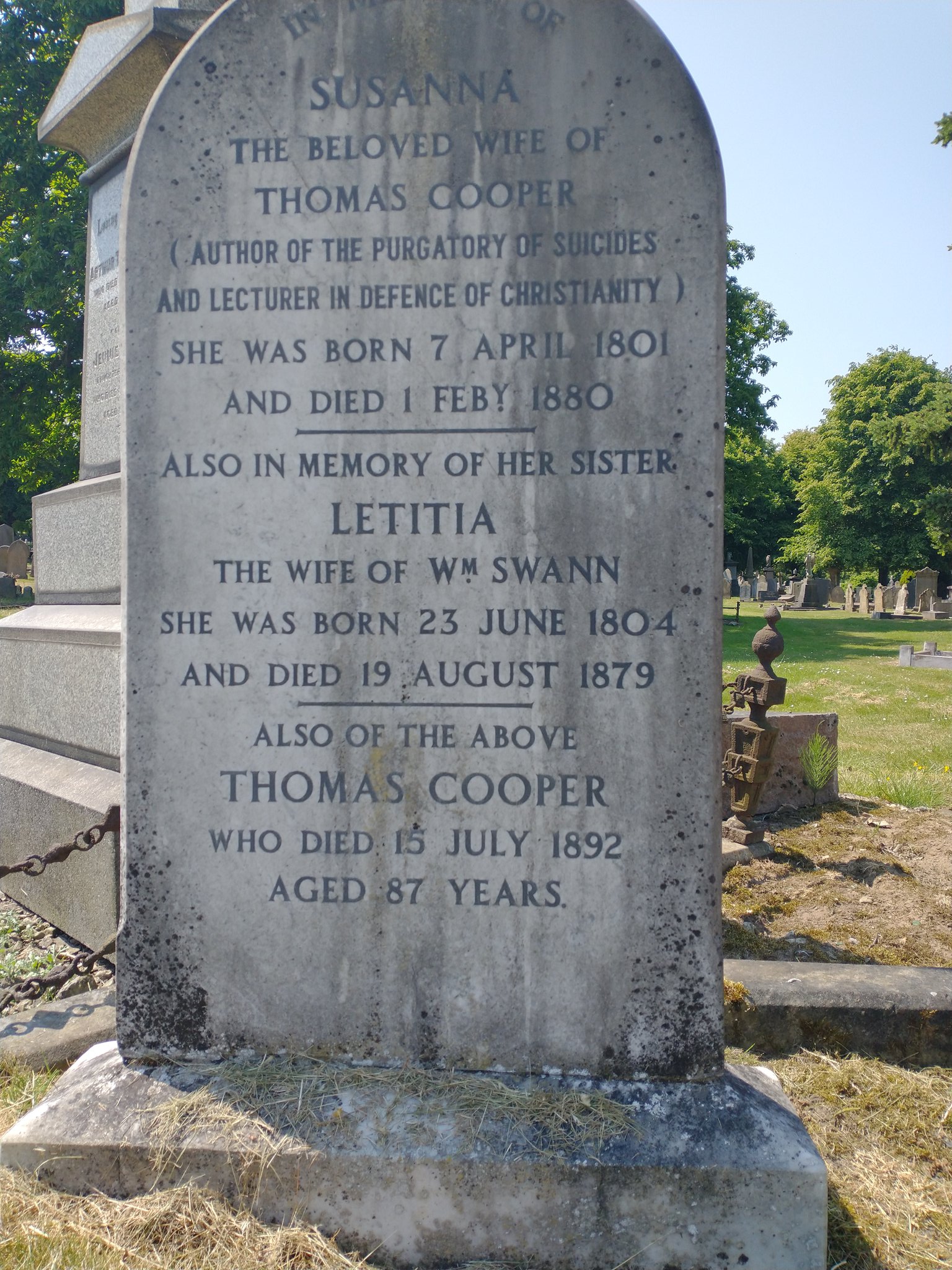
My PhD focuses on the literary activism of the Chartist poet and autodidact, Thomas Cooper. Unlike several other members of Chartism’s leadership, who came from middle-class or even aristocratic backgrounds, Cooper was proudly a working-class leader who worked as a shoemaker in Gainsborough before his entry into the movement. Aspiring to a career as an author, Cooper wrote prodigiously throughout his life, particularly during a two-year incarceration for his role in the strike wave of 1842 that saw the composition of an epic poem titled Purgatory of Suicides and a short story collection titled Wise Saws and Modern Instances. He also spent this time completing a novel he started in 1838, a medieval romance titled Captain Cobler. The last of these, generally considered to be a forgotten text among Chartist publications, is the focus of my current research.

Thanks to a research bursary provided by the Society for the Study of Labour History, I was able to visit Lincolnshire Archives in order to look at Cooper’s surviving prison notebook. Cooper was meticulous in his programme of self-education and I believed that the notebook would therefore contain vital information on the research he undertook during the composition of Captain Cobler. Investigation revealed that while the notebook did contain a comprehensive syllabus of texts that Cooper planned to read after serving his sentence, it also contained evidence of several planned novels suggesting that Cooper initially sought to carve out a niche for himself as an author of romances. Such evidence suggests that Captain Cobler, as the first in a collection of proposed romantic novels, is well worth further investigation as a precursor to several discourses that Cooper would articulate further in Purgatory of Suicides, the work that seemingly took precedence over his romances and the one for which he is best remembered.
In addition to a dense reading list of early drama and a list titled ‘Collections &c. relative to Robin Hood’, Cooper sketches out plans for three additional romances to follow Captain Cobler. The Student of Stamford, set in the medieval University of Stamford, was to follow the life of a student who had become ‘immersed in a sea of doubts’ over his faith. Cooper was beginning to grapple with his own religious identity around this time and was teetering on religious scepticism; it certainly seems like the discourses around religion and identity intended for The Student of Stamford found their way into Purgatory of Suicides. The same can be said of the subject of his second proposed novel, a Biblical romance titled The Book of Joktan. This novel was to feature discourses on society and government in the form of a conflict between the brothers Joktan and Peleg, figures from the Old Testament. While Peleg and his followers would ‘take westwards and commence the reign of “individualism”’, Joktan’s tribe would travel eastwards and ‘preserve Fraternity, Equality, Brotherhood’ while holding all property in common.
The last of these novels, titled Salome, was to be set during the English Civil War. Although this is the least detailed of Cooper’s planned romances, the notebook suggests that this romance would also take on a religious theme through the introduction of ‘Venner, & the Fifth-Monarchy-Men &c. &c.’. Thomas Venner and the Fifth Monarchists were a Nonconformist sect, active during the English Civil War who believed in the imminent coming of the Kingdom of Christ; while it is unlikely that Cooper shared in that particular belief, the novel’s setting suggests the possibility of discourses around both spiritual identity and republican government. As with the others, these particular subjects were later discussed at length in Purgatory of Suicides.
It seems that at some point during his sentence, Cooper abandoned his romances in favour of dedicating more time to composing the epic poem for which he is known. However, while he never wrote The Student of Stamford, The Book of Joktan or Salome, the mere existence of these plans indicate that Cooper was aware of a deep Chartist love for history and nostalgia. While the information in the notebook covered above has already been of use in supporting the arguments made in my current thesis chapter and those made in a conference paper delivered on June 17, 2023 at Chartism Day, I expect that it will also contribute significantly towards conversations surrounding Chartism and medievalism, as well as positioning Captain Cobler as a vital source of retrospective radicalism from one of the movement’s most accomplished authors.
Duncan Hamilton is undertaking a PhD on ‘Peace, Law and Order! The Traditional Radicalism of Thomas Cooper’ at the University of Manchester. He blogs at Thomas Cooper Circular.
Find out more about the Society for the Study of Labour History’s bursary schemes.
Discover more from Society for the Study of Labour History
Subscribe to get the latest posts sent to your email.
 Society for the Study of Labour History