My thesis focuses on the Communist Party of Great Britain’s British Road to Socialism (1951) within a wider international context of ‘national roads to socialism’, in which communist parties were told to adapt to ‘national’ circumstances. My research examines the British party’s ‘road to socialism’ at the British Empire’s centre, and that of the Communist Party of Australia (CPA) at its periphery in the early Cold War period, covering questions of race, identity, and culture in the language of ‘national communisms’.
Thanks to the research bursary granted by the Society for the Study of Labour History (SSLH), I have been able to make numerous research trips in the UK and Australia, which have been instrumental in helping me to develop a clearer understanding for the direction of my thesis. I can now confidently argue that the Communist Party Historians Group (CPHG) was at the forefront of the CPGB’s attempts to indigenise and ‘rescue’ a forgotten national and working-class history. A studious reading of the group’s minutes, and a host of other materials, shows that the CPHG was fully at home with the British Road’s emphasis on rescuing and resuscitating a ‘national-radical tradition’. But my research also reveals that while the CPGB often instrumentalised the ‘national-radical tradition’, for the Historians, this was a lifelong commitment that continued even after many broke with the party in 1956.
My first research trip was to the People’s History Museum in Manchester, which has been the major base for much of my thesis. Here, I examined many of the CPGB’s publications, including Communist Review and Labour Monthly, as well as internal party documents from the late 1940s and early 1950s that grapple with the party’s new policy program. Members of the CPHG were given a prominent role in articulating the party’s new flagship document, the British Road, and were regarded as the ‘jewel in the crown’ by the wider National Cultural Committee (NCC). [1] My aim was to examine to what extent the CPHG reflected and/or differed from the party in its representation of the ‘national-radical tradition’, so I chose to focus on the group’s internal minutes and correspondence, rather than its well-known published material, as much research has already focused on this area. I felt that the nuances and subtle misgivings over party direction would be better uncovered by examining the group’s public and private correspondence with the party centre. The group’s meetings were formative for the historians’ worldview – after all, Christopher Hill went as far as to suggest that his entire life’s work stemmed from discussions in the CPHG.[2]

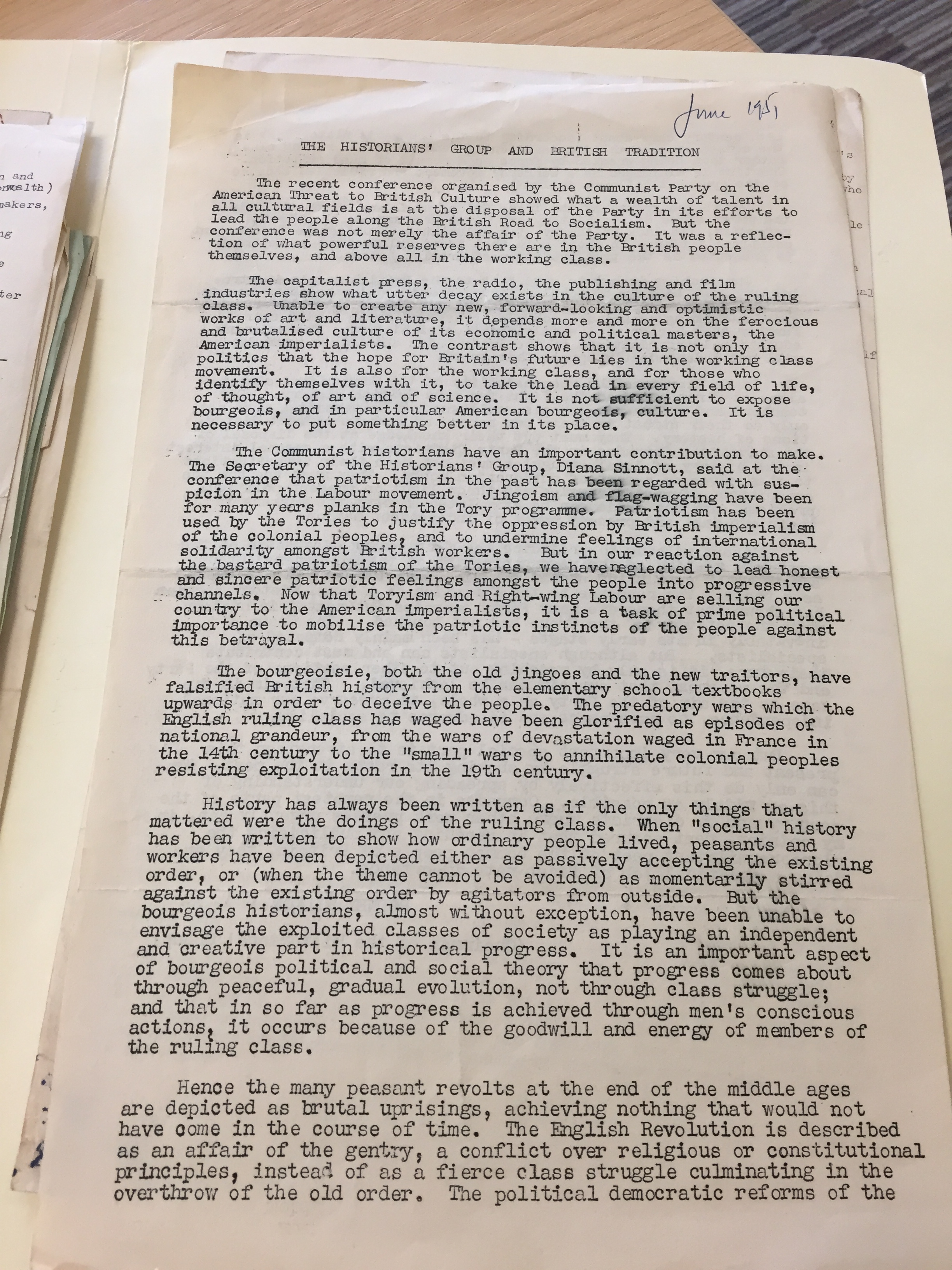
Complementing my work at the PHM, I also visited the Working-Class Movement Library (WCML) in Salford, the Marx Memorial Library (MML) in London, and briefly Nottingham’s Special Collections Material, and Hull’s Records Centre. At the MML I was fortunate to access the so-far in catalogued archive of CPHG member A.L. Morton, which illuminated many of the internal grievances the group had to constantly battle with. For instance, who exactly was the audience for its work – was it intended for specialists or for wider consumption? And, which came first – their role as party activists, or as historians? These trips helped clarify the internal discussions between CPHG members over their role as party members, their understanding and role in rolling out of the British Road, and finally, what I would argue are the beginnings of their break with the Party in 1956.
Finally, the SSLH in-part funded my research trip to the State Library of New South Wales in Sydney and the National Archives in Canberra. The research trip was a productive one, allowing me access to the CPA’s minutes and internal memos, and the party’s published articles and pamphlets. I have not yet been able to fully take stock of the material gathered during this recent trip but am confident that it offers an interesting contrast to my existing material on the CPGB and will be an important aspect of my thesis’ originality and contribution to knowledge.
To conclude, this research trip will help me to paint a clearer picture of the British Road to Socialism’s creation and evolution; its contrast with the CPA on the Empire’s periphery; and a better understanding of the CPHG’s relationship with the CPGB centre – on policy, creating a history from below, and fostering a ‘national-radical tradition’. I hope to further explore this development of a ‘national road’ in the communist parties of Britain’s Empire and am grateful for the SSLH’s support.
Gregory Billam is a Graduate Teaching Assistant and PhD Candidate at Edge Hill University researching British and Australian Communism in the post-war period.
[1] Ben Harker, The Chronology of Revolution (Toronto, 2021), 85.
[2] Christopher Hill, ‘Foreword’, in Harvey Kaye, The Education of Desire (London, 1992), pix.
Find out more about our bursary schemes.
Discover more from Society for the Study of Labour History
Subscribe to get the latest posts sent to your email.
 Society for the Study of Labour History