When the driver and firemen of an express train were killed in an horrific railway accident in 1898, the Amalgamated Society of Railway Servants was on hand to offer financial and moral support to their families.
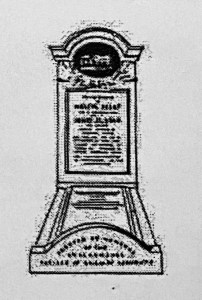
Somewhere in the vast expanse of Kensal Green Cemetery there are two near-identical gravestones. Carved from Portland stone, with plaques depicting a train and green slate ‘rails’ to represent track, they were paid for and erected by members of the Amalgamated Society of Railway Servants to mark the resting places of two footplatemen hailed as heroes for saving the lives of numerous passengers.
On 18 July 1898, engine driver Walter Peart and fireman Henry Dean were on the footplate of the 4.15pm from Windsor to Paddington as it approached Acton station, when without warning the connecting rod of the engine sheered through and was driven repeatedly at each revolution of the wheel through the casing of the boiler.
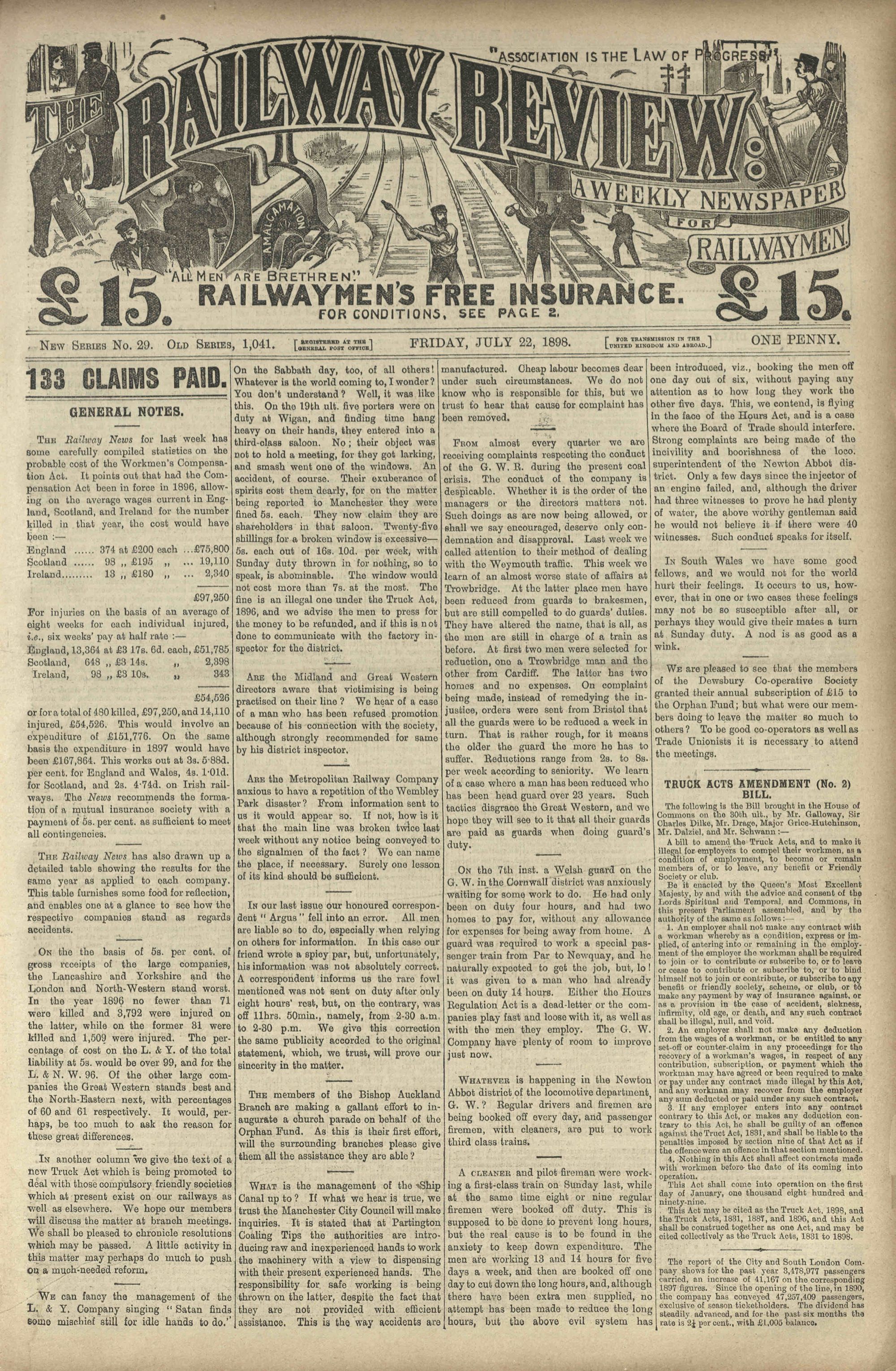
As the ASRS newspaper The Railway Review reported four days later: ‘A violent explosion followed, and a mass of piping, fire, cinders, and steam was blown forcibly from the fire-box into the faces of the unfortunate driver and fireman. Though terribly injured they stood in their places and shut off steam, and then only – when the train had been brought without accident to a standstill – did they stagger off the engine into the station.’
The two men were treated at the scene by a local doctor, then brought on to Paddington Station, where Foreman Baker of the Great Western Ambulance Department had an ambulance waiting to rush them on to St Mary’s Hospital. Despite hopes that Peart might survive, both men died within twenty-four hours of the accident, leaving young families.
Peart, who lived at 2 Kensal Place, Kensal Green, was 43 years old and married with five children; his wife Ada was 38, and both had lived in London all their lives. Dean, who lived at 29 Alperton Street, Queen’s Park, Kensal Town, was 25; he had married his wife Elizabeth just a year earlier in Devon where both were brought up. Widowed at the age of 24, she would give birth a week later.
Peart and Dean were not the only railwaymen to die in accidents that week – or even on that day. The same issue of The Railway Review which reported the Windsor accident also carried news of the death of Bro G. Smith, a foreman at Heaton Junction and member of the ASRS Newcastle No 1 branch, who died when he was run over by an engine (22 July 1898). That year, 542 fatal accidents were recorded on Britain’s railways, and the number killed annually did not fall below one hundred until 1964.
But Peart and Dean caught the popular imagination, and were instantly hailed as the ‘heroes of the footplate’ for their actions by newspapers across the country. Letters to the Daily Telegraph (22 July 1898) called for a fund to be established to help their families, and within days it stood at more than £360. The St James’s Gazette, meanwhile, declared: ‘Such bravery as this is not one whit inferior in quality to that which wins the Victoria Cross’ (23 July 1898).
Within days of the accident The Railway Review had sent a cheque for £15 to Mrs Peart, her husband having been a member of the ASRS and a subscriber to the paper. The union’s Paddington Branch took responsibility for organising the funeral arrangements, and added a further £5 death grant and £2 from its benevolent fund. The family also received five shillings a week thereafter for the three children who were under 13 years old from the union’s orphans’ fund. A record noting the death grant paid to Walter Peart can be found in the Railway Work, Life & Death trade union accidents database run by the University of Portsmouth, National Railway Museum and Modern Records Centre.
‘We have no doubt the Great Western Company will perform its part in providing for those left widows and fatherless under such heroic and lamentable circumstances,’ commented the Review.
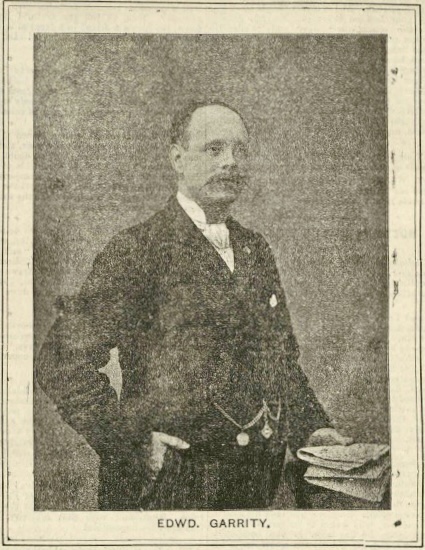
The union’s involvement did not end there, however. When the inquest took place, Edward Garrity, assistant secretary of the ASRS, attended throughout along with the union’s solicitor, Mr Morten. There had been some suggestions that the driver had not wanted to take the train out that day.
Having heard that the four-inch thick metal rod had had a previously unknown internal flaw which caused it to snap, the jury returned a verdict of accidental death. But it went on: ‘The jury is of the opinion that the said engine was not a fit and proper one to be used for drawing express trains. The jury desire to place on record their high appreciation of the conduct of the two deceased men in applying the break and keeping at their posts, thus probably averting a serious catastrophe and danger to the lives of the passengers of the train’ (Daily Telegraph, 23 July, 1898).
The following Monday, just a week after the accident, Walter Peart was buried at Kensal Green. The eighteen pall-bearers were all fellow members of the ASRS. The Railway Review reported that ‘an immense crowd had gathered long before the time the funeral was timed to take place, the road being thickly lined en route and the approaches to the cemetery crowded, There was a large attendance of railwaymen both in unform and in ordinary attire.’
It went on: ‘The ASRS was represented by Mr E. Garrity, assistant secretary, and Mr G. J. Wardle, Editor, Railway Review. The Paddington Branch by Mr Hemming, vice-chaiman; Mr Mitchell, secretary; and a contingent of all grades. Representatives from Stratford, Barnes, Clapham Junction and many other of the London branches were also present.’ The men’s employer, the Great Western Railway Company was also represented at a senior level.
Fireman Henry Dean appears to have been buried in his home town of Dawlish in Devon (Daily Telegraph, 25 July 1898; Railway Review, 29 July 1898). So the presence of gravestones for both men at Kensal Green is something of a mystery. Both men and both memorials, however, are listed by the Friends of Kensal Green Cemetery in their publication Paths of Glory: A Select Alphabetical and Biographical List of Persons of Note Commemorated at the Cemetery of All Souls at Kensal Green.
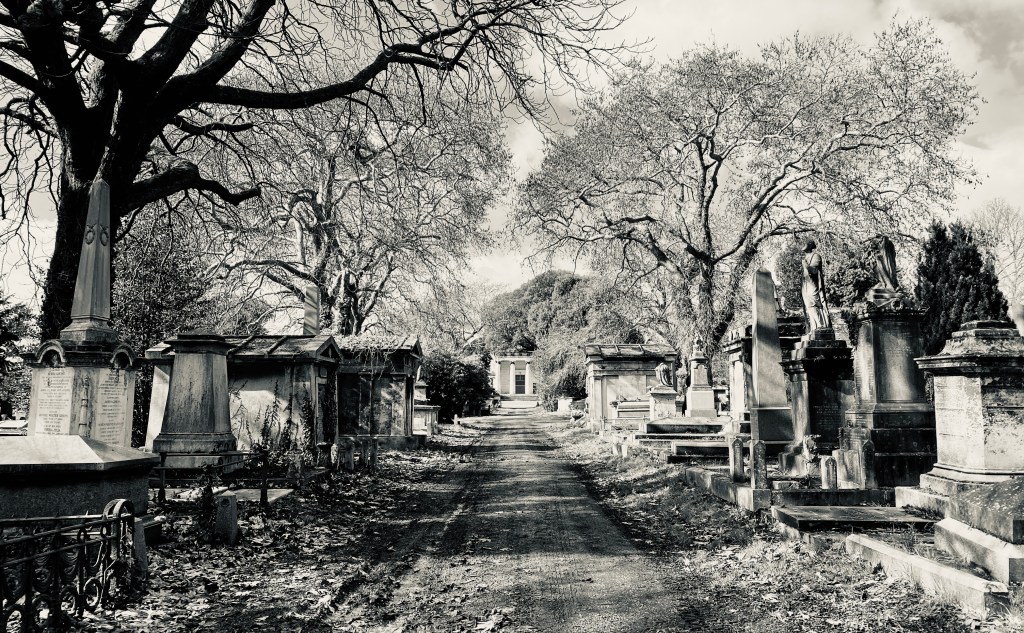
Despite searches of the cemetery I was unable to track down either grave. Future visitors to Kensal Green may want to look more closely in square 123 on the cemetery’s own map.
Sources and further information
- A run of Railway Review from July 1880 to December 1920 can be found on the website of Warwick University’s modern records centre.
- All other newspaper reports cited here are from the British Newspaper Archive.
- The photograph of Edward Garrity is taken from Fifty Years of Railway Trade Unionism, by G. W. Alcock, London: Co-operative Printing Society (1922).
- Railway Work, Life & Death is a fantastic and growing resource. Run by the University of Portsmouth, National Railway Museum and Modern Records Centre, it includes a database of 20,000 names drawn from trade union records.
Discover more from Society for the Study of Labour History
Subscribe to get the latest posts sent to your email.
 Society for the Study of Labour History