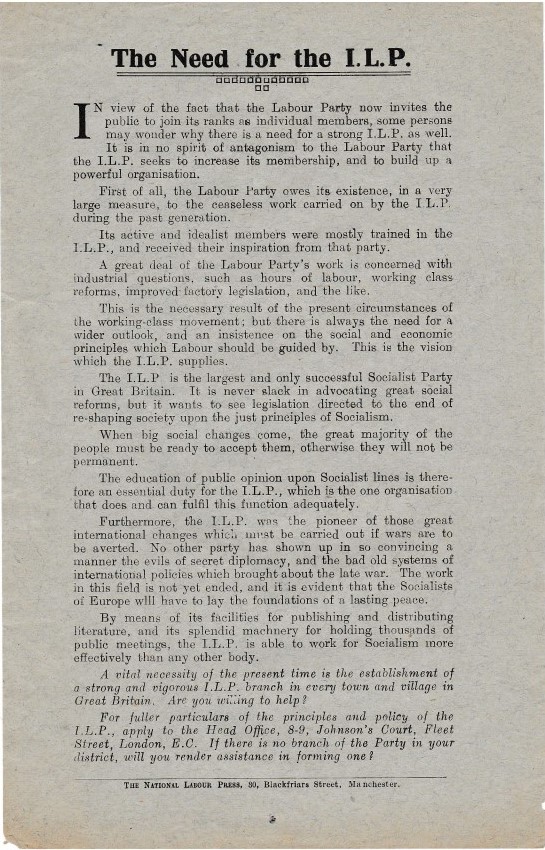
In 1918, the Independent Labour Party faced the biggest question in its history to date: if the Labour Party, to which it had been affiliated from the start, was now an individual membership organisation with an avowedly socialist platform, what was the point of the ILP? The leaflet shown here was its first attempt to provide an answer to that far from trivial question.
Formally established in 1900, the Labour Party had until the end of the first world war been a national federation of pre-existing organisations. These included some of the bigger trade unions, three relatively small socialist societies, a few dozen local parties and trades councils, the Women’s Labour League and a handful of co-operative societies. With a few minor exceptions, there were no individual party members; at national level, opinions were voiced and votes cast by the affiliated organisations.
Driven by a massive extension of the franchise that year which enable six million women to vote in parliamentary elections, Labour’s 1918 constitution upended that model. While retaining the right for trade unions and socialist societies to affiliate to the party and vote at its annual conference, it mandated the creation of local constituency Labour parties across the country made up of individual members and also gave those constituency parties the right to vote at conference. Sidney Webb, the author of the new constitution, declared this to be ‘an event of far reaching political importance’.
Although the ILP (one of the three affiliated socialist societies alongside the Fabians and the British Socialist Party) had supported the new constitution, it was well aware that this could present it with an existential threat. It was not just about individual membership. As the labour historian Keith Laybourn commented, the ILP ‘lost its primacy as a socialist parliamentary party when it had its birth right “filched” by the Labour Party, which adopted the famous Clause Four (3d) in its constitution’.
The ILP leaflet above shows that its members had not yet worked through their response to this fundamental change in Labour Party organisation and ideology, focusing as it does mostly on the ILP’s past services to the movement, its publishing facilities and ‘splendid machinery for holding thousands of public meetings’. None of these things was likely to prove a compelling or enduring reason for people to join it rather than the Labour Party proper in the years to come.
As time went on and the need to provide something that differentiated it became clear, the ILP would develop a distinctive ‘guild socialism’ approach, and after the fall of the 1924 government a platform for ‘Socialism in our Time’ advocating ‘the living wage’ and the nationalisation of banking, power, transport and land. For a time it could be seen as the conscience of the Labour Party. But many of its leading parliamentary figures switched their allegiance away from the ILP, which found itself increasingly at odds with the Labour leadership. By 1932, it had voted to disaffiliate.
In the years to come, having tried but failed to provide a convincing answer the question it set in 1918, the ILP went into decline. Its membership dropped from a peak of nearly 17,000 in 1932 to a little over 4,000 three years later. The leading left-wing Labour MP Aneurin Bevan would describe it as ‘pure but impotent’. Although the marginalised ILP struggled on in much reduced circumstances for four more decades, in 1975 it finally admitted defeat and reinvented itself as Independent Labour Publications, its members rejoining the Labour Party. The ILP today continues to work as ‘an educational trust, publishing house and pressure group committed to democratic socialism and the success of a democratic socialist Labour Party’.
Sources and further reading
The New Constitution of the Labour Party: A Party of Handworkers and Brainworkers, The Labour Programme and Prospects. Labour Party Leaflet No. 1, by Sidney Webb, 1921. On the LSE website.
The Independent Labour Party, 1914-1939: The Political and Cultural History of a Socialist Party, by Keith Laybourn, Routledge, 2020 (paperback 2022). More…
Independent Labour Publications website.
Discover more from Society for the Study of Labour History
Subscribe to get the latest posts sent to your email.
 Society for the Study of Labour History