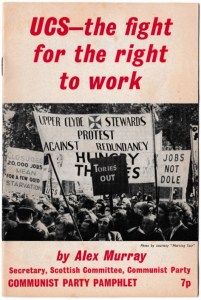
Introducing a pamphlet published by the Communist Party of Great Britain during the 1971 Upper Clyde Shipbuilders work-in. The pamphlet can be downloaded from this page.
‘We are not going to strike. We are not even having a sit-in strike. Nobody and nothing will come in, and nothing will go out, without our permission. And there will be no hooliganism, there will be no vandalism, there will be no bevvying, because the world is watching us, and it is our responsibility to conduct ourselves with responsibility, and with dignity, and with maturity.’
With these words, Jimmy Reid, senior shop steward for the Amalgamated Union of Engineering Workers at Upper Clyde Shipbuilders (UCS), set the tone for a new form of industrial action – the work-in. It was a tactic that would win support across the trade union movement and far beyond, forcing Edward Heath’s Conservative government into a humiliating retreat and saving thousands of jobs across the West of Scotland – and which would be copied in future disputes.
The UCS work-in began in July 1971, after the government refused a short-term subsidy to the partly state-owned company, even though it had full order books and was forecast to return to profit the following year. With 8,000 shipyard jobs under immediate threat and 20,000 more at risk in the wider supply chain, a work-in committee of shop stewards from the engineers’, boilermakers’ and other unions took control, and fulfilled the contracts that the receivers had sought to cancel.
UCS – The Fight for the Right to Work, reproduced here was written by Alex Murray, secretary of the Scottish Committee of the Communist Party of Great Britain even as the work-in was still in progress. It both told the story of the UCS dispute and highlighted the part played by the CPGB, making the case for ‘a bigger Communist Party’.

It was indeed true that the CPGB had played a central role in the work-in. Of the four shop stewards who constituted the inner leadership of the work-in committee and who through platform speeches and media appearances became the best known of a large group of union officials involved in it, three (Jimmy Reid, Jimmy Airlie and Sammy Barr) were CPGB members; the fourth, Sammy Gilmore, was on the left of the Labour Party.
In February 1972, the government gave way, providing additional cash and restructuring UCS, creating a new company, Govan Shipbuilders, as its successor to run the Govan, Scotstoun and Linthouse yards. Though shipbuilding would never see a return to the glory days of the early 1900s, when it was claimed that one in five of all ships in the world were made on the Clyde, the 1971 work-in helped secure shipbuilding in Scotland for decades to come.
Further information
The truth behind speech that saved Clyde yards, The Herald, 28 July 2011.
Background: when Clyde shipbuilding was the envy of the world, The Herald, 6 November 2013.
The Work-Ins of the Upper Clyde Shipbuilders, 1971-1972: Hearing the Voices of the Protests, by Cara Melissa Evans is a National Library of Scotland project which offers access to sound recordings in the University of Glasgow.
May Day: the UCS work-in collections introduces papers relevant to the dispute held at the University of Glasgow Library.
Discover more from Society for the Study of Labour History
Subscribe to get the latest posts sent to your email.
 Society for the Study of Labour History