There is nothing special about anniversaries. No intrinsic reason to look back at events fifty years ago rather than at the years either side. But just as we mark birthdays and other significant events in our lives, so societies do much the same on a bigger scale, not least as a politically charged means of creating shared histories. But what we choose to commemorate and how we remember it is not fixed. In the years of political consensus after the Second World War we might have looked back at the trade union legislation of 1823 or the heavy-handed policing of protest in 1873 and shuddered at such primitive politics; from the perspective of 2023, we may be more likely to see parallels with our own times. History is ever changing, ever being rewritten. What is important is that these stories are remembered and can be reinterpreted to make them relevant as times change. For that reason if no other, anniversaries have an important part to play.
- 1998: 25 years ago: Paid time off and a minimum wage
- 1973: 50 years ago: TUC expels twenty unions
- 1948: 75 years ago: Birth of the National Health Service
- 1923: 100 years ago: Labour stands on the verge of power
- 1898: 125 years ago: South Wales miners form ‘The Fed’
- 1873: 150 years ago: The case of the Ascott martyrs
- 1848: 175 years ago: Chartism and the people’s spring
- 1823: 200 years ago: Legal crackdown on workers
1998: 25 years ago: Paid time off and a minimum wage
The second year of Labour government brought a raft of measures intended to improve workplace rights and protections. Under the terms of the Working Time Regulations, implementing a European Directive, workers got the right to a maximum 48-hour working week, rest breaks and a minimum of four weeks’ paid holiday – probably the most sweeping reform of working conditions ever seen. Parliament also passed a National Minimum Wage Act, reversing at a stroke, when it came into effect in 1999, decades of measures eroding the work of wages councils in protecting vulnerable workers against low pay, and introducing a statutory minimum for all adult workers. Margaret Beckett, the President of the Board of Trade and Minister responsible for the legislation, described it as a chance to end a persistent ‘low cost, low quality, low pay culture’. It would, she said, benefit workers, their families and employers (by protecting against ‘cowboy’ firms undercutting pay rates). Until the mid-1980s, statutory underpinning for pay rates had been controversial in the labour movement, with some larger unions, including the engineering workers and the transport workers, fearing a return to the discredited incomes policies of the 1970s and the undermining of the unions’ role in the workplace. The National Union of Public Employees, which had long campaigned in favour of a legal minimum pay rate, succeeded in getting the policy adopted by both the Labour Party and TUC, on condition that it was dealt with as an issue of low pay rather than incomes policy.
Also, Referendums in the Republic of Ireland and Northern Ireland saw substantial majorities in favour of the Good Friday Agreement; the Government of Wales Act establishing a devolved Welsh Assembly became law; Parliament passed the Human Rights Act; the last working Cornish tin mine at South Crofty closed; an unofficial strike by Liverpool dockers came to an end after twenty-right months.
1973: 50 years ago: TUC expels twenty unions
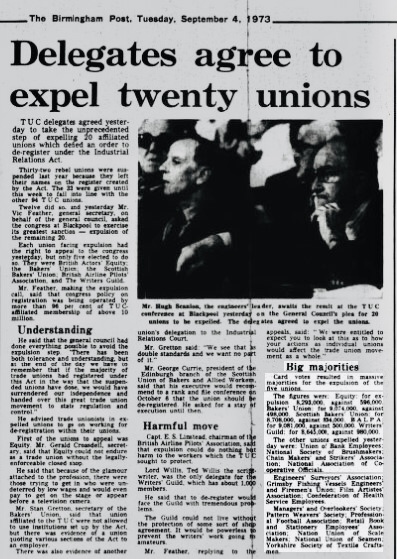
The Industrial Relations Act which became law in 1971 represented a fundamental change in the legal framework for trade unions, with the introduction of an Industrial Relations Court, the threat of prosecution for unions failing to comply with its provisions, and a new Registrar of Trade Unions and Employers Associations with which unions were expected to register. Despite a decision by the TUC General Council to boycott this new body, thirty-two unions representing half a million workers joined the register and were suspended by the TUC at the 1972 Congress. Although some later fell into line, twenty continued to defy the ruling, and in September 1973 they were expelled from the TUC. Among those expelled were the Confederation of Health Service Employees (COHSE), British Actors Equity, the Bakers Union, the British Airline Pilots Association, the National Society of Brushmakers, and the National Union of Seamen. The move led to recruitment battles between affiliated and expelled unions, with allegations by COHSE officials that the National Union of Public Employees was seeking to poach members in the North East of England, while the aggressively expansionist Association of Scientific, Technical and Managerial Staffs sought to move into the banking and insurance industries. The impasse between the TUC and those it had expelled would end when the incoming Labour government in 1974 repealed the 1971 Act.
Also, Labour took majority control of the Greater London Council after winning 47% of the vote; the Conservative government imposed a 7% cap on wage increases; Prime Minister Edward Heath announced the introduction of a three-day working week and 50mph speed limits on motorways and dual carriageways; Labour Party conference adopted Labour’s Programme for Britain, calling for ‘a fundamental and irreversible shift in the balance of power and wealth in favour of working people’.
1948: 75 years ago: Birth of the National Health Service
On 5 July 1948, Aneurin Bevan, visited what was then Park Hospital (now Trafford General). He was met by a nurses’ ‘guard of honour’ and the keys formerly held by Lancashire County Council were ceremonially handed to him as Minister for Health. Bevan was then introduced to thirteen-year-old Sylvia Beckingham (later Diggory), ever-after known as the first NHS patient. She would later recall: ‘Mr Bevan asked me if I understood the significance of the occasion and told me that it was a milestone in history – the most civilised step any country had ever taken, and a day I would remember for the rest of my life – and of course, he was right.’ Bevan had piloted the legislation needed to create the National Health Service through Parliament in the face of opposition from the medical profession, and from charities and local councils who objected to their loss of control over hospital services. But the origins of the NHS lay much further back in time – not just with William Beveridge, whose 1944 report had favoured a publicly provided but more decentralised healthcare system, but to Beatrice Webb and the 1909 Minority Report of the Royal Commission on the poor Laws. The creation of the NHS did not in the immediate term lead to more money, more doctors or nurses, or more hospitals. What it did, however, was to make access to healthcare available to all on a more equal basis rather than on the basis of the ability to pay.
Also, British Rail came into being, nationalisation of electricity supply took effect, and gas boards were created as gas ws nationalised; the Empire Windrush arrived; first new comprehensive schools opened, in Potters Bar and Hillingdon; the TUC and other Western European unions left the World Federation of Trade Unions to created International Confederation of Free Trade Unions while Soviet bloc unions remained in WFTU
1923: 100 years ago: Labour stands on the verge of power
In May 1923, Conservative Prime Minister Andrew Bonar Law stood down after just a few months in office to be replaced by his Chancellor of the Exchequer, Stanley Baldwin. Seeking a fresh mandate from the electorate which would allow him to abandon free trade in favour of protectionism, Baldwin called a general election, which was duly held on 6 December. The result was not as Baldwin had hoped or expected: the Tories remained the largest party with 258 seats, but lost 86, while the Labour Party, led by James Ramsay MacDonald, gained 49 seats to finish with 191 MPs, confirming Labour as the main party of opposition. Faced with the choice of supporting a minority Conservative government or backing Labour on a vote-by-vote basis, the Liberal leader H.H. Asquith chose the latter and joined with Labour to vote down Baldwin’s King’s Speech. As the year came to an end, Labour was set to form its first, minority, government. The election was also notable for the defeat of the sole Communist MP, Shapurji Saklatvala, in Battersea (though he would regain it the following year), and for the election of the first three Labour women MPs: Margaret Bondfield, Susan Lawrence, and Dorothy Jewson.
Also, a strike by thousands of members of the National Union of Agricultural Workers, centred on Norfolk, brought a halt to post-war reductions in pay; 50,000 dockers walked out over proposed pay cuts of a shilling a day.
1898: 125 years ago: South Wales miners unite to form ‘The Fed’

By the early 1890s, it had become clear to miners’ leaders in South Wales that the fragmented nature of trade union organisation in the coalfield was making it impossible to improve the lot of their members. But efforts to unite the miners, first in a loose federation of district unions and later in a more centralised Amalgamated Society of the Colliery Workmen of the South Wales Coalfield, proved ineffective, with opposition to the new organisation among Rhondda and anthracite miners fatally undermining its ability to present a united face to the coal owners. Despite this, in September 1897 the miners gave six months’ notice that they would strike if a sliding scale that linked wages to the price of coal was not reformed to protect pay rates from falling prices. In March 1898, when negotiations failed, the miners walked out calling for a 10% pay rise and a complete end to the sliding scale. The strike ended on 1 September with the miners having achieved few of their objectives. However, the obvious lack of unity and leadership seen in the dispute provided the spur to create a new organisation: the South Wales Miners Federation, which came into being on 29 October 1898. Before the dispute, no more than 18% of the South Wales coalfield workforce had been in unions; by the end of 1898, ‘The Fed’ had 60,000 members or 47% of the workforce, and by 1900 this had risen to 127,894 or 87% of the workforce. The Fed affiliated to the Miners Federation of Great Britain in 1899, and in 1945 would become the South Wales area of the National Union of Mineworkers.
Also, the Workers’ Union was founded on May Day with branches in London, Yorkshire and the North West; it would become the largest union in the UK before declining after the first world war and merging with the TGWU in 1929. A short-lived Association Footballers Union was formed to fight Football League proposals to restrict players’ movements between clubs and introduce a maximum wage of £4 a week.
1873: 150 years ago: The case of the Ascott martyrs

Founded the previous year in Warwickshire, the National Agricultural Labourers Union had within months spread to neighbouring counties. Early in 1873, however, farmworkers who had formed a branch of the union at Ascott-under-Wychwood in Oxfordshire were dismissed by a Mr Hambidge, who brought in strikebreakers from the neighbouring village of Ramsden. Sixteen women from Ascott who tried to persuade the strike-breakers to switch sides and join the union were arrested and taken to Chipping Norton, where they were tried and sentenced to imprisonment with hard labour – seven of them for ten days, and the remaining nine for seven days. A crowd of 1,000 people gathered at the police court in a fruitless attempt to free the women, and that night they were taken to Oxford Prison, two of them with young children. After questions were asked in Parliament, the hard-labour element of the sentence was suspended, and on their release the women were treated as martyrs to the cause. The union reportedly gave each of them £5 and enough blue silk to make a dress, and a later inquiry found that the establishment of the union branch had led to an increase of 2 shillings a day in the labourers’ wages. The Ascott Martyrs Educational Trust is organising events to commemorate the events of 1873 on the weekend of 24-25 June 2023, and will be publishing a collection of essays.
Also, Leonora Cohen, physical force suffragette, district organiser for National Union of General and Muncipal Workers Union, and president of Leeds trades council was born in Hunslet; she would live to the age of 105. George Howell became secretary to the parliamentary committee of the TUC; a veteran of the builders’ fight for a nine-hour day, and former secretary of the Reform League in the 1860s, he was later elected a Lib-Lab MP at Bethnal Green, serving from 1885-1895.
1848: 175 years ago: Chartism and the springtime of the peoples
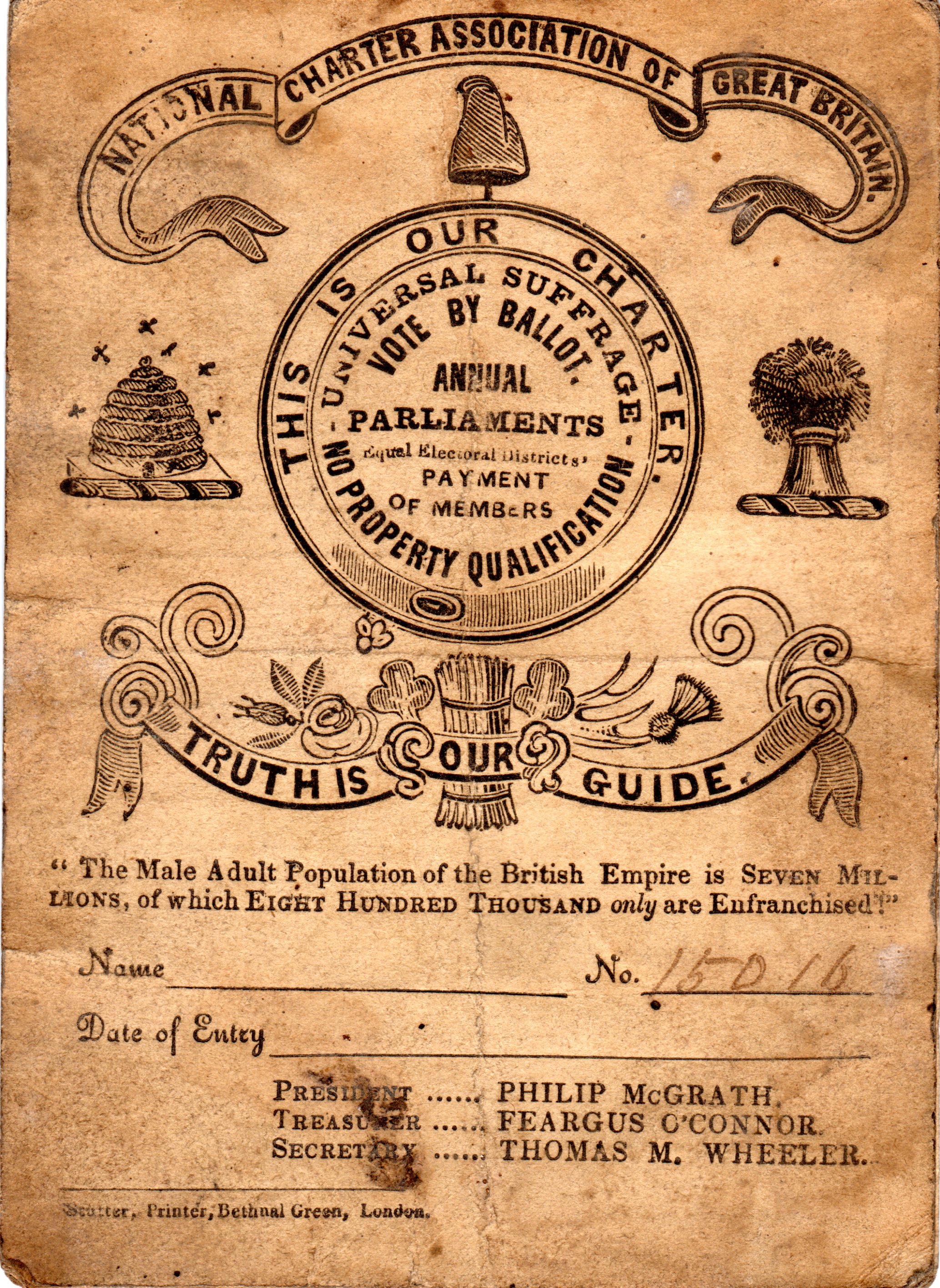
Later dubbed the ‘springtime of the peoples’, the early months of 1848 saw revolution and political upheaval sweep through much of Europe as the French overthrew their monarchy, and demands for liberal democratic reforms and national self-determination rocked the sprawling Habsburg Empire. In Britain, the Chartist movement roused from its slumbers to start a new petition in favour of the six points of the People’s Charter; and inspired by a new spirit of internationalism and by events across the channel, Chartist localities in many parts of the country switched their focus from the relatively bureaucratic activities required to support the land plan to the harder politics and demands of the Charter itself. The election of delegates to the Chartist convention set for April enabled Chartists to debate once again the strategies and tactics needed to win the Charter, and produced a flurry of activity on the part of the authorities, who brought back the Duke of Wellington to mastermind the defence of the capital, with tens of thousands of special constables and thousands of regular troops under his command. The story of the Kennington Common meeting of 10 April and the presentation of the third petition is widely known if still contested. However, it was not the end of the story. Plans had been mooted by some of the more radical Chartist leaders for a national rising when the petition was rejected. But that summer, plans to seize central London were thwarted and many of those involved, among them the London Chartist leader William Cuffay, were arrested; parts of West Yorkshire and Ashton-under-Lyne, both Chartist strongholds, also came close to a more general uprising. But as reaction set in across Europe and the authorities regained the upper hand, the final great Chartist wave subsided.
Also, An Irish nationalist rebellion led by the Young Ireland movement was suppressed, its leaders were arrested under the new Treason Felony Act, and some, including Thomas Francis Meagher and John Mitchel, transported to Tasmania. The Communist Manifesto written by Karl Marx and Frederick Engels was published in London. The Huddersfield Workhouse Scandal focused public attention on the appalling treatment of workhouse inmates.
1823: 200 years ago: Legal crackdown on workers
While earlier legislation dating back to the 1349 Ordinance of Labourers was largely devised for an agricultural economy and workforce, the Masters and Servants Act 1823 broadened the legal definition of ‘servants’ to include the new industrial workforce increasingly found in factories and mills. Recent research published in the journal Historical Studies in Industrial Relations reveals that the statute was written by a few Staffordshire Justices of the Peace, one of them an MP with large investments in coal mines, in order to derail a reform bill much more favourable to workers. The legislation enabled JPs to impose up to three months in prison with hard labour on workers who left their job before it was finished – in effect, criminalising strikes. Courts in the 1840s and 1850s seized on the legislation to attempt to restrict trade union activities – and would continue to do so throughout the nineteenth century. The Masters and Servants Act was also influential in shaping similar anti-union legislation in the United States, Australia, Canada and South Africa.
Also, The Transportation Act allowed convicts to be used in public works. Working with William Cobbett and others, the surgeon Thomas Wakley, later Radical MP for Finsbury and supporter of the Tolpuddle labourers and Chartism, established reforming medical journal The Lancet.
Further reading
There has yet to be a definitive history of the Labour governments of 1997-2010. However, in Heroes or Villains? The Blair Government Reconsidered (Oxford: OUP, 2019), Jon Davis and John Rentoul aim to provide a ‘balanced’ account. Eric Shaw’s Losing Labour’s Soul? New Labour and the Blair Government 1997-2007 (Abingdon: Routledge, 2008) focuses more on party than government, although it is of course difficult to separate the two during this period. There are also numerous diaries and memoirs from those who were in or close to government in this period, from Alastair Campbell’s multi-volume diaries to Gordon Brown’s My Life, Our Times (London: Vintage, 2018). It is, however, hard to see Tony Blair’s own A Journey (London: Hutchinson, 2010) as the former prime minister’s final word on this subject.
There are a number of recent general histories of the NHS, including The NHS at 70 by Ellen Welch (Barnsley: Pen & Sword, 2018) and The NHS: Britain’s National Health Service, 1948–2020 by Susan Cohen (London: Shire Publications, 2020). A comprehensive survey of historical writing about the NHS from 1948 onwards can be found in The British National Health Service 1948–2008: A Review of the Historiography by Martin Gorsky (Social History of Medicine, Vol 21(3) December 2008, pp. 437–460). Nye Bevan’s best-known biographer is Michael Foot, whose two volume life of his friend and political ally covers the years 1897-1945 and 1945-1960. More recently, Nick Thomas-Symonds, the Labour MP for Torfaen, wrote Nye: The Political Life of Aneurin Bevan (London: Bloomsbury Publishing, 2014).
The best-known histories of ‘The Fed’ were published while coal mining was still a major employer in South Wales. They are: The Fed: A History of the South Wales Miners in the Twentieth Century by Hywel Francis and David Smith (London: Lawrence & Wishart, 1980); South Wales Miners: Glowyr de Cymru: A History of the South Wales Miners’ Federation (1898-1914) by Robin Page Arnot (London: George Allen & Unwin, 1967) and the same author’s subsequent South Wales Miners: Glowyr de Cymru: A History of the South Wales Miners’ Federation (1914-1926) (Cardiff: Cymric Federation Press, 1975). More recently, The South Wales Miners by Ben Curtis (Cardiff: University of Wales Press, 2013) focuses on the period from 1964 to 1985, long after the Fed had become part of the National Union of Mineworkers.
Malcolm Chase’s Chartism: A New History (Manchester: MUP, 2007) remains the go-to book on the Chartist movement, providing an unrivalled narrative history. But there are numerous studies focusing on different aspects of Chartism, from David Goodway’s London Chartism 1838-1848 (Cambridge: CUP, 1982) and Paul Pickering’s Chartism and the Chartists in Manchester and Salford (Basingstoke: Macmillan, 1995) to Dorothy Thompson’s Outsiders: Class, Gender and Nation (London: Verso, 1993) and the volume edited by Joan Allen and Owen R Ashton, Papers for the People: A Study of the Chartist Press (London: Merlin Press, 2005). The Chartist Ancestors website provides a good way into Chartism and includes a databank naming 14,000 people associated with it.
Discover more from Society for the Study of Labour History
Subscribe to get the latest posts sent to your email.
 Society for the Study of Labour History