The Labour Research Department has been at the forefront of an information war against the far right for the past hundred years. Jeff Howarth tells the story of this century-long struggle through the LRD publications to be found in the TUC Library.
Throughout the twentieth century and now into the twenty-first, the trade union movement has monitored the activities of far-right groups in an attempt to understand their aims and the threat that they presented.
The Labour Research Department (LRD) has waged an information war, monitoring groups such as the British Union of Fascists, the League of Empire Loyalists, and the National Front in order to gather data on their finances, leaders, members, methods, and message.
On the evidence I have found in the collections in the TUC Library, LRD has sometimes used subterfuge to carry gather classified information: it was certainly on the mailing list of many of the groups, if not actually a member of some. There are even thank you letters for their ‘support’ and appeals for ‘contributions’ to be found in the archive.
LRD’s origins lie in the Fabian Research Department, set up in 1912 to produce research reports and organise lectures and conferences. Among the authors and activists to have been involved were George Bernard Shaw, Sidney and Beatrice Webb, Ellen Wilkinson, and G.D.H. and Margaret Cole.
In 1918, this became the Labour Research Department, focusing on supplying unions and other groups with information to use in negotiations, debates and public meetings. National and local trade unions, co-operative and socialist bodies could affiliate, and in return for an annual fee receive the monthly Labour Research and access to the LRD’s inquiry service.

From 1922 onwards LRD directed more attention to the companies that dominated British industry, their accounts, profits, directors and shareholders, together with wages and conditions. For example it undertook an investigation into the cotton industry for the United Textile Factory Workers Association, a large scale enquiry into theatre companies for the Musicians Union and one on night work for the Railway Clerks Association.
From our archives it is obvious the LRD was collecting information on various pressure groups and where appropriate exposing their practices. Many of these groups were characterised by their anti-trade union and anti-labour stances.
They included:
The Anti-Socialist Union of Great Britain – a pressure group that supported free trade economics and opposed socialism. Active from 1908 to 1948 its heyday was before the First World War;

The National Citizens’ Union (incorporating the Middle Class Union) – set up in 1919, it became associated with the emerging strand of British fascism and shared members; and
The British Empire League –founded in 1895 with the aim of securing permanent unity for the British Empire.
But possibly the most significant group was the British Empire Union, founded in 1915, which was pro-empire, anti-trade union and anti-socialist. Its publications included Keep Britain for the British, and aimed:
- ‘To exclude undesirable aliens.’
- ‘To oppose the teaching of sedition, blasphemy and atheism to children in the Communist, Proletarian and some Socialist Sunday schools.’
- ‘To encourage private enterprise, and the co-operation between capital and labour by impressing upon employers and workers that their real interests are identical.’
- ‘To protect the worker from tyranny and undue interference by the State, Employers, or Trades Unions.’

In 1925 LRD exposed its work in a comprehensive article entitled ‘Strike Breaking Organisations’ which revealed a proposal to enrol 2,000 to 3,000 British Fascists into Wolverhampton and Liverpool special constabularies with the support of sympathetic chief constables.
However, British Fascists was a small organisation and it was to be overtaken by the more successful British Union of Fascists (BUF) formed by Oswald Mosley in 1932. An internal report from 1934 marked ‘completely confidential’ reveals how seriously LRD took the threat of the BUF. It noted: ‘Fascist propaganda is far more effective and is making more headway than is commonly realised.’
The report noted that BUF had advised its members to become active in trade union branches and to attempt to discredit national and local union leaders in order to cause dissension and disruption. And it said some union branches were reporting that 20% of members were fascists. It was alleged BUF had members in the National Union of Railwaymen, TGWU, and the engineering unions.
‘In the two years since its establishment this new political structure has been built up with branches across the country, with the significance of Mosley especially marked amongst the rank and file of the party,’ the report notes. It continues: ‘There is a special problem here in writing anti-Fascist propaganda which will be read by those individuals who are already interested in Fascism. It is possible to approach them in various ways and reveal the systematic brutality, the economic and social impossibility of the State they are working for.’
The report also noted the support BUF had in the press, especially the Daily Mail, whose owner Lord Rothermere published an infamous editorial in 1934 headlined, ‘Hurrah for the Blackshirts’.
The files include details of BUF’s methods, including the use of weapons, and there is a frightening letter tracking down the supply of knuckledusters, which were frequently used by BUF members, to a sports shop in Lambeth, South London. With some urgency the report details ‘Methods of Combatting Fascism’, including the importance of collecting information about the BUF at all levels across the country, sustaining the research, penetrating BUF in order to expose it, and using the information it had gathered effectively.
As a consequence LRD started publishing a series of pamphlets, among the first of which was Who Backs Mosley? Fascist Promise and Fascist Performance, published in 1934.
The intention of this booklet was to draw attention to the true nature of the BUF’s charismatic leader Sir Oswald Mosley, a politician and former cavalry officer. LRD wanted to expose the extreme views hidden behind the promises and BUF’s links to the establishment, and to shame those who provided support.
It begins with a critique of Mosley, describing the history of his family as landowner accused of ‘oppression, injustice and vexation’ and explaining how Mosley inherited or married into his wealth through his wife Lady Cynthia Curzon, daughter of American millionaire and an Earl. The pamphlet does much to detail the lavish lifestyle the rich couple led, travelling, staying in the best hotels and accumulating properties. During election campaigns Mosley had hired a modest car, hiding away his own luxury vehicle.
In 1932 Mosley visited Rome and met Mussolini. He had also been in touch with Nazi leaders. Soon afterwards the BUF issued a statement that ‘the decision on all matters of policy is in the hands of Sir Oswald Mosley’. There followed the publication of Mosley’s fascist manifesto The Greater Britain.
Mosley, like all populists, attempted to appeal to people’s grievances about poverty and societal neglect, and offered vague hopes of economic and political solution through authoritarian policies.
Despite Mosley’s pronouncements about breaking with the establishment, the LRD pamphlet does much to connect him to the ruling class and financial power, including support from Lord Inchcape, a shipping magnate, and Lord Rothermere.

The pamphlet also deconstructs fascist theory and explodes its fantasy promises of ‘recovering millions of acres from the sea’, and ‘doubling agriculture production’. It details the proposal for state run labour camps for the unemployed based on the model in Nazi Germany. And it provides evidence of Antisemitism, and the contradiction between mild official public statements and those much more extreme views expressed within BUF publications.
A second pamphlet from 1935 titled Mosley, Fascism – The Man, His Policy and Methods again focused on critiquing the BUF leader, but a section on ‘Blackshirt Brutality’ detailed BUF violence, including the use of knuckledusters, short knives, sections of broom handles, and the throwing of potatoes embedded with razor blades.
BUF violence culminated with a rally at the Olympia centre in London in 1934 when some of the 12,000 supporters attending attacked and beat up anti-fascist protesters. However, as the Nazi threat in Europe increased, BUF became weaker and less popular. Its activities were curtailed following a 1936 Public Order Act which forbade wearing paramilitary uniforms and outlawed rallies. And in 1940 the BUF was finally banned.

After the war, LRD continued to monitor far right groups which continued with many of the same individuals from the inter-war period. Many on the far right were focused on Britain’s remaining colonial territories, LRD was able to expose the company connections and financial interests in Malaya, Kenya, Rhodesia and West Africa of the League of Empire Loyalists, a small group of current or former members of the Conservative Party whose main purpose was to stop the dissolution of the British Empire.
With post-war economic expansion, successive governments appealed to the Commonwealth for workers to migrate to the ‘motherland’. The 1950s saw large-scale immigration from the Caribbean, then from the Asian sub-continent a decade later. Racism was overt in the 1950s and 1960s, with colour bars in housing, employment and entertainment. There were race riots in Notting Hill and Nottingham. Race was an issue in the 1964 General Election. And in 1968 the Conservative Government minister Enoch Powell gave his infamous rivers of blood speech.
LRD exposed the activities of racist organisations, stressing the need for a law against the dissemination of race hatred, and in 1961 in the face of moves to limit immigration issued a pamphlet The Colour Bar Bill, answering the racist arguments
Later, in Powell and his Allies, a pamphlet published in June 1969, LRD linked Enoch Powell’s speeches on immigration to a wave of racial abuse and violence. The pamphlet examined Powell’s lies and exaggerations, his misuse of statistics, his obsession with black and not white immigrants, and his links to far-right groups such as the Monday Club.

LRD continued to keep tabs on far-right groups including the National Front after its formation in 1967, published details of their electoral successes, and warned against complacency. At its peak the National Front polled 8% in local elections in Leicester in 1972, rising to 27.5% in one ward in 1976.
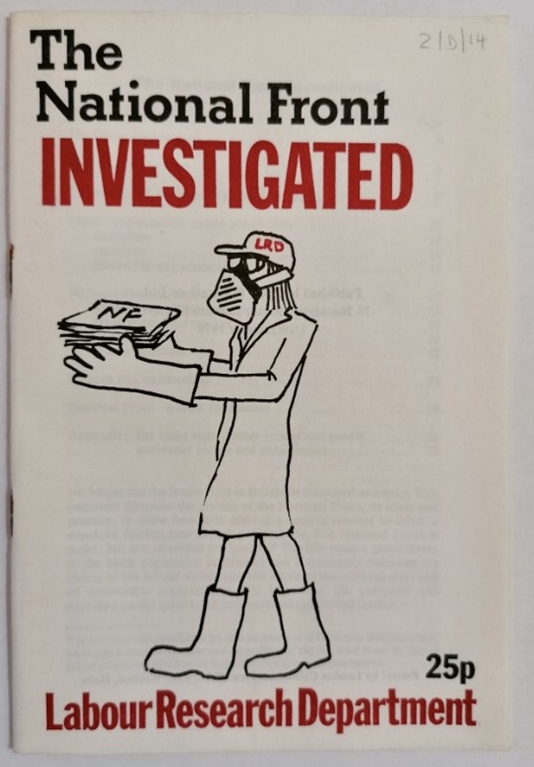
In 1978 LRD published The National Front Investigated, which discussed the growth of the National Front, its ideas and practice, to show how it was making a serious attempt to inject a streak of fascism into British political life. It also described the origins of the NF in the merger of the League of Empire Loyalists, British National Party and the Greater Britain Movement, with direct links back to BUF.
The report examined attitudes of the National Front, including its claims for nation above class and the superiority of the white English male, along with a philosophy of the superiority of leaders over non-leaders. The pamphlet also detailed the NF in action, including case studies of violent publicity stunts such as heckling and pelting MPs with food, and thus winning recruits in those places who then formed branches.
In 1973 the NF set up a trade union section with the aim of being an effective force to put pressure on the government to stop non-white immigration and start repatriating black migrants. However a consistent conflict between the Nazis and the racists within the NF led to its break-up in 1980. And when the Conservative Party took a swing to the right under Margaret Thatcher it absorbed many former NF supporters.
The archives thin out from the late part of the 20th Century but LRD is still monitoring far right groups, carrying out research on the British National Party, the electoral success of the far right across Europe, and UKIP.
The mainstreaming of UKIP and populist politicians such as Nigel Farage, followed by Brexit and the subsequent shift to the right by the Conservative Government has emboldened those on the far right. This provides a challenge to the trade union movement. And the establishment of coalitions such as Unite Against Fascism and The Trade Union Co-ordinating Group proves how seriously unions take this threat.
The Labour Research Department continues to provide an important role in collecting and providing the information the labour and trade union movement has needed to counter such manifestations in Britain.
Jeff Howarth is Academic Liaison Librarian for TUC Library Collections.
Further information
- Introduction to the TUC Library’s Labour Research Department Archive and indexes to LRD materials (See the archives dropdown on this page)
- Labour Research Department
Discover more from Society for the Study of Labour History
Subscribe to get the latest posts sent to your email.
 Society for the Study of Labour History