The chance discovery of a cache of microfilms enabled the TUC Library to digitise its card index and make a century’s worth of cards covering the publications in its collection available online to all, as Jeff Howarth explains.
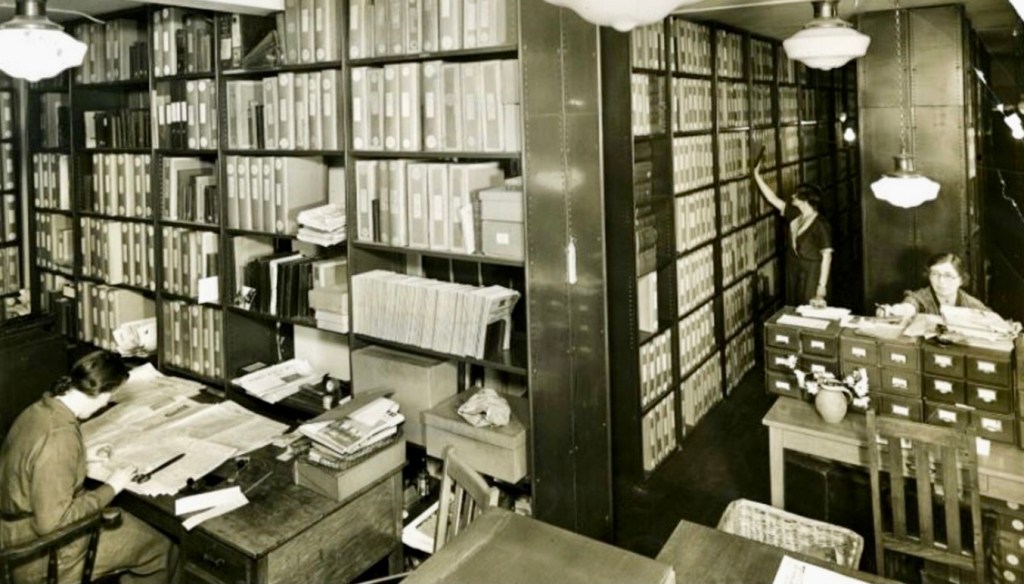
The TUC Library was founded one hundred years ago, in 1922, with the amalgamation of the TUC Parliamentary Committee, the Labour Party Information Bureau, and the Women’s Trade Union League. Around that time it started building its card catalogue, consisting eventually of some 130,000 cards – although some older cards appear to predate this foundation and record items earlier than 1922.
The Library moved to its current home at London Metropolitan University in 1996 as it was believed it could better serve its wide audience in an academic setting. From this point TUC Library and London Metropolitan University staff started to catalogue all new acquisitions and some older items on OPAC (an online public access catalogue).
But the vast majority of the contents of the TUC Library are only accessible via the card catalogue. And so the card catalogue, with its enormous collection of printed, handwritten and annotated cards, has continued to be an important finding aid. The card catalogue is organised by category, author and publisher, but, most significantly not title.
This September, after working with the digitisation and archive services company Max Communications, the TUC Library was able to launch a new digital card catalogue at the annual conference of the International Association of Labour History Institutes. This will allow users to search through the cards that have been digitised as part of this project.
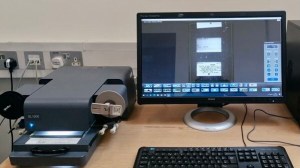
The initiative to digitise the card catalogue started several years ago when I discovered a cache of 22 reels of microfilm labelled ‘card catalogue’ at the bottom of the microfilm cabinet. This occurred as a consequence of the Library getting a digital microfilm reader.
During training I learnt that it was possible to set the device up to scan reels of microfilm into PDF files. From a previous project I was aware that it was possible to run Adobe to OCR PDF files and make them searchable.
I made several attempts to set the device up to record reels overnight but there were always problems in getting the device to consistently identify the cards as ‘frames’. So, although I could digitise the microfilm the results were inconsistent. But this put the idea into my head about starting a digitisation project.
I had previously successfully worked with Max Communications back in 2007 on an archive digitisation project, so I contacted them to discuss this. I got an estimate from them to digitise the reels of film and raised a small grant.
Max Communications took the reals and digitised them and passed them through optical character recognition software. They then provided me with high-resolution images and screen resolution PDF files, and I split these large PDF files into smaller files that approximately matched the physical drawers.
Having spoken previously to the university’s IT department I loaded these files into cloud storage and in 2020 made them available to users in virtual drawers as protected, searchable PDFs. This allowed users across the world access to all the catalogues of the TUC Library for the first time.
But what was available was basic and slow working. Unless users had extremely fast broadband the online PDF files were slow, and the system would have tested user’s patience.
I was then lucky enough to get the offer from a publisher who wanted to digitise one of our archive collections of some money to do so. I approached Max Communications again and they agreed that they could create a searchable website. This was a new venture for them and they spent approximately six months developing a combination DRYAD, AtOM, Ajax and WordPress software to produce the site.
The site allows the user to key in their search terms; the website then searches through the OCR files and presents all the relevant digitised cards. This enables users to search by title for the first time.
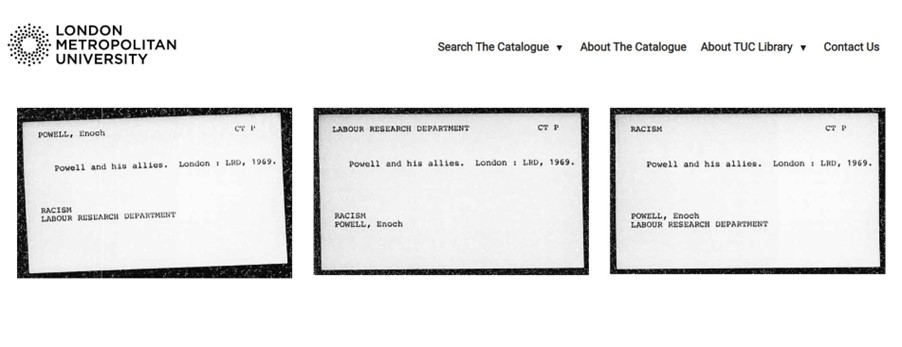
For example searching for the title ‘Powell and his allies’ leads to three cards (see below). This also demonstrates the nature of the catalogue, that in theory there are three cards for each publication, one by author, one by publisher and one by theme.
If you click on a card you get more detail including the OCR text (see below).
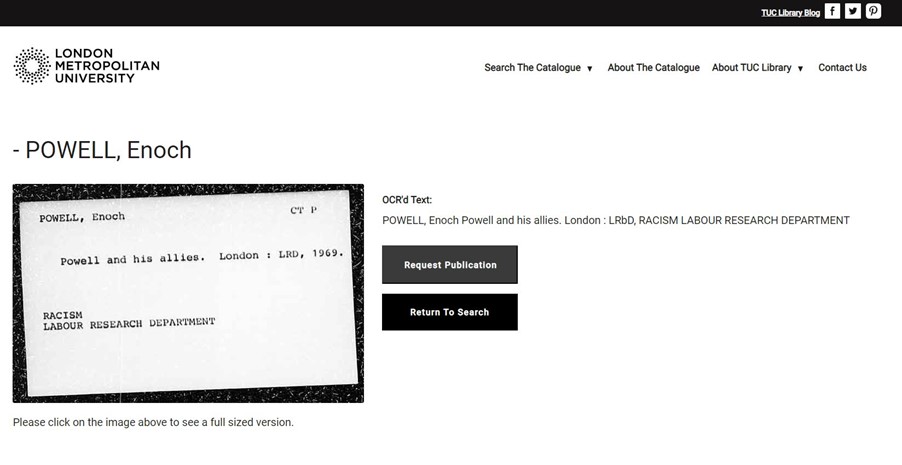
Users can ask to see the publications, and this gives us the opportunity to invite them in.
Making the digital drawers available in 2020 was a breakthrough in allowing users access to all the catalogues online for the first time. Launching the new digital card catalogue website in 2022 has made access easier and the process of searching so much simpler and quicker. It allows users comprehensive coverage of all publications and to a certain extent allows ‘data mining’, as users can discover roughly what proportions of the library cover certain topics or themes.
The TUC Library, along with other members of the university’s Special Collections (including the Archives of the Irish in Britain and Frederick Parker Collection), will be making indexes to their archive collections available through a new Epexio Archive Management Software platform soon, and this will complete the user access to all catalogues and indexes online.
Jeff Howarth is Academic Liaison Librarian for TUC Library Collections.
Discover more from Society for the Study of Labour History
Subscribe to get the latest posts sent to your email.
 Society for the Study of Labour History