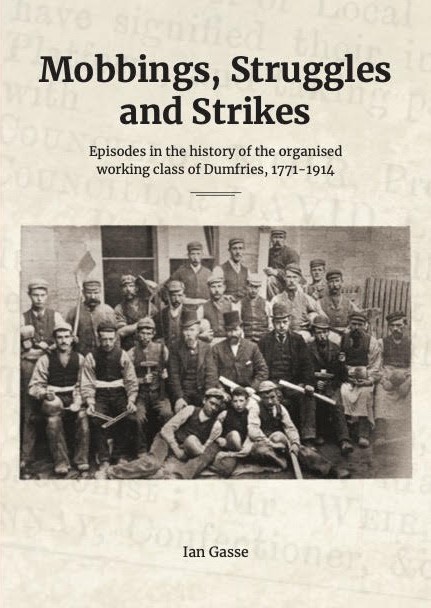
Mobbings, Struggles and Strikes: Episodes in the History of the Organised Working Class of Dumfries, 1771-1914, by Ian Gasse: the author, in association with the Scottish Labour History Society, 2022, pp. xvi + 400, h/b, £20 + £4p&p, ISBN 978 9163050 4 5
Class conflict in Dumfries so often centred on that most basic of staples, bread. From food riots in the 1770s during which ‘meal mobs’ ransacked ships in harbour to prevent the export of grain, by way of the price hikes instituted by meal merchants in the 1840s that led local people to set up their own co-operative store, and on to bakers’ strikes in the 1890s and 1900s, the price of a loaf and the wages paid to those who made it were a regular flashpoint within the Scottish market town. Small wonder though, when as one woman told a local ploughmen’s association in 1867, a full 8s 4d of her ploughman husband’s weekly wage of 11s 6d went on meal and flour.
Mobbings, Struggles and Strikes is the second book by local author (and Scottish Labour History Society member) Ian Gasse which attempts to reclaim the history of the organised working class in nineteenth-century Dumfries, following his 2021 history of the town’s co-operative movement, Something to Build On. Starting with food riots which began in Dumfries in 1771 and continued as late as 1842, the book goes on to cover the local campaign for manhood suffrage from 1838-1885, farmworkers’ early attempts at trade union organisation in the 1860s, bakers’ strikes in 1889 and 1905, a stonemasons’ strike in 1899, and the Ryedale Glove Factory Strike of 1912 – a dispute in which, as Gasse explains, the National Federation of Women Workers was instrumental in helping to secure victory.
The author’s subtitle is well chosen: the seven chapters are indeed to a large extent treated as separate episodes in the town’s labour history, and each chapter happily stands alone; three have appeared in earlier versions in the journal Scottish Labour History. They are none the worse for that. And in the ‘almost complete absence of extant trade union records for nineteenth century Dumfries’, the author has had to rely heavily on the local press. He is to be commended on his dedication to the cause of reconstructing the town’s labour history from what must often have been frustratingly meagre information from primary sources. Much effort, too, has gone into sourcing photographs and other images which give a real sense of working-class life in the town. The author tells us that he set out to provide an overview of some of the ways in which the Dumfries and Maxwelltown working class used collective self-help to improve their lives and livelihoods, and to rescue them, adapting E. P. Thompson’s phrase, from ‘the enormous neglect of posterity’. As he himself concludes: ‘The history remains incomplete but a start has been made.’
Both books are available direct from the author via coophistory@myphone.coop, or for members of the Scottish Labour History Society through the Society’s website. Locally, the book is available from Waterstones in Dumfries High Street, from Dumfries Museum and from Moffat Bookshop in Well Street, Moffat.
Mobbings is due to be formally launched at Culture in Society, a two-day event on Friday/Saturday 18/19 November at the Robert Burns Centre Film Theatre in Dumfries. More details.
Mark Crail
Discover more from Society for the Study of Labour History
Subscribe to get the latest posts sent to your email.
 Society for the Study of Labour History