Where do you cry in an open plan office? This is the emotional question lingering in the back of my thoughts as I complete research into commercial office interior spaces and the relationship of these spaces to the labour process. My research seeks to revisit the history of office spaces, considering and unpicking the relationship between the design of office interiors and the experience of work under and within capitalism. Guided by Harry Braverman’s Labour and Monopoly Capital (Monthly Review Press, 1974), my doctoral thesis suggests that office designs are shaped by a continuing need on the part of management to control the labour process and dictate the way in which work is undertaken. This research bridges the gap between studies of labour and studies of the built environment, understanding and exploring the office as a site of labour not just as a place where work tasks are completed.

Generous support from the Society for the Study of Labour History allowed for travel to Holland, Michigan (United States), to visit the archives of furniture-maker Herman Miller (now known as MillerKnoll after a merger with rival furniture manufacturer Knoll).
Work in Holland targeted two distinct yet thematically interrelated areas of Herman Miller’s expansive archival holdings – materials related to Herman Miller’s implementation of a Scanlon Plan (an employee participation and gainsharing programme), and materials related to Herman Miller’s flagship Action Office furniture system (a co-ordinating system of office furniture components).
Herman Miller’s Action Office system forms the case study supporting the second chapter of my dissertation, covering the mid-century office (post-war to 1980) and developments related to the emergence and popularization of Theory Y management.
Secondary research conducted prior to this archival deep dive suggested that Herman Miller’s Scanlon plan and Action Office were closely related – that the principles and ideologies which led to the way the company implemented its Scanlon plan were the same as those which led to the formation of Action Office, based around a Theory Y understanding of labour relations and processes.

Materials consulted in the archive included an extensive run of internal Herman Miller newsletters, internal guidebooks and pamphlets explain the company’s Scanlon plan, blank and filled Scanlon plan improvement forms, promotional literature for Action Office, internal communications regarding the development of Action Office, design diagrams, management lectures and talks, and a model kit illustrating the variable parts and configurations of the Action Office system.
These materials highlighted a consistent attitude and understanding among Herman Miller’s leadership and product designers regarding productivity, efficiency, and the role of management in facilitating the aforementioned factors. Archival materials substantiated a reliance on Theory Y notions of labour relations and processes, and an overarching belief in harmonious relations between workers and enlightened management. Through the consulted documents, a story is told of Herman Miller’s conceptualization of productivity – in terms of the mutually beneficial execution of specific tasks, and a denial of concepts of extraction of labour.
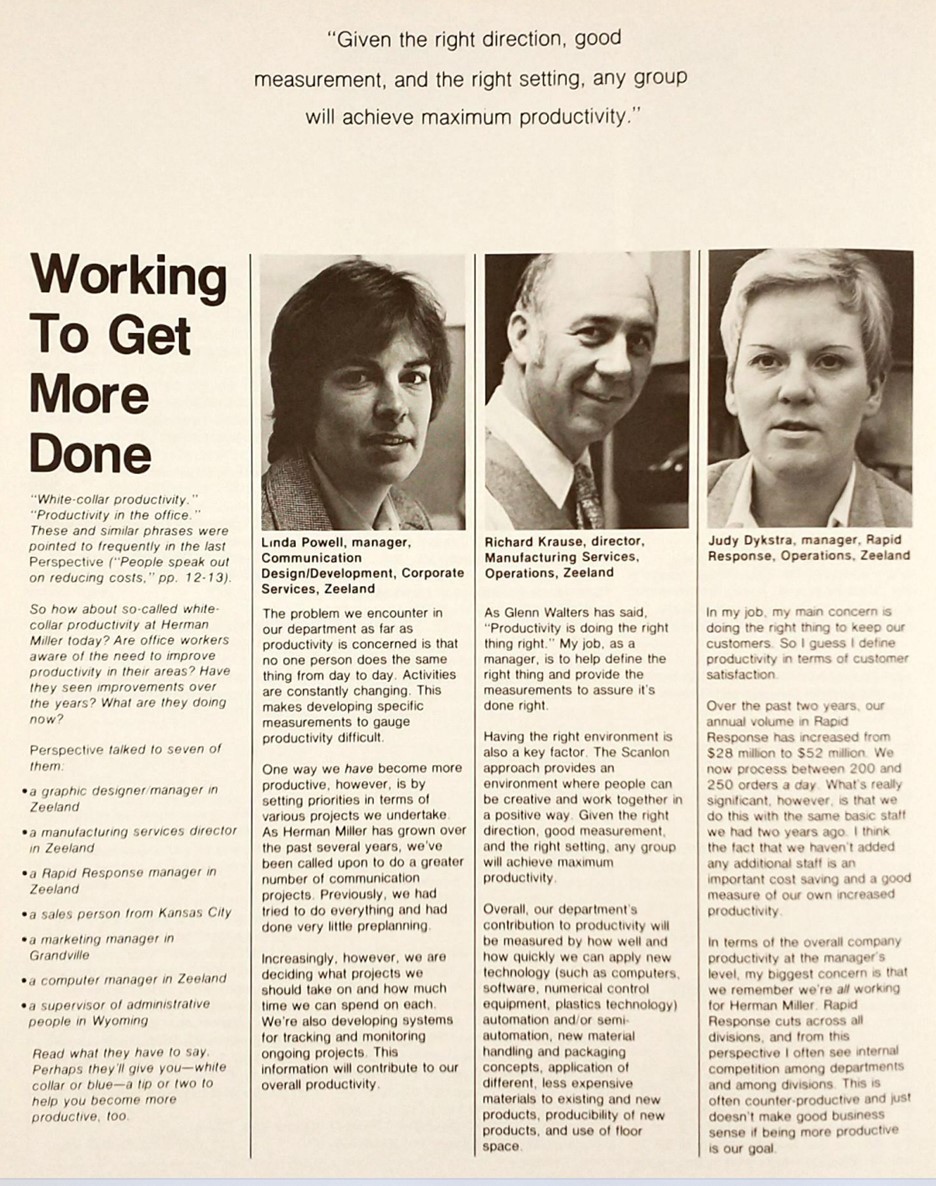
Beyond suggesting the existence of a core ideological framework, archival materials also show that these attitudes played out internally and externally in the construction, maintenance, and promotion of both the Scanlon Plan and the Action Office system. Language and concepts mobilized in internal documents regarding Herman Miller’s own production and its Scanlon Plan were also present in external materials promoting the Action Office system, suggesting a cohesive company outlook and understanding of labour, productivity, and the design of office spaces.
These are preliminary findings, as much work remains to be done in reviewing and analyzing the thousands of pages of documents photographed and scanned during this research trip, potentially providing additional insights.
The archival trip funded in part by the Society for the Study of Labour History also bore additional, unexpected fruit including the unearthing of a 1966 evaluative study of Action Office I which concludes that the system provided limited improvement to worker productivity, and suggests that the efficacy of office systems might be impossible to measure. Such a conclusion would seem to contradict the voluminous promotional material for the subsequent Action Office II system, which argues for the system’s productivity advantages over other office furnishings.

Special thanks must be given to Amy Auscherman and Alexa Hagen, MillerKnoll’s stupendous archive staff, for their assistance and insight leading up to, and during, this archival research.
Petra Seitz is a PhD candidate at the Bartlett School of Architecture, UCL, a lecturer in Architectural History and Theory at the University of Greenwich, and a principal investigator on the Chandigarh Chairs project.
Find out more about bursaries on offer from the Society for the Study of Labour History.
Discover more from Society for the Study of Labour History
Subscribe to get the latest posts sent to your email.
 Society for the Study of Labour History