One hundred and eighty years ago the people of Halifax marched to demand bread and the ballot. Now thanks to Calderdale Trades Council and its supporters, their struggle has been marked with a series of events and in more permanent ways, as Dan Whittall explains.
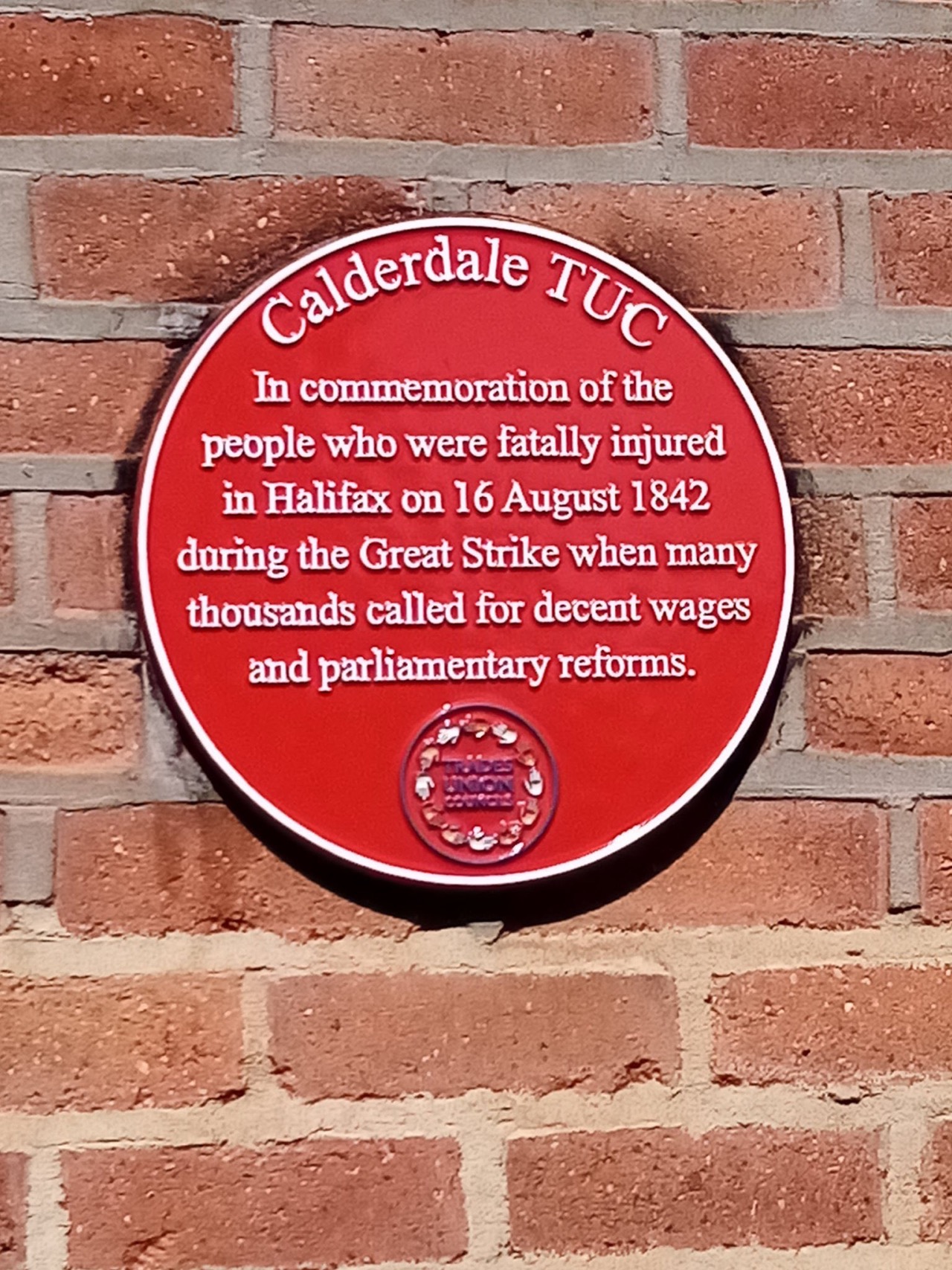
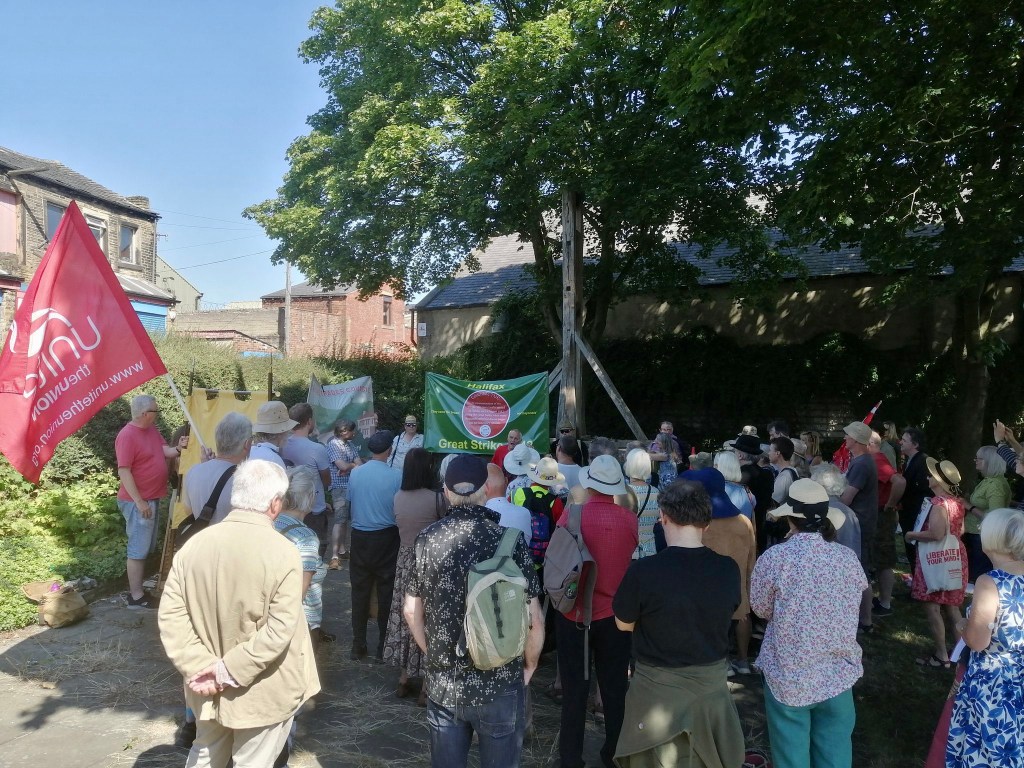
At least 150 people gathered in Halifax on Saturday 13 August to take part in a series of commemorative events to mark the 180th anniversary of the Great Strike of 1842, an event often referred to as the first general strike in a capitalist country. Supported by the Society for the Study of Labour History, as well as by donations from local trade unions and trades councils, Calderdale Trades Council has been able to put on a series of events that brought this important history into far greater prominence.
On 17 July, a packed public meeting (reported in the Morning Star) was held at Calderdale Industrial Museum at which leading academics spoke about the history and contemporary relevance of 1842. Speakers included Matthew Roberts, Katrina Navickas, James Dean, Neil Pye and Catherine Howe.
It is Catherine Howe’s book Halifax 1842: A Year of Crisis that provided the inspiration for this year’s events. After Halifax-based NUJ delegate to Calderdale Trades Council Mark Metcalf read the book, he became determined to mark the history of that year by raising a plaque in the town. Supported by comrades in Calderdale Trades Council, Mark’s vision has now become a reality.
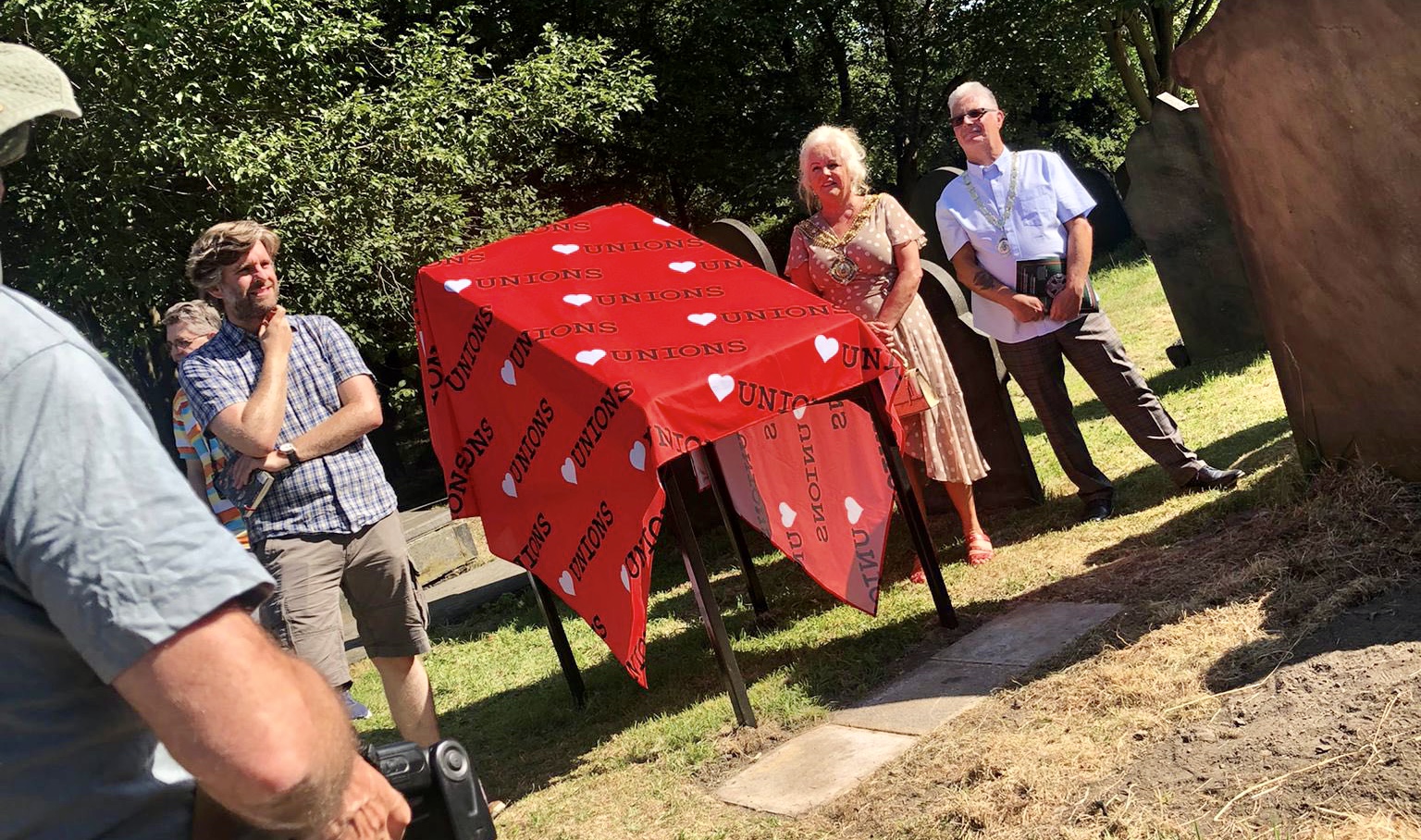
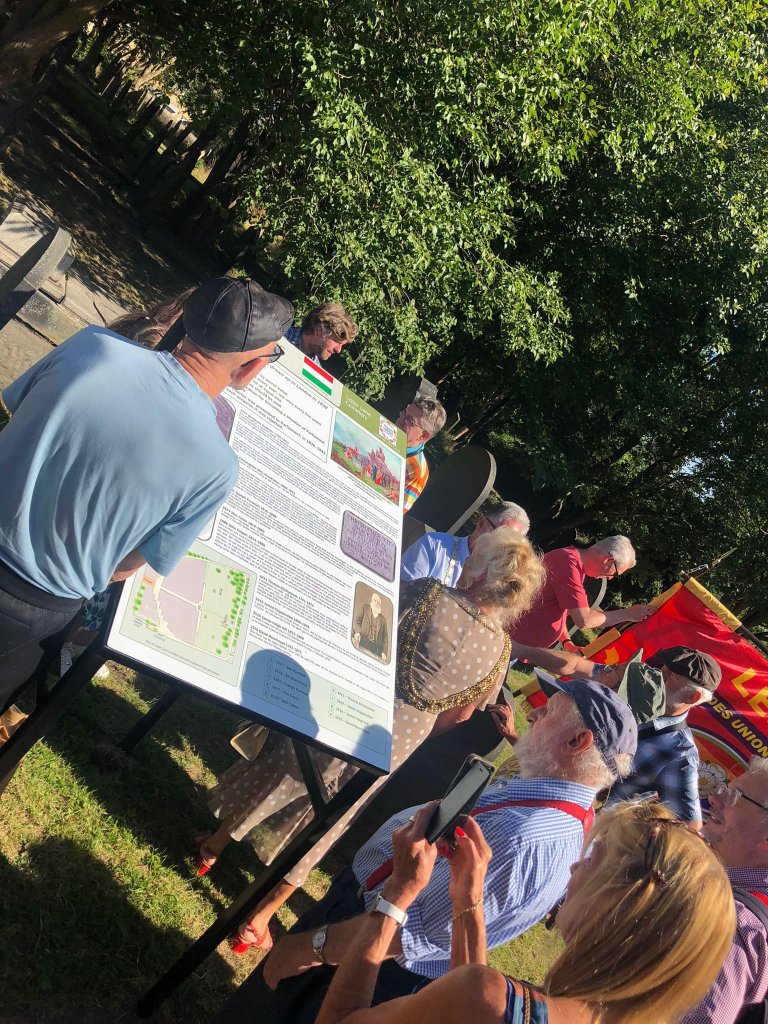
The day began at Lister Lane Cemetery. At 9.30am, chair of the Friends of Lister Lane and local historian David Glover ran a superb tour that guided attendees around the nine known graves of Chartists and Chartist-supporters in the cemetery. After a brief talk by David Glover, Calderdale Mayor Angie Gallagher unveiled a fine commemorative board providing information about the Chartists buried in Lister Lane.
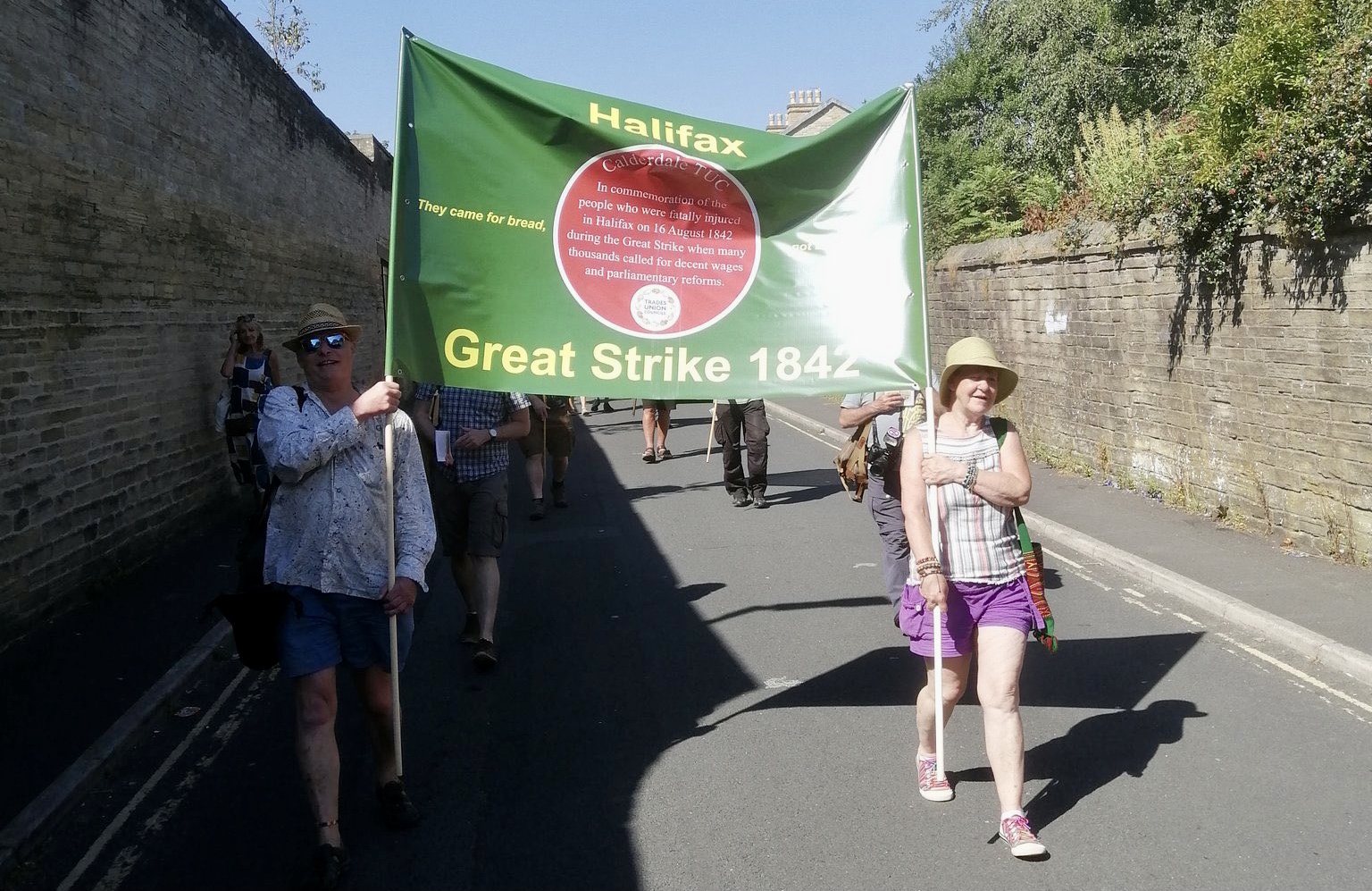
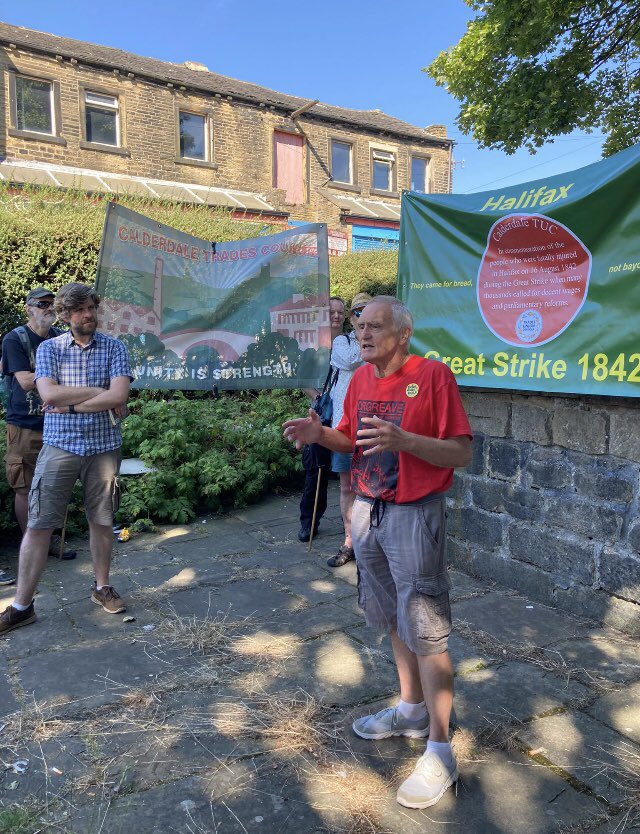
The crowd that had assembled then proceeded to march off from the cemetery towards Halifax town centre. The crowd were led by a green banner stating ‘They came for bread, not bayonets’. This was a reference to a piece in the Northern Star on 20 August 1842, which noted that when protestors had approached the cavalry blocking their way on the town’s North Bridge, one woman had marched up to the soldiers and called out, ‘We didn’t come here for bayonets, we came for bread.
On the way to Halifax town centre, the crowd paused at the Halifax gibbet. Here, two rousing speeches from Jane Aitchison, President of Leeds TUC, and John Dunn of the Orgreave Truth and Justice Movement, inspired the crowd. Dunn reflected on the fact that it was on 1 August 1842 that 800 miners had come down into Halifax and made the call for a national mineworkers union for the first time, and gave a moving speech that reminded the crowd of how important it is to ensure that although we commemorate the history of general strikes, we also organize to ensure that ‘next time we win’. Aitchison, meanwhile, drew powerful links between that violence done by the gibbet in seventeenth and eighteenth century Halifax, and the violence being inflicted on working people today. It was particularly special to have Jane speak so powerfully at the event, given that she has recently overcome a bout of severe ill health. All who heard her speak were inspired by her words.
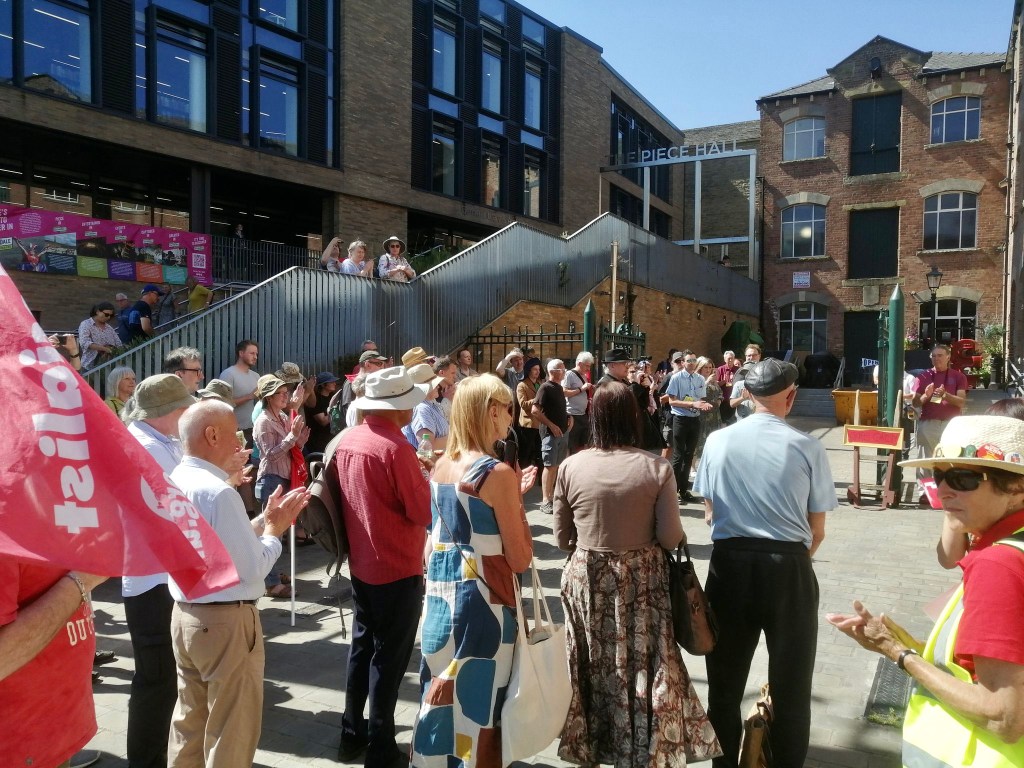
Following this, the crowd marched through Halifax town centre, via the Piece Hall, a Georgian cloth hall where the military were garrisoned during the strike of 1842, and down towards Calderdale Industrial Museum. Outside the museum a series of speeches were heard. Historian Matthew Roberts, who has played an important role in supporting the efforts to commemorate the Great Strike (and who also published a fine database of Chartist banners in Halifax on the morning of the event), talked through the history of the strike and the complex relationship between Chartism and commemoration. Then Bernard Wadsworth of Calderdale Industrial Museum welcomed the crowd to the museum and spoke of the pride the museum felt in having the plaque on the side of its building.
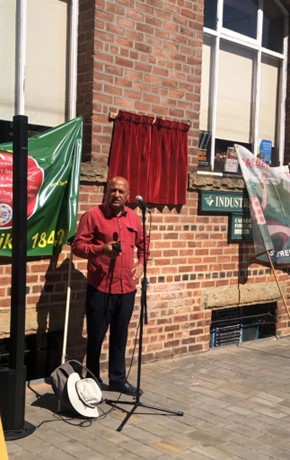
Local poet Keiron Higgins read a specially-written poem to mark the commemoration. This verse was felt by all present to be a fitting way to commemorate those who had struggled for better pay, working conditions and democratic reforms in 1842, especially given the Chartists’ own love of poetry and song.
Trade unions and trades councils were well represented on the event, and speeches from trade union figures followed. First up was Mohammad Taj, first Asian TUC President (whose biography, written by Mark Metcalf, can be read here), followed by CWU political office Dave McGarry, West Yorkshire FBU regional officer Dave Williams, and the RMT’s John Stewart. All gave inspiring speeches that explored the history of the events of 1842 and made direct links to the struggles being waged by trades unions and working class communities today. It was fitting that a commemoration of a general strike 180 years ago was accompanied by trade unionists exploring how the active disputes they were involved in were related to the history of events 180 years ago, seeking to draw a ‘useable past’ out of that history that could be set to work to support current struggles.
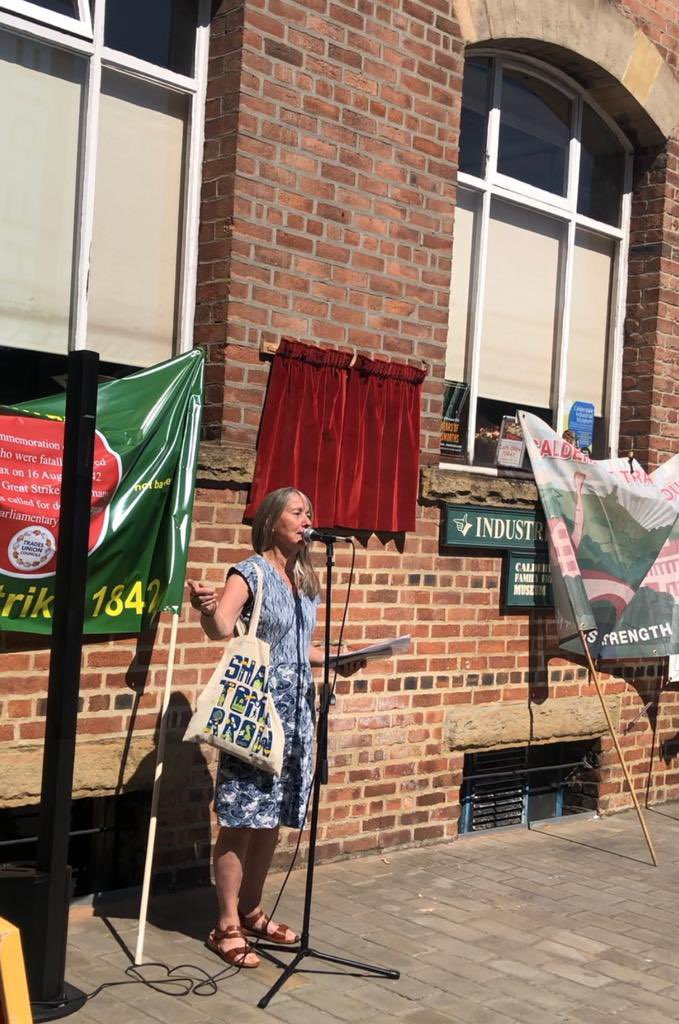
Finally, the event moved towards the grand unveiling of the commemorative plaque. Fittingly, this was done by Catherine Howe, whose research has done so much to build on that of Dorothy Thompson and others into Halifax Chartism. Howe poignantly read out the names of those known to have been killed and injured in the brutal military response to the Great Strike in Halifax, and noted the importance that there was – at last – a permanent commemoration to mark the efforts of the Chartists and trades unionists who had brought an estimated 25,000 people out onto the streets of Halifax in 1842. The day’s events owe everything to Catherine and her important research, and it was especially pleasing to see that all available copies of Halifax 1842 sold out on the day.
Following the unveiling, some in the crowd visited Halifax Central Library, where a small exhibition of historical newspaper articles is on display that brings to life the history of 1842. Particularly striking is the story of Samuel Crowther, thought not to have been directly involved in the protests but who was nevertheless shot through the stomach by a soldier on King Street, beside Halifax Minster, on his way home, in full view of two Leeds journalists.
Then the crowd moved to the Grayston Unity pub, the backyard of which played host to a range of musicians. John Bromley played a set that included his version of Leon Rosselson’s outstanding song about the Diggers, The World Turned Upside Down. Keiron Higgins returned to treat the crowd to a second recital of his new 1842 poem, as well as a selection of his other verses. Then, Gareth Scott performed songs from his acclaimed album Basin Stone, the eponymous track of which is a rousing epic that takes the listener from the ills of industrialization in the Calder Valley, via the oppositional political meetings held at the Basin Stone on the moorland above Todmorden, through to the ills of industrialization in China and Haiti, the ongoing gentrification of the Calder Valley, and the potential for Chartist-style resistance in the present. Jennifer Reid then treated the crowd to a mesmerizing performance of 19th century folk songs, including a heartrending retelling of The Testimony of Patience Kershaw that had the crowd gripped and brought many a tear to the eyes of those assembled. Kershaw, a child miner from Boothtown, whose story opens and runs throughout Howe’s Halifax 1842, contributed to the commission that ultimately prohibited the use of child labour in mines, and it was a special moment to hear her testimony sang in Halifax 180 years on. Johnny Campbell then closed out the event with a great set that included his recent protest epics Winter Hill Trespass and A Right to Roam.
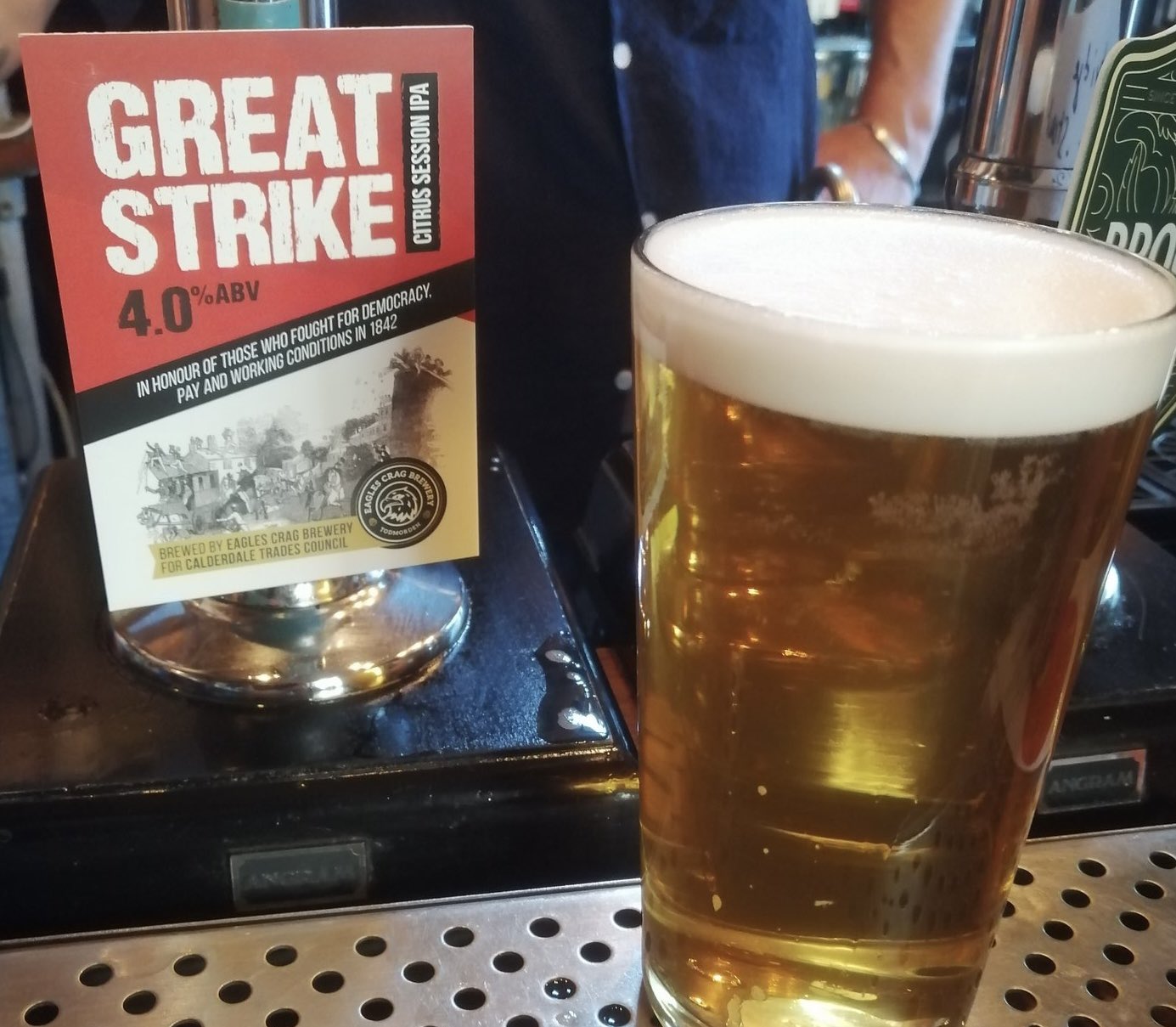
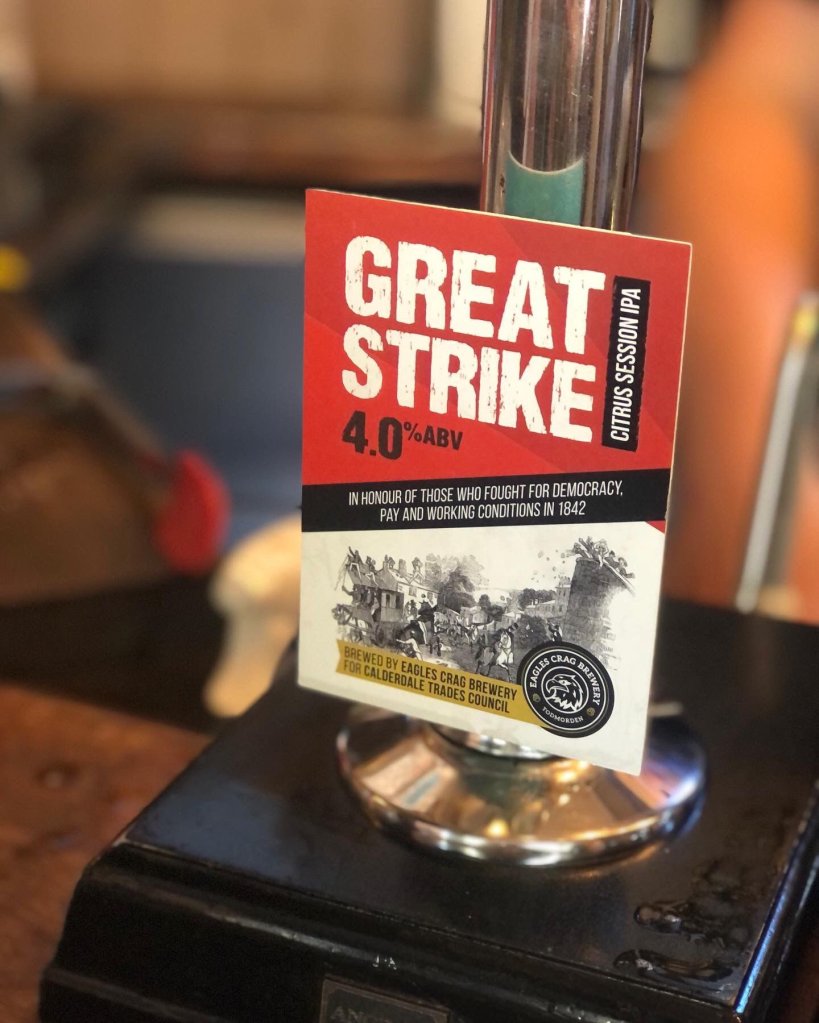
At the Grayston Unity the crowd also enjoyed the superb new Great Strike beer, brewed specially to mark the commemoration by Todmorden brewery Eagle’s Crag. This superb commemorative ale is currently available in the Grayston Unity, Meandering Bear, and Big Six Inn in Halifax, as well as a range of other local hostelries (including the Trades Club and Fox and Goose in Hebden Bridge, the Golden Lion and the Ale House in Todmorden and Bridge Street Beer House in Burnley). Special thanks are due to Michael Ainsworth and his staff at the Grayston Unity for supporting and hosting the event, and for first suggesting Eagles Crag as the ideal brewers for a commemorative beer.
Overall, the events were a great success, bringing a large crowd out to commemorate Chartism, trade unionism and labour history in Halifax. They also helped bring together and forge links between local trade unionists in the area. The sight of so many people parading through the town centre chanting ‘Remember 1842, when strikers fought for me and you’, and ‘They came for bread, not bayonets’, will not be soon forgotten by any who saw it. The Society for the Study of Labour History, and all those trade unions and trades councils who contributed, are to be sincerely thanked by all of us here in Calderdale for their efforts in commemorating this important history.
Some of the organisers of these events have recently written up their interpretation of the history of 1842 in an article for Tribune: Remembering the Great Strike of 1842 (tribunemag.co.uk) And a short podcast with Catherine Howe can be heard here: 1842 Halifax – Killing democracy! by Unite Oral History (anchor.fm)
Mark Metcalf and others will now continue the important work of producing a documentary to be made available free online that will provide a fitting resource for others to learn about the history of the Great Strike of 1842.
Dan Whittall is chair of Calderdale Trades Council. All photographs are reproduced here with the kind permission of Calderdale Trades Council.



Discover more from Society for the Study of Labour History
Subscribe to get the latest posts sent to your email.
 Society for the Study of Labour History